
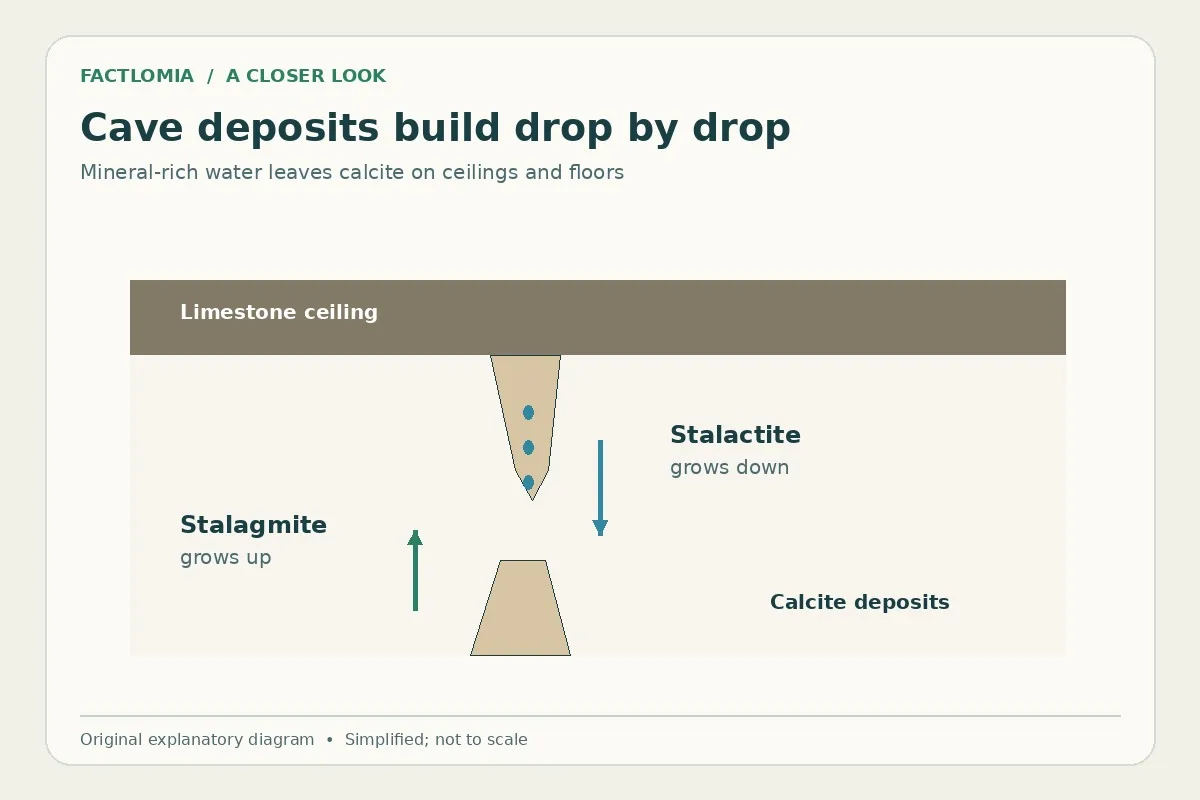
Stalactites and stalagmites form when mineral-rich water drips through limestone caves and leaves behind calcite. Water absorbs carbon dioxide and dissolves a little limestone as it travels underground. Inside a cave, it can release carbon dioxide and deposit calcite: downward from the ceiling as a stalactite and upward from the floor as a stalagmite.
Rainwater carries dissolved limestone
Rainwater moving through soil picks up carbon dioxide, making it mildly acidic. As it seeps through cracks in limestone, it can dissolve some calcite and carry calcium and carbonate compounds in solution. A cave may form through dissolution, while later mineral deposits decorate its ceiling and floor. [1][2]
When this mineral-rich water enters a cave, conditions change. Carbon dioxide escapes from the drop into the cave air, and calcite can precipitate out of the water. Repeated drips leave tiny deposits that build over long periods. The growth rate varies with water supply, chemistry, temperature, and cave conditions. [1]
The ceiling and floor deposits grow in opposite directions
A stalactite hangs from a ceiling or ledge, where drops repeatedly leave mineral material behind. Many begin as a thin hollow tube sometimes called a soda straw. A stalagmite grows upward where drops hit the floor and deposit calcite. Because the falling drop splashes, a stalagmite often becomes wider than the stalactite above it. [2]
If the two structures continue growing until they meet, they form a column. They are not ice: the familiar icicle-like shape is made of cave minerals, commonly calcite. Other cave formations include flowstone, draperies, and twisting helictites, each shaped by how water moves and deposits minerals. [2]
Why cave formations grow slowly
A small amount of calcite is left behind with each drop. Growth is therefore gradual, and the pace depends on how much water reaches a particular spot and how much dissolved mineral it carries. A dry spell or a change in water chemistry can slow or stop growth. Human contact can damage fragile formations or alter their surfaces, so visitors should follow cave rules and avoid touching them. [3]
The chemistry also explains why a cave can have many shapes and colours. Pure calcite is pale, while trace minerals and organic material can tint deposits. The precise appearance is a record of local water and rock conditions, not a uniform template. Explore another landscape shaped by cooling rock in why basalt columns often form polygons.
Frequently asked questions
Which grows from the ceiling?
A stalactite hangs from the ceiling. A stalagmite grows upward from the cave floor.
Are stalactites made of ice?
No. In limestone caves they are commonly mineral deposits made mainly of calcite.
Can a stalactite and stalagmite join?
Yes. If both keep growing in the same place, they can meet and form a column.
Sources and evidence
- National Park Service — How Stalactites and Stalagmites Form ↗
Explains carbonic acid, limestone dissolution, carbon dioxide loss, calcite deposition, and growth directions.
- U.S. Geological Survey — Geology of Wind Cave National Park ↗
Describes dripstone, stalactites, stalagmites, and calcite deposition.
- National Park Service — Stalactites, Stalagmites, and Cave Formations ↗
Describes fragile cave features and mineral deposits.
Sources consulted: 2026-10-27. Written with AI assistance and checked against the linked references; not independently reviewed by a subject specialist. Sources do not endorse this article. See our editorial policy.
Revision: First published 27 October 2026. Original explanatory diagram; claims checked against linked sources.