
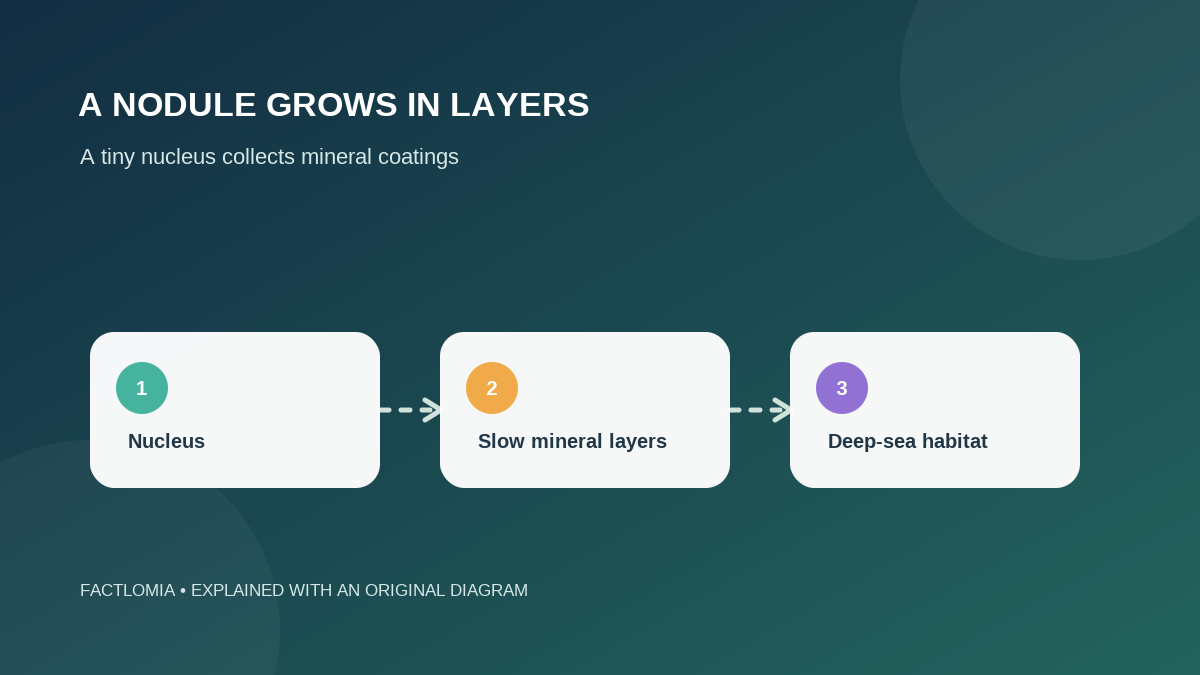
Polymetallic nodules are rounded mineral deposits that grow around a small nucleus on some deep-sea plains. Layers containing metals such as manganese and iron accumulate extremely slowly, often over millions of years. Their distribution and ecological setting vary, so mapping a nodule field does not by itself establish how much metal could be recovered or what mining would do to the ecosystem.
How does a nodule grow?
A nodule typically begins around a tiny core, such as a fragment of rock, shell, or older nodule. Dissolved metals in seawater and sediment accumulate in successive layers around that core. Growth is so slow that a nodule may record extremely long periods of seafloor history.
In many areas, manganese and iron oxides make up much of the nodule. Smaller amounts of other elements may also occur. The exact chemistry depends on the region and the material from which layers formed.
Where are they found?
Nodules occur on some broad, low-sediment plains in the deep ocean. They are not distributed evenly across the seabed. Water depth, seafloor conditions, sediment cover, and geological history all influence where they form and how abundant they are.
NOAA’s 2026 mapping work around the Northern Mariana Islands includes areas where seabed nodules may occur. High-resolution bathymetry helps researchers identify terrain and plan more targeted surveys, but mapping is only an early step. Sampling and environmental studies are required to assess deposits and ecosystems.
Why do scientists study the habitat?
Deep-sea organisms can live on, among, or near nodules. The nodules may provide hard surfaces in otherwise soft sediment, so removing them could change habitat structure as well as disturb the seabed. Scientists need baseline information about species, sediment, and natural variation to evaluate possible impacts.
Potential mineral value and environmental effects are separate questions. A map or estimate is not proof that extraction is safe, practical, or authorized.
Frequently asked questions
Are polymetallic nodules the same as hydrothermal-vent minerals?
No. Nodules form on seafloor sediment over very long periods; vent deposits form through hot, mineral-rich fluids rising from the seafloor.
Can you identify a nodule field from a map alone?
Maps can guide exploration, but direct observations and sampling are needed to confirm what is present.
Sources and evidence
- NOAA Ocean Exploration: Mariana Islands seafloor mapping ↗
Regional mapping coverage and NOAA’s description of potential nodule areas and the need for ecological baselines.
- International Seabed Authority: Polymetallic nodules ↗
General background on nodule deposits and their deep-sea setting.
Sources consulted: November 15, 2026. Written with AI assistance and checked against the linked references; not independently reviewed by a subject specialist. Sources do not endorse this article. See our editorial policy.
Revision: Updated November 16, 2026: topic-matched original cover illustration added; primary-source claims and citations reviewed.