
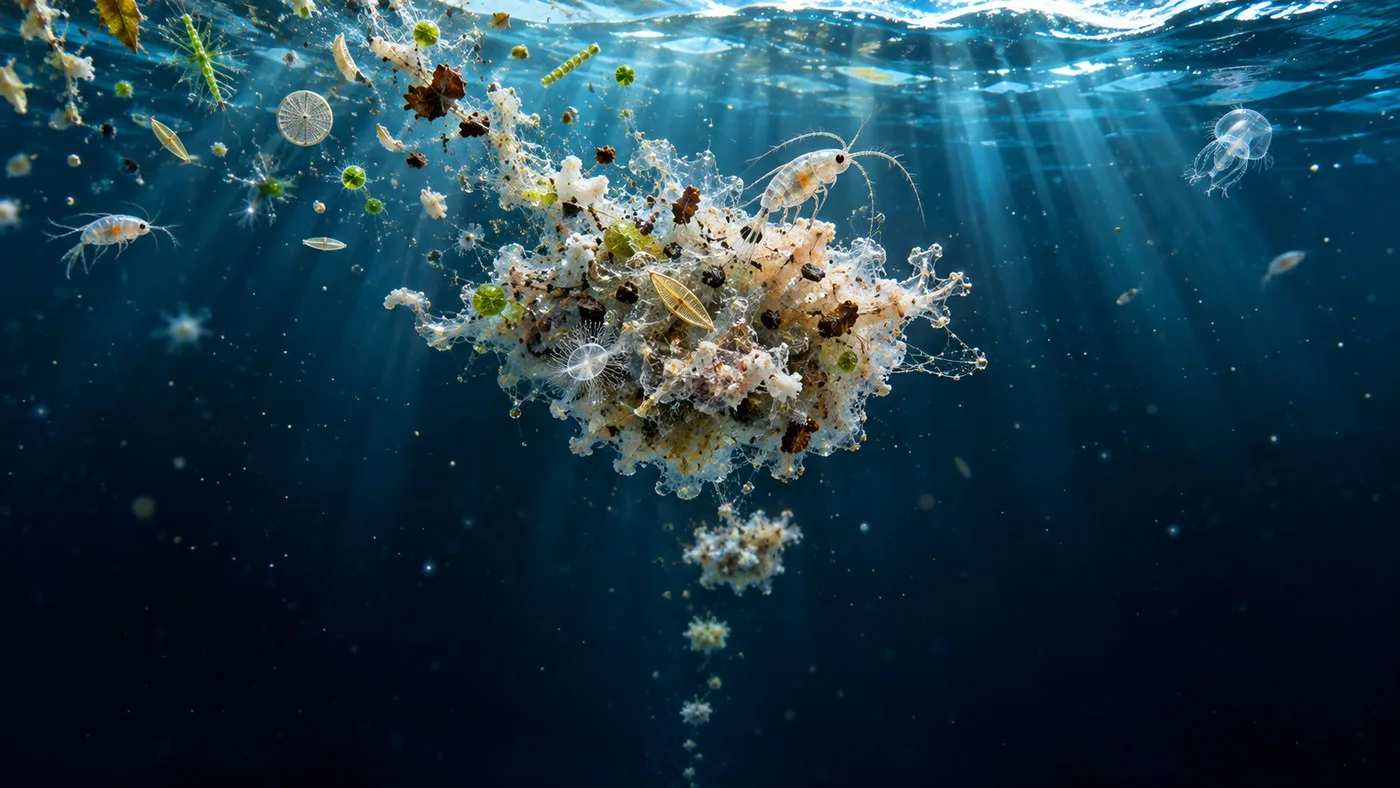
Marine snow is a steady fall of organic particles from surface waters toward the deep ocean. A 2026 study found that particle stickiness affects how quickly bacteria break them apart. In laboratory work and simulations, stickier particles persisted longer and were estimated to carry more than six times as much carbon to deep water as less-viscous particles.
What ocean “snow” is made of
Marine snow consists of small clumps of organic and mineral matter, including dead plankton, mucus, waste and sediment. Some material forms near the surface and sinks, carrying carbon away from the sunlit ocean. Bacteria consume and break down particles as they descend, returning some of that carbon to surrounding water. [1]
The surprising role of stickiness
Researchers at Scripps developed imaging methods to observe bacteria interacting with marine-snow particles. Bacteria tended to colonize less-viscous areas near the surface, while denser regions were harder to penetrate. Laboratory experiments showed more-viscous particles resisted degradation longer. Simulations suggested they could sink deeper. The researchers estimated that highly viscous particles may carry more than six times the carbon to deep water as less-viscous particles. [1]
Why the result matters—and what it cannot tell us yet
Carbon reaching deep water may remain away from the atmosphere for centuries or longer, depending on depth and circulation. But this sixfold comparison is a study estimate, not a direct measurement of global storage. Oceans contain many particle types, currents and microbial communities; scientists still need to learn how often sticky particles form and how they behave in different regions. [2]
FAQ: marine snow
Is marine snow frozen? No. It is a name for sinking organic and mineral particles.
Does all of it reach the seafloor? No. Some is consumed or broken apart as it sinks.
Will ocean slime solve climate change? No. The study clarifies one part of the carbon cycle, not a substitute for reducing emissions.
Sources and evidence
- Science — Marine snow viscosity regulates microbial degradation ↗
Primary study of viscosity, bacterial degradation and carbon transport.
- Scripps Institution of Oceanography — Gooier marine snow transports carbon ↗
Research team summary of the experiment and findings.
Sources consulted: 14 November 2026. Written with AI assistance and checked against the linked references; not independently reviewed by a subject specialist. Sources do not endorse this article. See our editorial policy.
Revision: Initial publication. Claims and limitations checked against linked institutional and primary sources.