
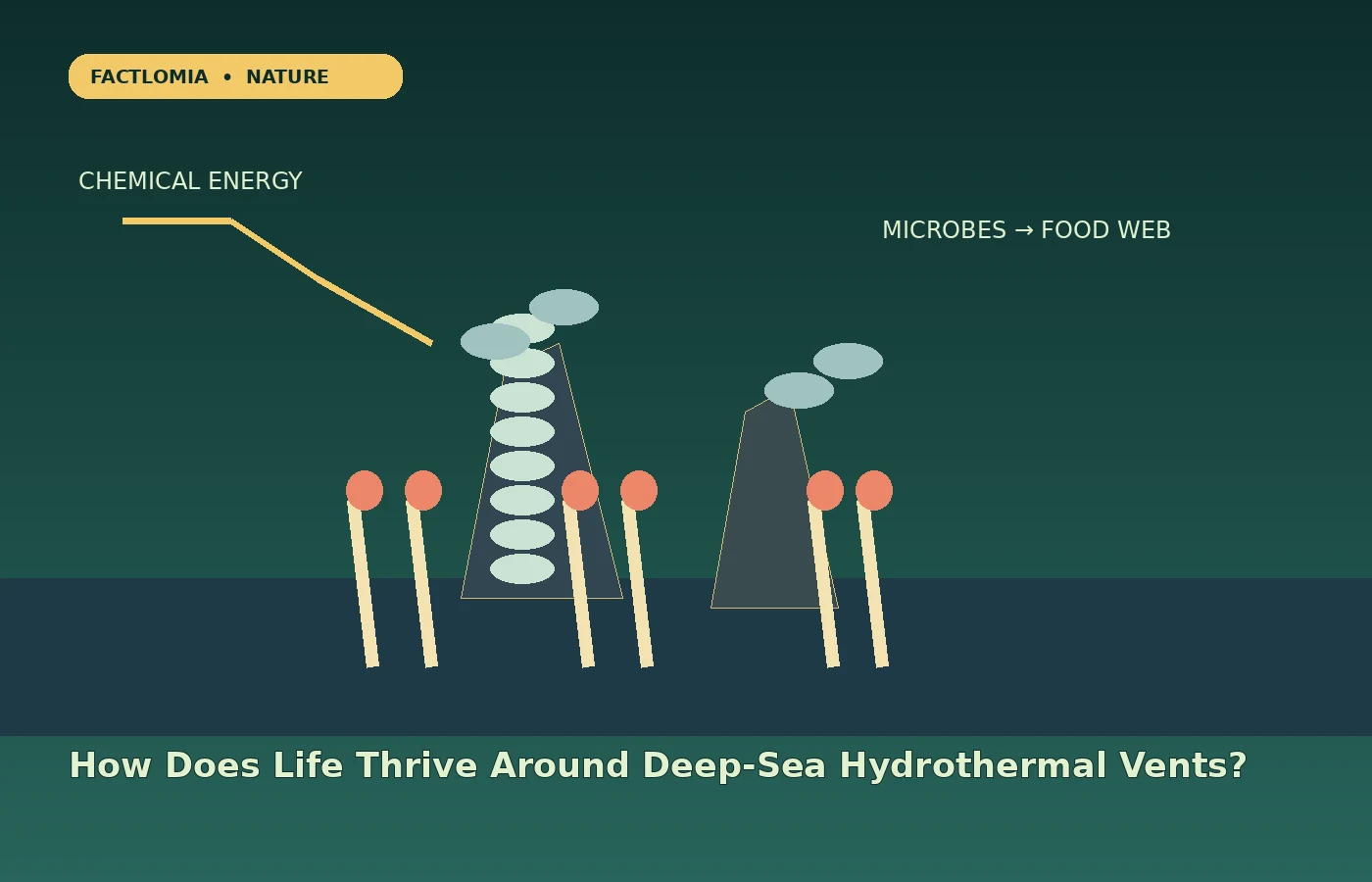
Hydrothermal-vent ecosystems can thrive without sunlight because microbes use energy from chemical reactions in vent fluids to make organic matter. This process, called chemosynthesis, supports animals such as tube worms, clams and shrimp. The communities are concentrated around vents and depend on local chemistry; they are not evidence that sunlight is unnecessary for most life on Earth.
Chemicals replace sunlight as the energy source
Sunlight cannot reach the deep seafloor, so plants and algae cannot photosynthesize there. But seawater circulates down through cracks in ocean crust, heats near magma and rises again carrying dissolved chemicals. Microbes use compounds such as hydrogen sulfide or methane to build organic molecules. NOAA describes these microbes as the foundation of vent food webs. [1]
This process is called chemosynthesis. It is not simply “eating hot water”: microbes obtain energy by driving chemical reactions, then use that energy to build the carbon-rich compounds that other organisms can consume. The exact chemistry varies among vents and microbial species. [2]
A food web grows around a small, powerful source
Tube worms, mussels, clams and other animals can graze on microbial mats or host microbes inside their bodies. Predators and scavengers feed on these animals, creating a local food web. The animals cluster near the chemicals they need, while much of the surrounding deep ocean has far less food. NOAA calls the vent areas oases because biomass can be dense around a relatively small source. [3]
Vent fluid can be extremely hot as it leaves a chimney, yet it rapidly mixes with near-freezing seawater. Many animals live in this mixed boundary, not inside the hottest fluid. Species differ in how much heat, pressure and chemistry they tolerate. The vent itself can be temporary: tectonic activity and mineral deposits can alter or shut off a source.
Does this mean life can exist anywhere?
Vent ecosystems show that sunlight is not the only way to power a food web, but they do not show that life can thrive without energy or liquid water. The microbes still need suitable chemicals, temperatures and environments. Scientists study vents partly because similar chemical processes may be possible beneath ice on ocean worlds, but the existence of chemosynthesis on Earth does not prove life exists elsewhere.
Are hydrothermal vents the same as cold seeps? No. Both can support chemosynthetic communities, but vents release hot, magma-heated water and can be short-lived; cold seeps release fluids closer to ambient deep-ocean temperature and may persist longer. Can humans see these communities? Only with specialized deep-sea submersibles or remotely operated vehicles. Compare this dark ecosystem with how some deep-sea animals produce light.
What the evidence does—and does not—show
| What is supported | Important limit |
|---|---|
| Chemosynthetic microbes can form the base of food webs around deep-sea vents. | These ecosystems still require energy and suitable chemistry; they do not establish that another world has life. |
This summary draws on the references listed below. Follow the source links for the observations and their context.
Sources and evidence
- NOAA Ocean Exploration — Hydrothermal Vents and Volcanoes ↗
Explains how vent fluids form and how chemosynthesis supports communities without sunlight.
- NOAA Ocean Exploration — What Is the Difference Between Photosynthesis and Chemosynthesis? ↗
Describes the energy sources and chemical pathways used in chemosynthesis.
- NOAA — What Is the Difference Between Cold Seeps and Hydrothermal Vents? ↗
Compares vent and seep environments and their chemosynthetic food webs.
Sources consulted: 29 October 2026. Written with AI assistance and checked against the linked references; not independently reviewed by a subject specialist. Sources do not endorse this article. See our editorial policy.
Revision: New explainer clarifies chemosynthesis, local food-web dependence and the limits of comparisons with other worlds. Updated 30 October 2026: added an evidence summary and clarified the limits of the explanation; repaired text formatting.