
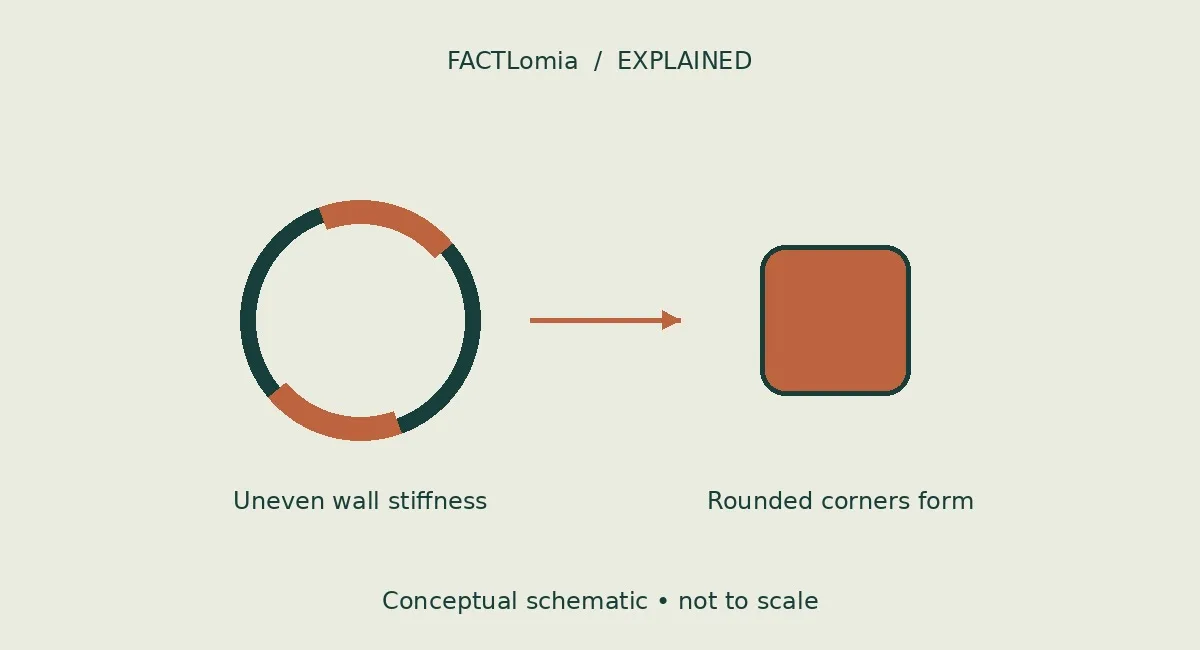
Wombats form cube-shaped droppings inside the intestine, before the feces pass through a round anus. Differences in intestinal tissue stiffness, muscle contractions, and drying help mold the corners. The mechanical explanation is better established than the complete evolutionary story of why the shape developed.
Corners form before the exit
Researchers examined bare-nosed wombat intestines and found that the material became more cube-like toward the end of the digestive tract. The intestinal wall did not have the same stiffness around its circumference. Models incorporating unequal stiffness produced squared cross-sections, supporting a role for tissue mechanics rather than a square opening. [1]
Why a cube might be useful
Wombats leave droppings at shared latrines, often near prominent objects. A 2025 study described individually different chemical signatures and greater investigation when unfamiliar scat was introduced. That supports communication through scent. The idea that flat sides help droppings remain in place is plausible, but the study does not prove that preventing rolling alone caused cube shapes to evolve. [2]
A shape is not a perfect manufacturing specification
The word cube describes a recognizable biological shape, not identical blocks with mathematically exact right angles. Imagine comparing a rounded pebble and a block on a sloping board: the block illustrates why flat faces might help something stay put. That thought experiment cannot substitute for evidence about what natural selection favored in wombats.
Do wombats have square anuses?
No. The unusual shape develops upstream in the digestive tract. [1]
Can scientists read the messages in wombat poop?
Researchers have evidence for individual scent differences and behavioral responses, but the full information encoded in those chemical mixtures remains an active question. [2]
Keep exploring
Continue with How Do Ants Find Their Way Back to the Nest? and How Do Honeybees Tell Other Bees Where to Find Flowers?.
Sources and evidence
- University of Geneva — How wombats poop cubes ↗
Research synthesis of intestinal mechanics.
- University of Georgia — Why wombats have square poop ↗
2025 research on chemical signatures and responses to unfamiliar scat.
Sources consulted: 15 October 2026. Written with AI assistance and checked against the linked references; not independently reviewed by a subject specialist. Sources do not endorse this article. See our editorial policy.
Revision: Initial publication; factual claims checked against linked sources.