
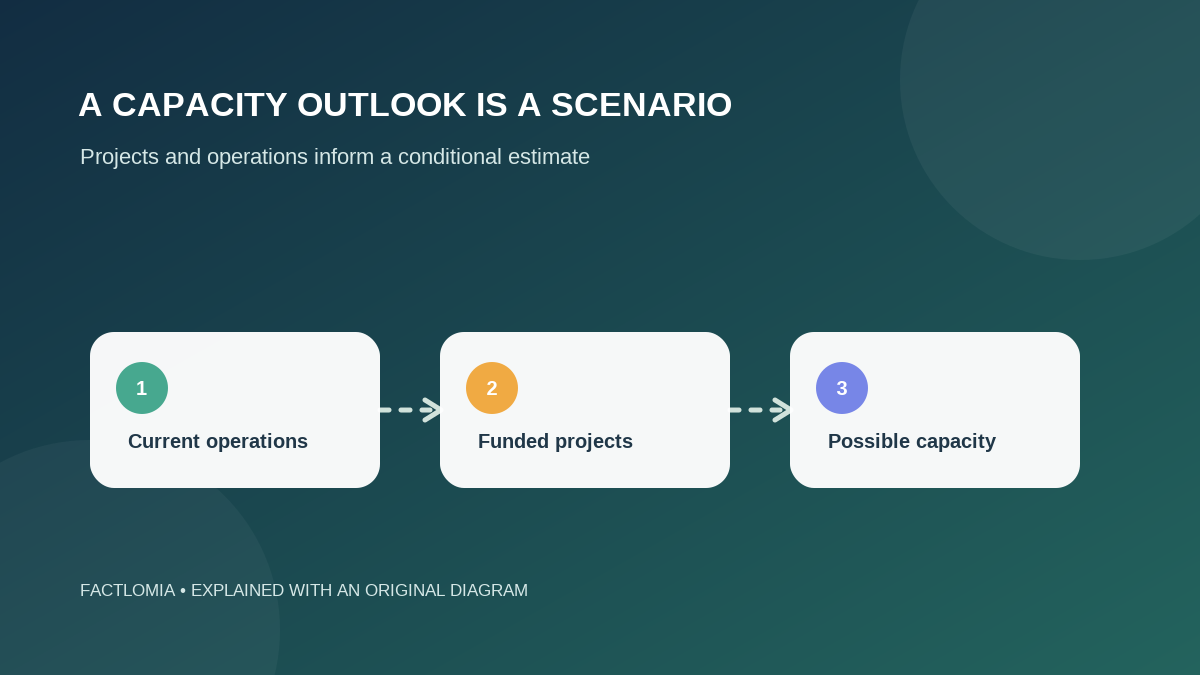
A production-capacity outlook estimates how much industry could be able to produce if announced and funded projects progress and existing operations continue under stated assumptions. It is not a guarantee of future output, a measurement of mineral reserves, or a forecast of market prices. The USGS’s November 2026 outlook covers eight minerals through 2030.
What did the USGS project?
The U.S. Geological Survey’s second World Minerals Outlook assessed production capacity through 2030 for antimony, copper, graphite, niobium, potash, silicon, silver, and tungsten. The agency reported that the United States relied on imports for more than half of annual consumption of each mineral.
The report projected global capacity growth of 20% for natural graphite and 18% for potash, with increases of 4% to 10% for the other six minerals. These figures describe the agency’s estimates of production capacity, not guaranteed production or demand.
How is capacity estimated?
The outlook draws on datasets and mineral specialists’ knowledge. It considers announced, funded projects and when they might start, subtracts operations nearing the end of their announced lives or with depleted resources, and accounts for idled capacity. Where detailed capacity data are unavailable, the methodology uses a conservative approach based on actual production.
Every projection depends on assumptions. A project can be delayed, costs can change, permits may differ, and market conditions can shift. A forecast is most useful when its scope and methods are kept in view.
Capacity is not the same as reserves
A mineral resource is a concentration that may have potential value; a reserve is the economically mineable portion demonstrated under defined conditions. Production capacity asks how much output facilities may be capable of producing. These are distinct measures and should not be substituted for one another.
Capacity also does not tell us what a mineral will cost. Prices depend on supply and demand, inventories, trade, processing, and other market factors.
Frequently asked questions
Does a 20% capacity increase mean 20% more graphite will be mined?
No. It means projected ability to produce increases by that amount under the outlook’s assumptions; actual output may be lower or higher.
Why are minerals called critical?
The USGS list identifies minerals considered important to the economy or national security and vulnerable to supply disruption. The designation does not mean every deposit is viable to mine.
Sources and evidence
- USGS: World production capacity for eight critical minerals, 2026–2030 (Nov. 12, 2026) ↗
Minerals covered, reported import reliance, capacity projections, and modeling methodology.
- USGS: 2025 List of Critical Minerals ↗
How the agency defines and updates its critical-minerals list.
Sources consulted: November 15, 2026. Written with AI assistance and checked against the linked references; not independently reviewed by a subject specialist. Sources do not endorse this article. See our editorial policy.
Revision: Updated November 16, 2026: topic-matched original cover illustration added; primary-source claims and citations reviewed.