
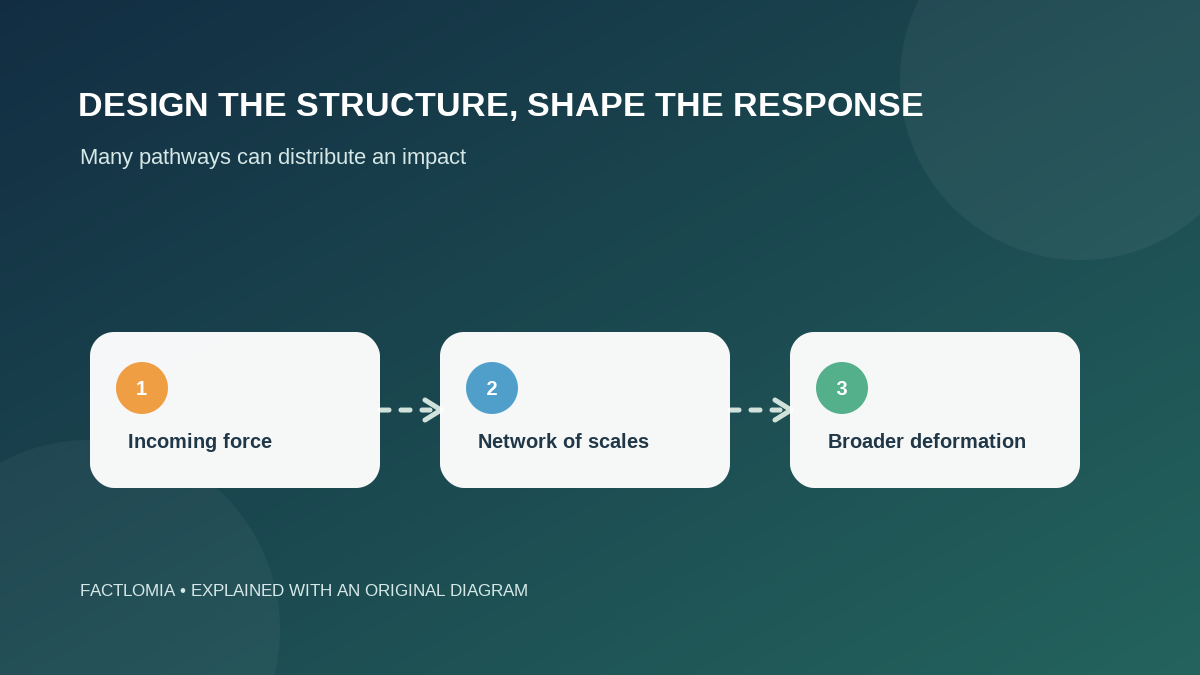
A metamaterial gets important properties from its designed internal structure as well as the substance it is made from. In a 2026 study, researchers tested “scale-rich” structures with beams of different lengths, thicknesses, and connections. Compared with a regular lattice in their experiments, the irregular networks spread deformation more evenly and withstood impact better. This is an early materials result, not yet proof of a finished helmet or armor product.
What makes a metamaterial different?
Ordinary material properties depend heavily on composition: steel, rubber, and foam respond differently because of their chemistry and structure. A metamaterial adds another design layer. Its geometry—such as repeated cells, beams, or connected networks—can shape how it responds to forces.
Engineers can use computer models and 3D printing to test structures that would be difficult to manufacture by conventional methods. The goal is to tailor properties such as stiffness, flexibility, sound control, or impact absorption.
Why add irregularity?
Many engineered lattices repeat the same unit. That regularity can work well, but under some loading conditions strain can concentrate in one region and trigger a chain of failures. The NSF-described “scale-rich” design uses beams and connections across different sizes, inspired by irregular networks found in biological structures.
In laboratory impact tests, the printed networks distributed deformation more broadly than a conventional square lattice. The researchers also demonstrated a pomelo-like structure that cushioned a fragile object at its center. These results show a design concept, not a product ready for commercial use.
Where could the idea lead?
If further testing confirms the advantages across materials, sizes, and real-world conditions, scale-rich structures could inform protective equipment, packaging, and systems that manage vibration. Engineers would still need to measure durability, weight, manufacturing consistency, cost, and performance in realistic impacts.
Biological inspiration does not mean a design copies nature exactly. Researchers translate useful patterns into mathematical structures and then test how those structures behave.
Frequently asked questions
Is a metamaterial a new chemical?
Usually the defining feature is the engineered arrangement of a material, not a new chemical ingredient.
Are scale-rich helmets available?
The 2026 report describes experimental research. It does not establish that a certified consumer helmet using this design is on the market.
Sources and evidence
- National Science Foundation: Nature-inspired metamaterial design (Nov. 12, 2026) ↗
Structure, inspiration, 3D-printed tests, impact results, and potential applications.
- Nature: research publication associated with the NSF report ↗
Peer-reviewed research article on scale-rich metamaterial architectures.
Sources consulted: November 15, 2026. Written with AI assistance and checked against the linked references; not independently reviewed by a subject specialist. Sources do not endorse this article. See our editorial policy.
Revision: Updated November 16, 2026: topic-matched original cover illustration added; primary-source claims and citations reviewed.