
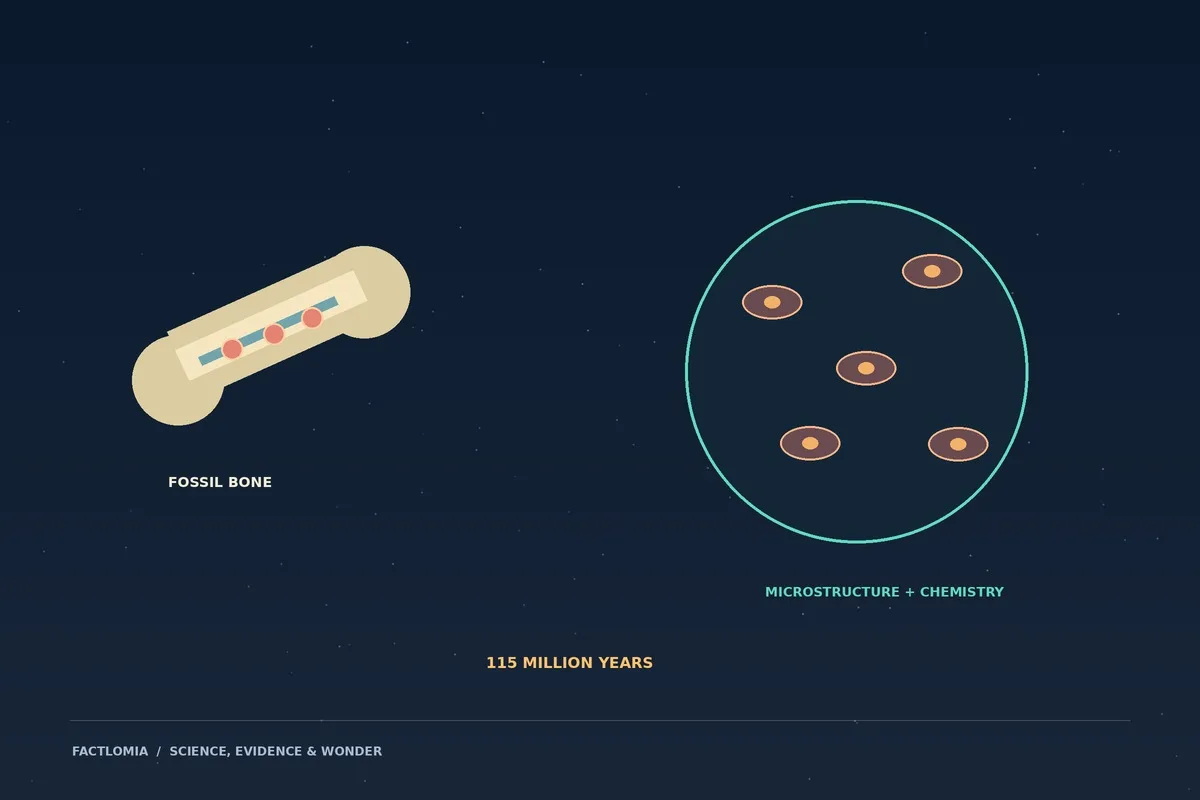
Researchers studying a 115-million-year-old Brazilian dinosaur fossil reported tiny structures interpreted as mineralized red blood cells alongside heme-related chemical signatures. The findings provide evidence that some blood-related chemistry can persist in fossils. They do not mean intact liquid blood, living cells or recoverable dinosaur DNA were found.
What was found inside the bone?
The fossil came from Aratasaurus museunacionali, a theropod dinosaur from what is now Brazil. In a 2026 Proceedings of the National Academy of Sciences paper, researchers described ellipsoidal microstructures within vascular canals and chemical signals related to heme, the iron-containing part of hemoglobin. They interpreted the structures as mineralized red blood cells. [1]
The combination matters: shape, mineral context and chemical measurements provide several lines of evidence. The researchers argue that the fossil preserved molecular traces linked to blood rather than merely a cell-like shape.
How could any blood-related material survive?
Fossilization can replace or mineralize biological structures, and chemical conditions can sometimes protect some molecular traces from rapid breakdown. The study discusses how mineralization and surrounding materials may have helped preserve structures and heme-derived molecules. The result is not ordinary soft tissue kept unchanged for millions of years; it is a fossil record of altered structures and chemistry. [1]
The fossil was recovered in Brazil and survived the 2018 fire that destroyed the National Museum of Brazil, where many specimens were lost. Researchers later used microscopy and chemical analyses to examine the surviving bone. [2]
What the discovery does—and does not—mean
The paper does not report intact blood, complete cells, or dinosaur DNA. “Blood evidence” here means microscopic structures and heme-related chemical signatures that the team interprets as remnants of red blood cells. Such claims require careful analysis because fossil chemistry can change and structures may be difficult to identify.
If confirmed and replicated, this approach could help paleontologists study aspects of ancient animal biology that bones alone do not reveal. It does not make it possible to clone a dinosaur.
FAQ: dinosaur blood evidence
Was liquid blood recovered? No. The study reports mineralized microstructures and chemical signatures interpreted as blood-related.
Did researchers find dinosaur DNA? No. The paper reports heme-derived chemical signals, not recoverable dinosaur DNA.
Sources and evidence
- PNAS — Heme signatures in mineralized red blood cells within a 115-million-year-old dinosaur bone ↗
Primary paper describing the fossil structures and chemical evidence.
- Curtin University — Dinosaur blood discovery and fossil evidence ↗
Research-team explanation and the fossil’s scientific context.
Sources consulted: 11 November 2026. Written with AI assistance and checked against the linked references; not independently reviewed by a subject specialist. Sources do not endorse this article. See our editorial policy.
Revision: Initial publication. Current claims and limits were checked against the linked research and institutional sources.