
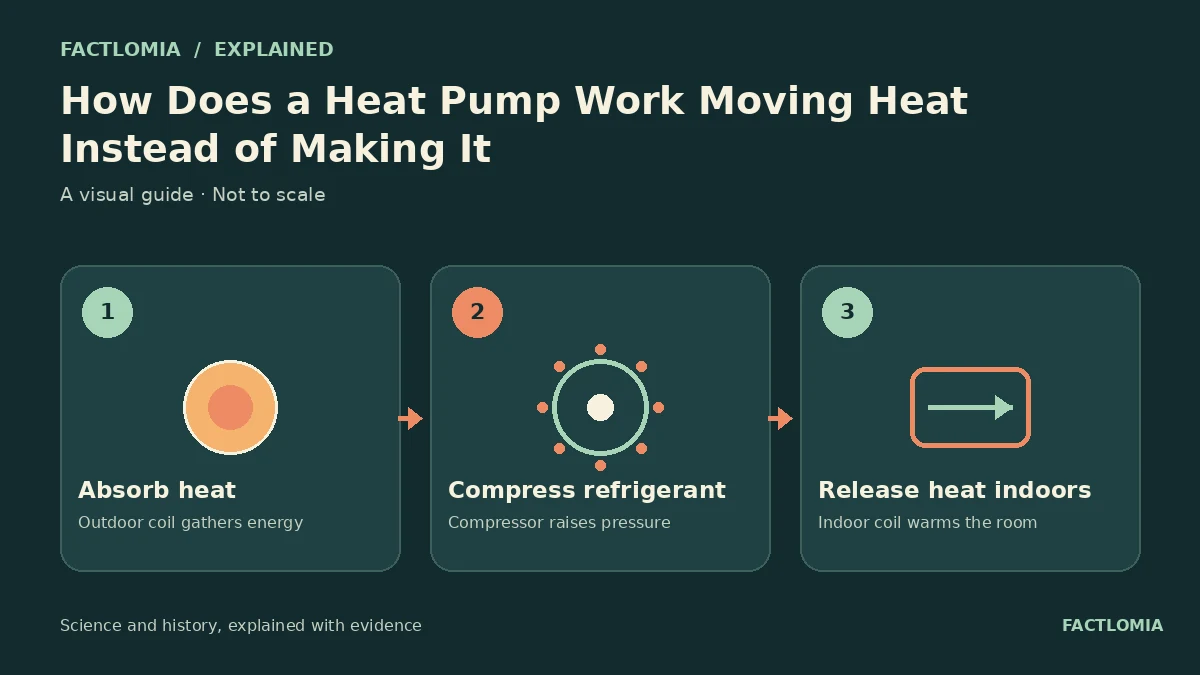
A heat pump moves heat from one place to another using a circulating refrigerant, a compressor, and heat exchangers. In heating mode, it extracts heat from outdoor air or the ground and releases it indoors. Many systems reverse the cycle in summer to move indoor heat outside. A heat pump transfers heat rather than generating it mainly through electric resistance.
A refrigerant carries heat
The refrigerant absorbs heat in one coil as it evaporates, then a compressor raises its pressure and temperature. In a second coil, it releases heat and condenses. An expansion device lowers the refrigerant’s pressure so the cycle can repeat. The same basic vapor-compression idea appears in refrigerators and air conditioners, but a heat pump can be designed to provide both heating and cooling. [1]
Heating can work even when it feels cold
Outdoor air contains thermal energy above absolute zero. In heating mode, the refrigerant can absorb some of that heat and deliver it indoors, even when the outside temperature is low. How much heat a system can move depends on its design and operating conditions; efficiency generally changes with outdoor temperature. Cold-climate models are designed to operate effectively at lower temperatures, but performance and backup needs vary by system and home. [2]
The cycle can reverse
A reversing valve changes which coil absorbs and releases heat. In winter, the indoor coil warms the home; in summer, the system can move heat out of the home and work like an air conditioner. Some systems use air, ground, or water as the source or sink. Installation, insulation, climate, and electricity rates all influence a home’s costs, so a general science explanation cannot predict an individual bill. [1]
Frequently asked questions
Does a heat pump create heat?
It mainly transfers heat from outside to inside; electrical energy powers the compressor and fans.
Can heat pumps work below freezing?
Many can, though capacity and efficiency vary with temperature and equipment design. Cold-climate systems are designed for lower temperatures.
Can one heat pump cool a home too?
Many heat-pump systems reverse their refrigerant cycle to provide cooling in summer.
Sources and evidence
- U.S. Department of Energy — Heat Pump Systems ↗
Explains heat-pump operation, system types, and heating/cooling modes.
- U.S. Department of Energy — Heat Pumps ↗
Consumer-level explanation of heat pumps and cold-climate performance.
- U.S. DOE Building Science Education — Heat Pump Systems ↗
Describes the vapor-compression cycle and heat transfer.
Sources consulted: 4 November 2026. Written with AI assistance and checked against the linked references; not independently reviewed by a subject specialist. Sources do not endorse this article. See our editorial policy.
Revision: New explainer; notes that cold-weather capacity and household cost depend on system and conditions.