
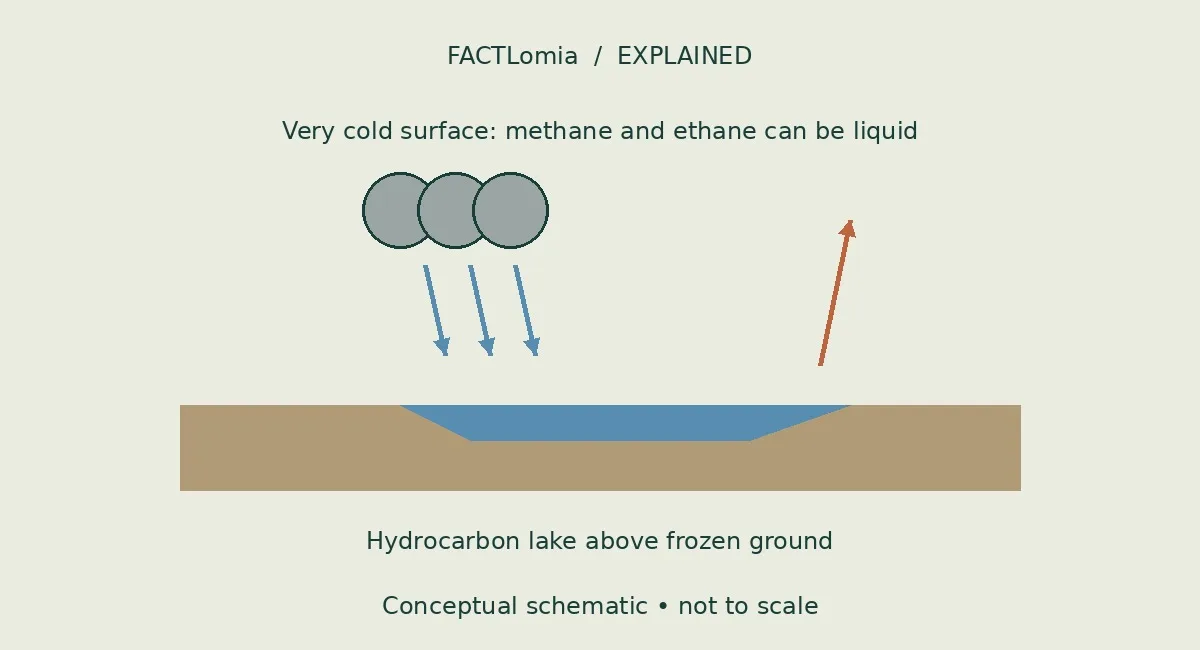
Titan has lakes of liquid methane and ethane because its surface is extremely cold—around minus 290°F, or minus 180°C. Under Titan’s temperature and pressure conditions, those hydrocarbons can remain liquid while water at the surface is frozen. A substance’s familiar state on Earth is not its only possible state.
Temperature changes the role of familiar chemicals
Methane is usually a gas in everyday conditions on Earth, while water is commonly liquid. Titan reverses that familiar picture at its frigid surface: methane and ethane can fill lakes, while water ice forms part of the solid landscape. This does not mean water has vanished from Titan. It means surface liquid water is not stable under the prevailing conditions. [1]
An Earth-like cycle with different ingredients
Cassini observations support a hydrocarbon cycle involving evaporation, clouds, rain and surface reservoirs. The comparison with Earth is useful because the movement of a liquid can shape terrain even when its chemistry differs. The analogy is not exact: lake composition, seasonal behavior and the way individual basins formed remain subjects of investigation. [2]
A lake is a physical setting, not proof of life
Imagine a map showing a shoreline without naming the fluid. The shape alone would not tell you whether the liquid was water or methane. Scientists combine radar observations and other measurements with models of the environment. The presence of an intriguing liquid environment motivates research; it does not demonstrate organisms living in Titan’s lakes.
Are all Titan lakes chemically identical?
No. Observations indicate differences between bodies of liquid. Calling them methane lakes is useful shorthand, not a claim that each contains chemically pure methane. [2]
Could a lake basin have more than one origin?
Yes. Dissolution has been proposed for some basins, while other models explore explosive formation for certain steep-rimmed lakes. These are explanations for particular features, not one established origin for every lake. [3]
Would methane be liquid at room temperature on Earth?
Not under ordinary atmospheric pressure. Titan’s environment is essential to the comparison; moving the liquid to different conditions changes its state.
Keep exploring
Continue with Why Does Mercury Have Ice Near Its Poles? and Why Is Venus Hotter Than Mercury?.
Sources and evidence
- NASA Science — Lakes on Titan ↗
Methane and ethane stability under Titan conditions.
- NASA JPL — Cassini reveals surprises with Titan’s lakes ↗
Radar observations, composition and the hydrocarbon cycle.
- NASA JPL — New models for lake craters ↗
Alternative basin-formation hypotheses.
Sources consulted: 15 October 2026. Written with AI assistance and checked against the linked references; not independently reviewed by a subject specialist. Sources do not endorse this article. See our editorial policy.
Revision: Initial publication; factual claims checked against linked sources.