
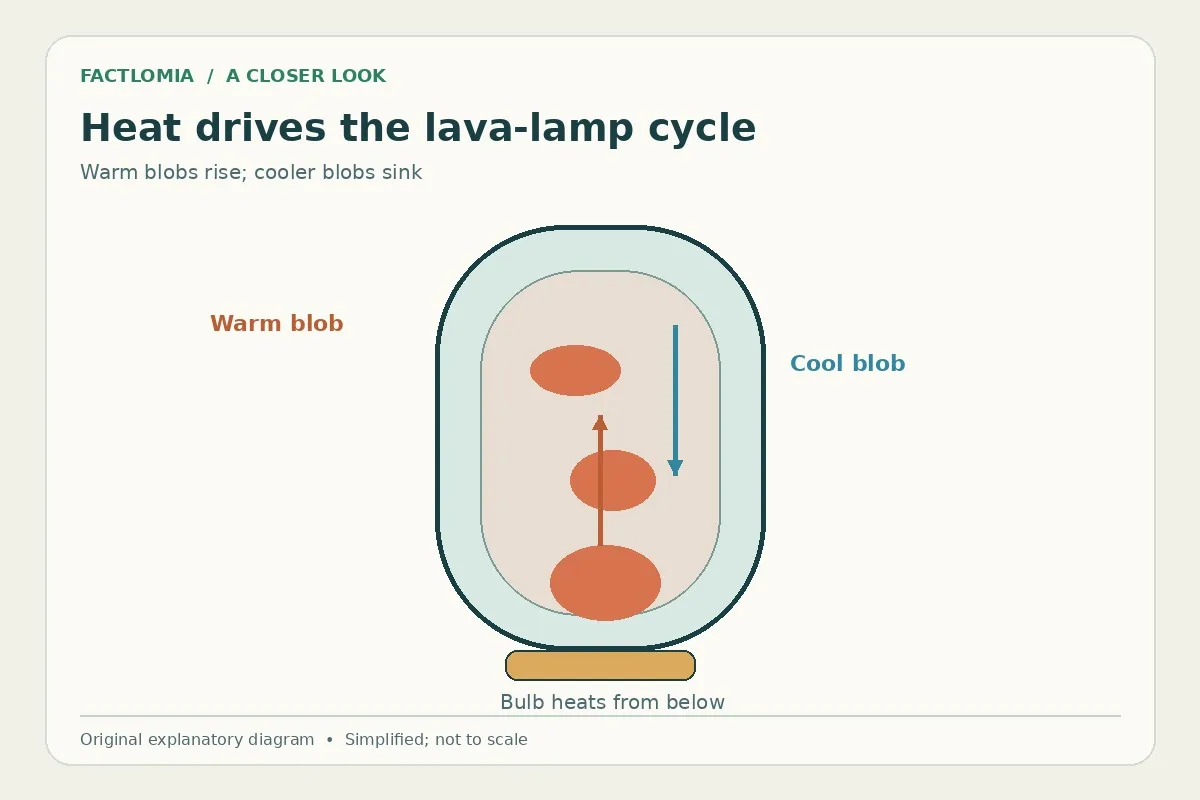
A lava lamp works through heat-driven convection between two liquids that do not mix. The bulb warms the denser wax-like blobs at the bottom. As a blob warms, it expands and becomes less dense than the surrounding liquid, so it rises. Near the top it cools, becomes denser, and sinks again.
Two liquids stay separate
A lava lamp contains a coloured wax-like material and a surrounding liquid that do not mix. At room temperature, the blobs are denser than the surrounding fluid, so they rest near the bottom. The lamp’s bulb supplies heat from below, creating a temperature difference through the container. [1]
The important feature is not simply that wax melts. The two fluids are selected so their densities are close enough for temperature changes to reverse which one is heavier in a given volume. The exact recipe varies by manufacturer and is generally proprietary, so a simple household oil-and-water recipe should not be assumed to reproduce a commercial lamp.
Warm blobs rise and cool blobs sink
When a blob absorbs heat near the bottom, it expands. Its density falls, and the surrounding liquid can push it upward. Near the top, the blob loses heat to the cooler region, contracts, and becomes denser again. It then sinks. This repeating circulation is thermal convection. [1][2]
Laboratory research on lava-lamp convection measured periodic rising and sinking in an immiscible two-fluid system heated at the bottom and cooled at the top. The blob motion is not a miniature version of molten rock circulating in Earth’s mantle; the scientific study cautions that the popular analogy fails for accepted mantle-convection models. [2]
Why the blobs split and merge
The shapes change as blobs rise, cool, and interact with the surrounding liquid. Surface tension, viscosity, the temperature gradient, and the fluid properties influence whether blobs stretch, divide, join, or pause near the top. The motion can be periodic without every blob following an identical path. [2]
A lava lamp is therefore a visible demonstration of heat transfer and density-driven flow. It should be used according to its instructions: the glass and bulb can become hot, and the sealed lamp should not be opened or heated directly.
Frequently asked questions
Does the wax melt and then float because it is lighter?
Heating changes the blob’s volume and density. A blob rises when it becomes less dense than the surrounding liquid, then sinks after cooling.
Do the liquids mix?
No. The lamp relies on two immiscible liquids that remain separate while heat moves through them.
Is a lava lamp a model of Earth’s mantle?
It can illustrate convection, but the detailed physics of a lamp is not a faithful model of mantle convection.
Sources and evidence
- Gyüre & Jánosi — Basics of lava-lamp convection, Physical Review E ↗
Primary laboratory study of heating, periodic blob rise and sinking, and limits of the mantle analogy.
- PubMed — Basics of lava-lamp convection ↗
Abstract of the peer-reviewed study and its experimental findings.
Sources consulted: 2026-10-27. Written with AI assistance and checked against the linked references; not independently reviewed by a subject specialist. Sources do not endorse this article. See our editorial policy.
Revision: First published 27 October 2026. Original explanatory diagram; claims checked against linked sources.