
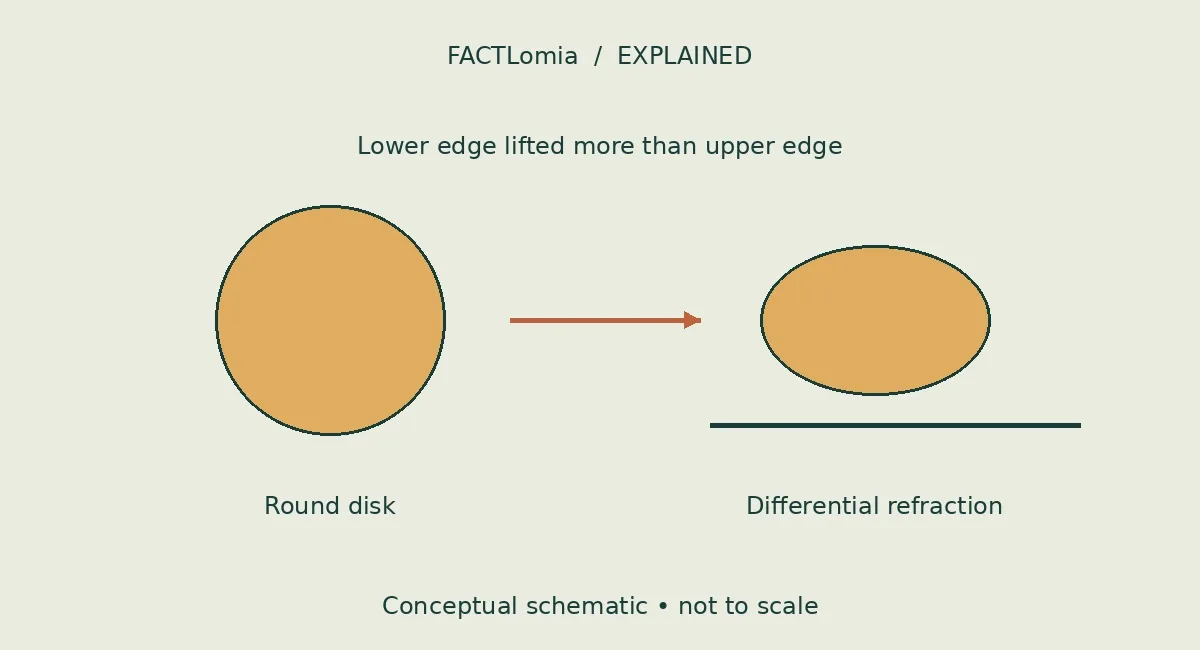
The Sun can look flattened near the horizon because Earth’s atmosphere bends light from its lower edge more strongly than light from its upper edge. The lower part of the image is lifted more, reducing the apparent vertical diameter. The Sun itself has not suddenly changed shape.
Different parts of the disk take different paths
Air’s refractive properties vary with height and atmospheric conditions. Light arriving at a shallow angle near the horizon passes through layers that bend its path. The bottom and top of the solar disk are seen along slightly different directions, so their apparent vertical displacement is unequal. This differential refraction compresses the image. [1]
Why some sunsets look stranger than others
Near-horizontal light paths are especially sensitive to temperature structure close to the ground. Unusual layers can produce mirage distortions, changing the rim into shapes more complicated than a smooth oval. A standard-atmosphere calculation explains ordinary flattening, but local conditions can depart from that simplified model. A photograph is therefore a record of the optical path as well as the distant Sun. [1, 2]
Flattening is different from the “huge sunset” impression
The disk’s measurable shape distortion is an optical effect in the atmosphere. The impression that a horizon Sun looks enormous involves a separate perceptual question. Mixing the two makes it harder to test either explanation. Compare vertical and horizontal proportions in a properly filtered image, rather than relying only on how large the Sun feels.
Does the Moon also look flattened near the horizon?
It can. Atmospheric refraction acts on incoming moonlight too, and can distort the apparent shape of a low full Moon. [2]
Is the Sun becoming physically oval?
Not on the timescale of a sunset. The changing appearance described here is produced along the light path to the observer.
Is sunset safe for direct viewing?
Do not assume it is. Avoid staring at the Sun, and never use binoculars, telescopes or an optical camera viewfinder without appropriate solar-viewing protection.
Keep exploring
Continue with What Causes the Green Flash at Sunset? and Why Are Sunsets on Mars Blue? The Science.
Sources and evidence
- San Diego State University — Flattening of the setting Sun ↗
Differential refraction and atmospheric temperature structure.
- Neda and Volkan — Flatness of the setting Sun ↗
Model calculations compared with observed solar distortion.
Sources consulted: 15 October 2026. Written with AI assistance and checked against the linked references; not independently reviewed by a subject specialist. Sources do not endorse this article. See our editorial policy.
Revision: Initial publication; factual claims checked against linked sources.