
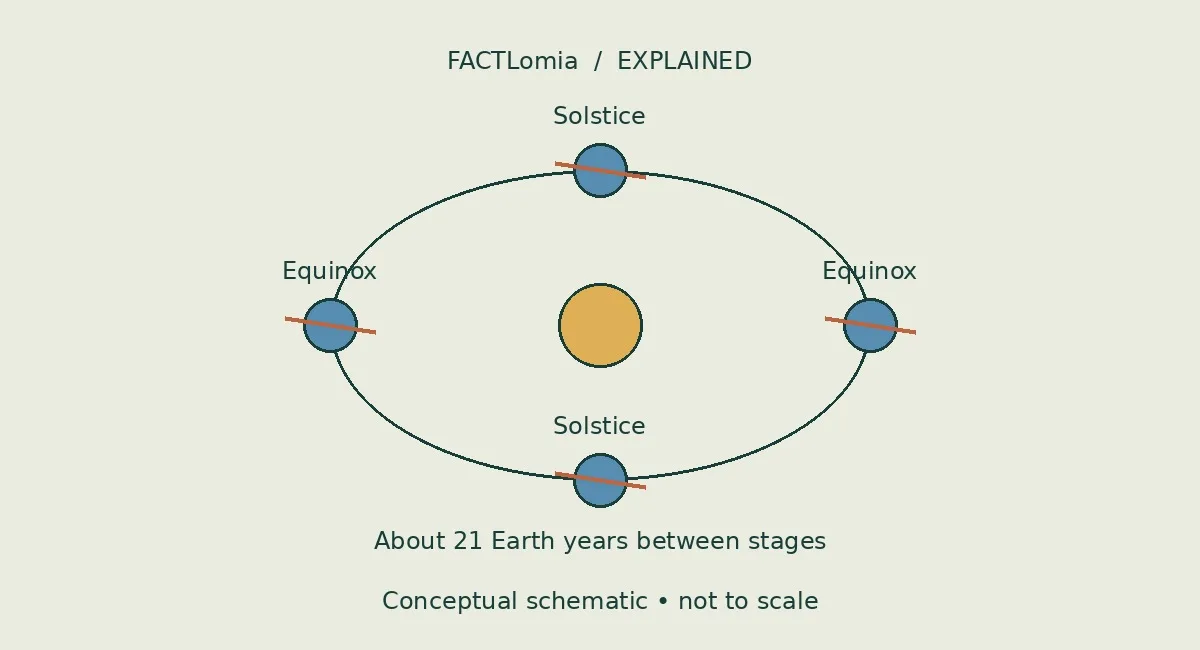
Each season on Uranus lasts about 21 Earth years because the planet takes roughly 84 Earth years to orbit the Sun. Its extreme axial tilt creates long periods of polar daylight and darkness. The often-quoted 42 years describes approximately half an orbit, not the length of one season.
One orbit contains four seasons
Dividing an 84-year orbit into four broad seasonal intervals gives about 21 years each. This is a useful approximation rather than a promise of identical weather throughout each interval. A planet’s seasonal geometry is easier to define than the timing of storms or changes in atmospheric temperature. [1, 2]
The sideways tilt changes the sunlight
Uranus has an axial tilt of about 98 degrees. Near a solstice, one polar region faces the Sun while the other points away. Around an equinox, the distribution becomes more balanced. The Sun does not remain directly overhead at one pole for the entire long daylight interval; the direction changes continuously along the orbit. [1]
A lifetime measured against a Uranian year
Someone born near one Uranian equinox would be about 21 Earth years old at the following solstice and roughly 42 at the next equinox. That calendar comparison makes the timescale tangible without claiming that an observer could stand on a solid Uranian surface. Uranus is an ice giant without a surface like Earth’s. [2]
Is a Uranian day also 21 years long?
No. A day describes rotation, while a season describes the changing illumination during an orbit. They are different cycles.
Do scientists know why Uranus tipped over?
A major ancient impact is one hypothesis. Its present tilt is measured; the exact history that produced it remains uncertain. [3]
Keep exploring
Continue with Is a Day on Venus Longer Than a Year? and Why Do Planets Sometimes Appear to Move Backward?.
Sources and evidence
- NASA — Uranus facts ↗
Orbit, tilt and extreme seasons.
- Canadian Space Agency — Uranus ↗
Approximately 21-year seasons and lack of a solid surface.
- NASA — Seasons on Earth, Mars, and beyond ↗
Axial tilt and uncertainty about its origin.
Sources consulted: 15 October 2026. Written with AI assistance and checked against the linked references; not independently reviewed by a subject specialist. Sources do not endorse this article. See our editorial policy.
Revision: Initial publication; factual claims checked against linked sources.