
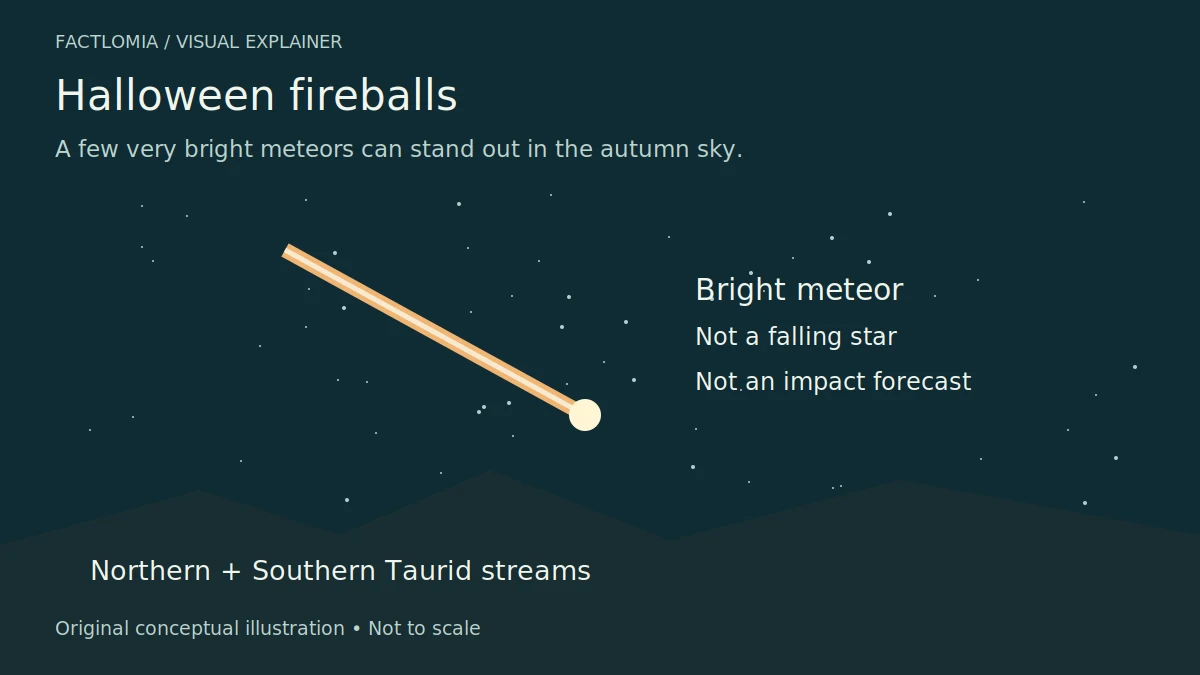
Taurid meteors are nicknamed Halloween fireballs because their autumn activity overlaps Halloween and the stream can produce unusually bright meteors. A fireball is a very bright meteor, not a different object flying below the clouds. The Taurids include northern and southern branches.
Why can a Taurid be so bright?
The Taurid stream includes relatively substantial debris that can produce conspicuous meteors as it enters the atmosphere. Its reputation comes from bright individual events rather than a constant rain of streaks. The Royal Observatory Greenwich describes the shower as containing heavier material and producing relatively slow, long-lasting meteors. [1]
Why are there two Taurid showers?
The Northern and Southern Taurids have overlapping autumn activity but somewhat different radiant locations and timing. Their paths appear to trace back toward Taurus, which gives them their name. The stream is associated with the comet Encke complex; the radiant is a viewing direction, not a source among the stars. [2]
What are the useful November 2026 dates?
The American Meteor Society highlights November 4–5 for Southern Taurids and November 11–12 for Northern Taurids. These are broad observing opportunities rather than an appointment for a guaranteed fireball. Activity extends over weeks, and the two branches overlap. [2]
Does a bright fireball mean a meteorite will land?
Brightness alone does not establish that a fragment will reach the ground. The visible event happens during atmospheric entry; determining whether anything survives requires more evidence. Do not interpret a fireball nickname as a prediction of an impact near the observer. Read why meteors glow for the entry physics.
Is 2026 guaranteed to be spectacular?
No. A seasonal label is not evidence of a storm. A patient observer under a dark, clear sky might see a memorable meteor, but an individual outing can also produce none. That uncertainty is part of planning a realistic observing session.
Sources and evidence
- Royal Observatory Greenwich — Night Sky Highlights, November 2026 ↗
October 2026 feature explaining the Halloween-fireball nickname and debris characteristics.
- American Meteor Society — Meteor Shower Calendar 2026–2027 ↗
Separate northern and southern branches and November dates.
Sources consulted: 31 October 2026. Written with AI assistance and checked against the linked references; not independently reviewed by a subject specialist. Sources do not endorse this article. See our editorial policy.
Revision: Initial publication. Checked against cited references; dated event information is identified in the text and uncertainties are stated.