
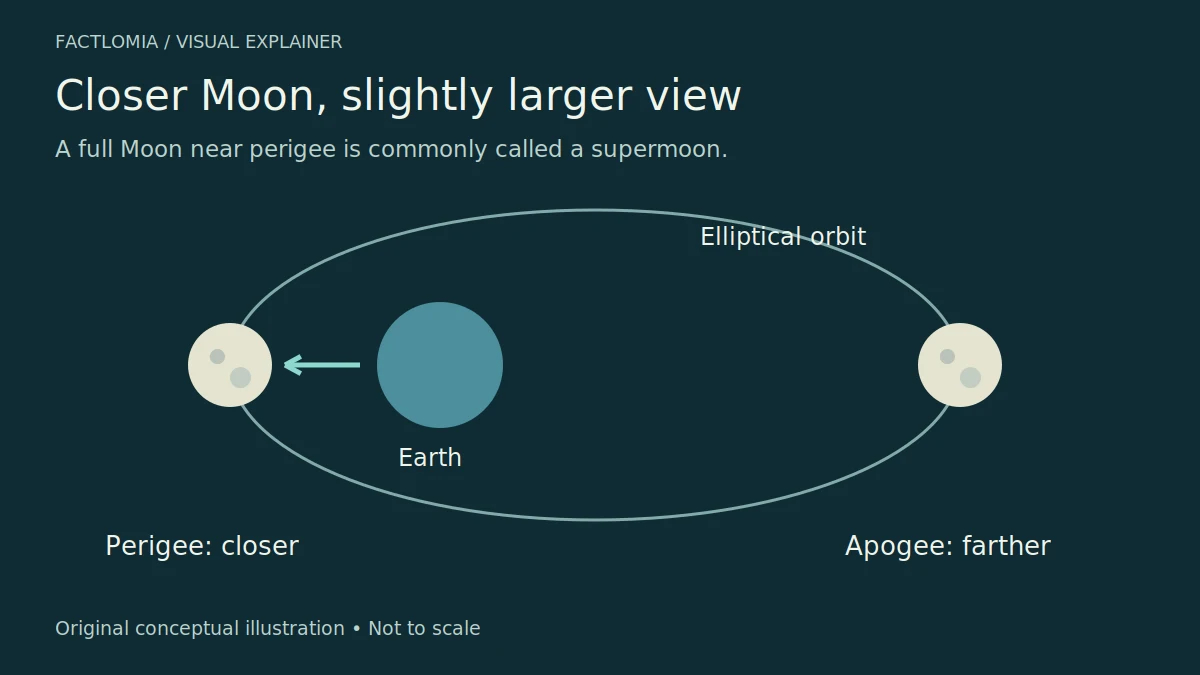
A supermoon is a full Moon occurring near the close part of the Moon’s elliptical orbit around Earth. NASA lists the next one for November 24, 2026. It can appear somewhat larger and brighter than a distant full Moon, but the difference is modest to the unaided eye.
Why does the Moon’s distance change?
The Moon follows an elliptical orbit, so its distance from Earth varies. The nearby part is called perigee; the faraway part is apogee. A full Moon near perigee is commonly called a supermoon, although this is not a formal astronomical classification with one universally fixed cutoff. [1]
When is the November 2026 supermoon?
NASA’s supermoon page lists November 24, 2026, at 14:54 UTC. The Moon is visible from any particular location only when it is above that location’s horizon and weather permits. The instant of full Moon is not the same as your local moonrise, so consult a local rise-time forecast. [1]
Will it look dramatically bigger?
Not usually. NASA compares the closest full Moon with the farthest full Moon: the apparent diameter can differ by up to about 14 percent. That is an extreme near-versus-far comparison, not a promise that every supermoon looks 14 percent bigger than the previous month’s Moon. [2]
Is a supermoon the same as a blue moon?
No. “Supermoon” concerns distance and phase; “blue moon” is a calendar or seasonal naming convention. Neither term means the Moon changes into a different kind of object. A photograph can also exaggerate apparent scale through framing and lens choice. [2]
Why can it look enormous near the horizon?
That impression also involves perception. Compare this orbital explanation with the Moon illusion rather than attributing every large-looking Moon to a supermoon.
Sources and evidence
- NASA — Supermoons ↗
Definition, orbit geometry and November 24, 2026 date.
- NASA — Super Blue Moons: Your Questions Answered ↗
Apparent-size comparison and distinction from blue moons.
Sources consulted: 31 October 2026. Written with AI assistance and checked against the linked references; not independently reviewed by a subject specialist. Sources do not endorse this article. See our editorial policy.
Revision: Initial publication. Checked against cited references; dated event information is identified in the text and uncertainties are stated.