
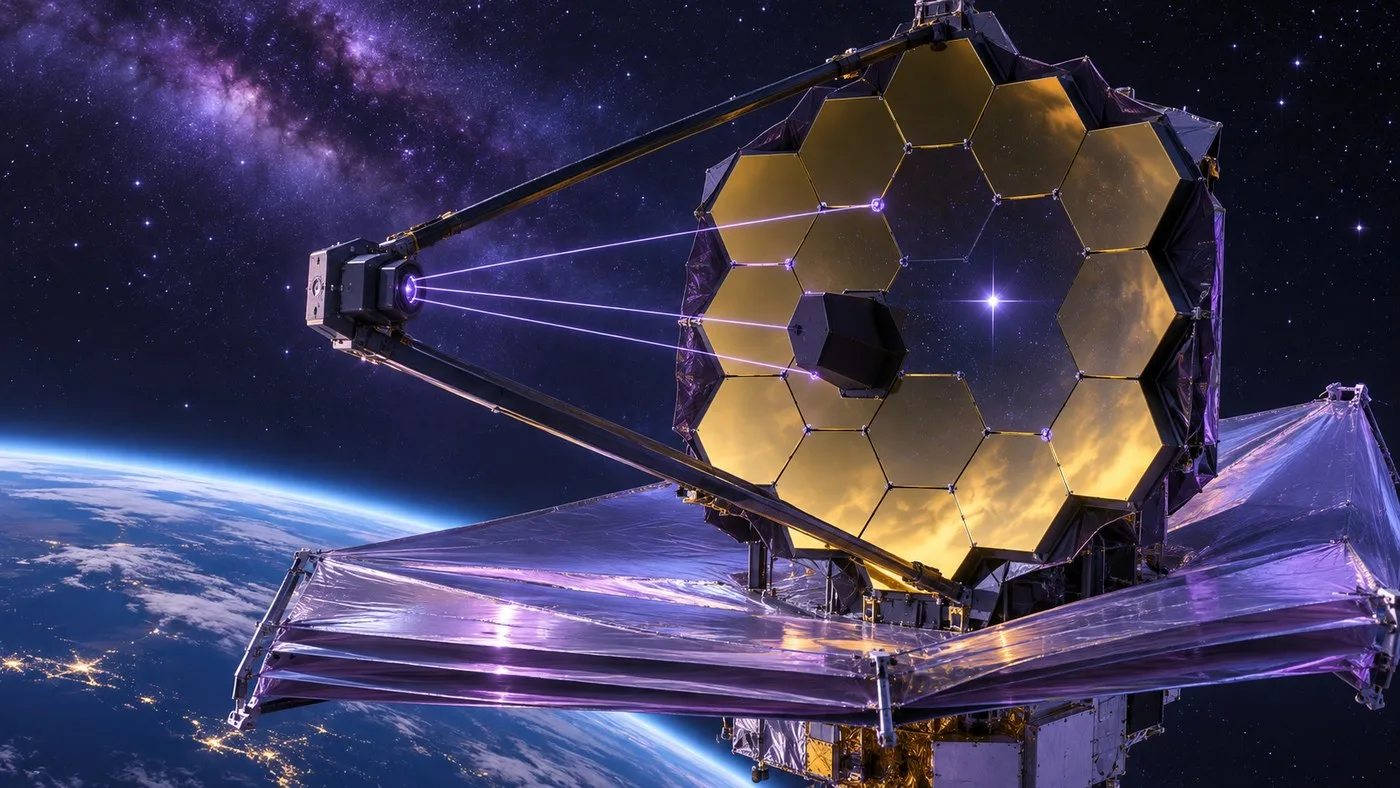
Roman needs precise optical alignment because even a small amount of scattered starlight can hide a much fainter nearby planet. NASA recently aligned key mirrors, masks and optics in Roman’s coronagraph. The milestone prepares the instrument for more tests; it does not mean Roman has already imaged an exoplanet.
A telescope is a chain of aligned optics
Light passes through mirrors and optical components before it reaches a detector. If one component shifts, the image may blur or move. NASA says the Roman team adjusted the secondary mirror, the mirror connecting the telescope to its coronagraph, and the masks and optics inside that instrument. [1]
Why block a star’s light?
A star can be millions or billions of times brighter than a planet reflecting it. A coronagraph uses masks and optical elements to suppress much of the star’s glare so the planet’s faint light can be measured. Roman’s coronagraph also has deformable mirrors whose surfaces can be changed by thousands of tiny moving parts to further control starlight. Alignment is an early step; active control is more complex. [1]
What the milestone does—and does not—mean
NASA reported a key alignment milestone in November 2026, with further tests planned for the deformable mirrors. Commissioning progress is not the same as a confirmed planet observation. Roman’s coronagraph is a technology demonstration designed to mature direct-imaging methods. See our overview of exoplanet discovery methods.
FAQ: telescope alignment
Has Roman found a planet? The reported milestone was about alignment, not a planet detection.
Why not use a longer exposure? Longer exposures also collect glare; the coronagraph suppresses starlight.
What is a deformable mirror? A mirror whose surface can be adjusted to correct distortions in light.
Sources and evidence
- NASA — Instruments on NASA’s Roman Space Telescope Get in Sync for Science ↗
Recent instrument alignment and upcoming coronagraph tests.
- NASA — Roman Space Telescope ↗
Mission and instrument context.
Sources consulted: 14 November 2026. Written with AI assistance and checked against the linked references; not independently reviewed by a subject specialist. Sources do not endorse this article. See our editorial policy.
Revision: Initial publication. Claims and limitations checked against linked institutional and primary sources.