
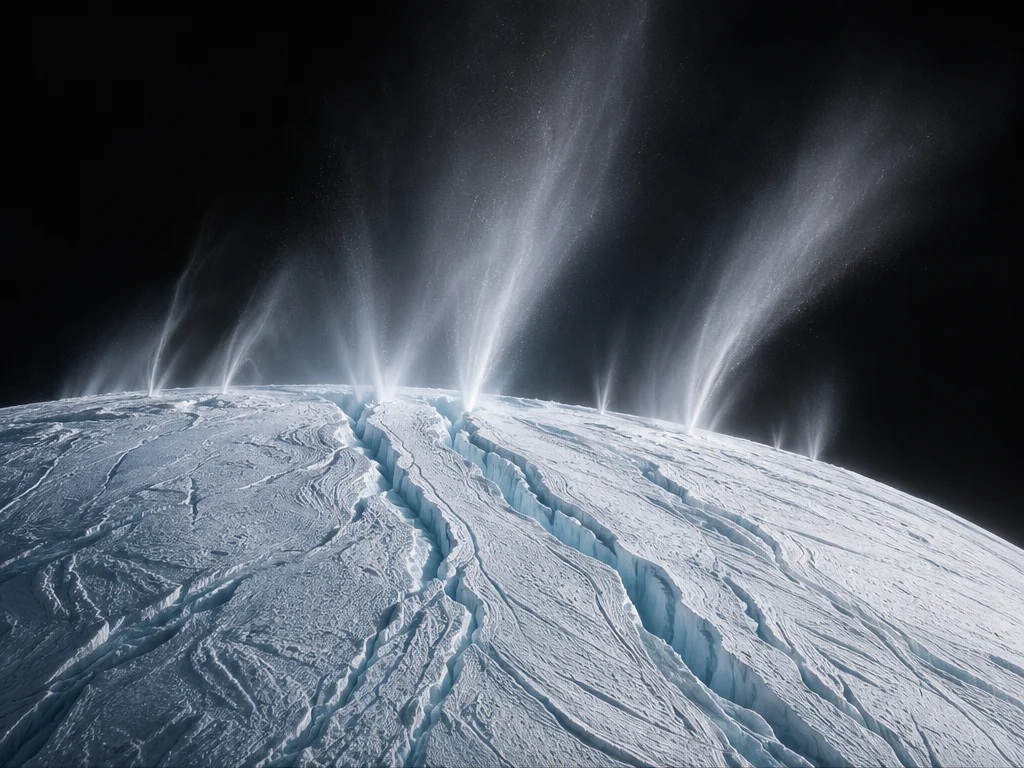
Enceladus sprays ice grains and water vapor through fractures near its south pole. Cassini linked the plumes to a salty ocean beneath the moon’s icy crust. The same eruptions help supply Saturn’s faint E ring.
Cracks in an icy shell
Four long fractures curve across the moon’s south polar terrain. Cassini scientists nicknamed them tiger stripes. The spacecraft photographed jets above the limb and mapped their locations to the fractures. Several jets lined up with localized warm spots, a clue that material was traveling through openings in the ice. [1] [2]
How a plume reveals an ocean
Cassini sampled material as it flew through the plume. Some ice grains contained salts, consistent with a source of liquid water that has been in contact with rock. Other spacecraft measurements supported a global ocean below the shell. Together they let scientists connect a visible feature above the surface to a hidden reservoir far below. [1]
Where the spray goes
Some ice grains fall back and coat the surface with fresh material. Others escape the small moon’s gravity and spread along its orbit around Saturn, supplying the diffuse E ring. The eruptions therefore leave traces both on the moon and far from the vents themselves. [1]
Frequently asked questions
Are the geysers hot lava?
The plumes consist mainly of water vapor and ice particles.
Did Cassini find life?
Cassini identified ingredients relevant to habitability. Whether Enceladus hosts life remains an open question.
Sources and evidence
- NASA Science — Cassini at Enceladus ↗
South polar vents, the global subsurface ocean and the connection to Saturn’s E ring.
- NASA — Cassini Spacecraft Reveals 101 Geysers ↗
Mapping individual jets and their association with warm fracture sites.
Sources consulted: 28 November 2026. Written with AI assistance and checked against the linked references; not independently reviewed by a subject specialist. Sources do not endorse this article. See our editorial policy.
Revision: Initial publication.