
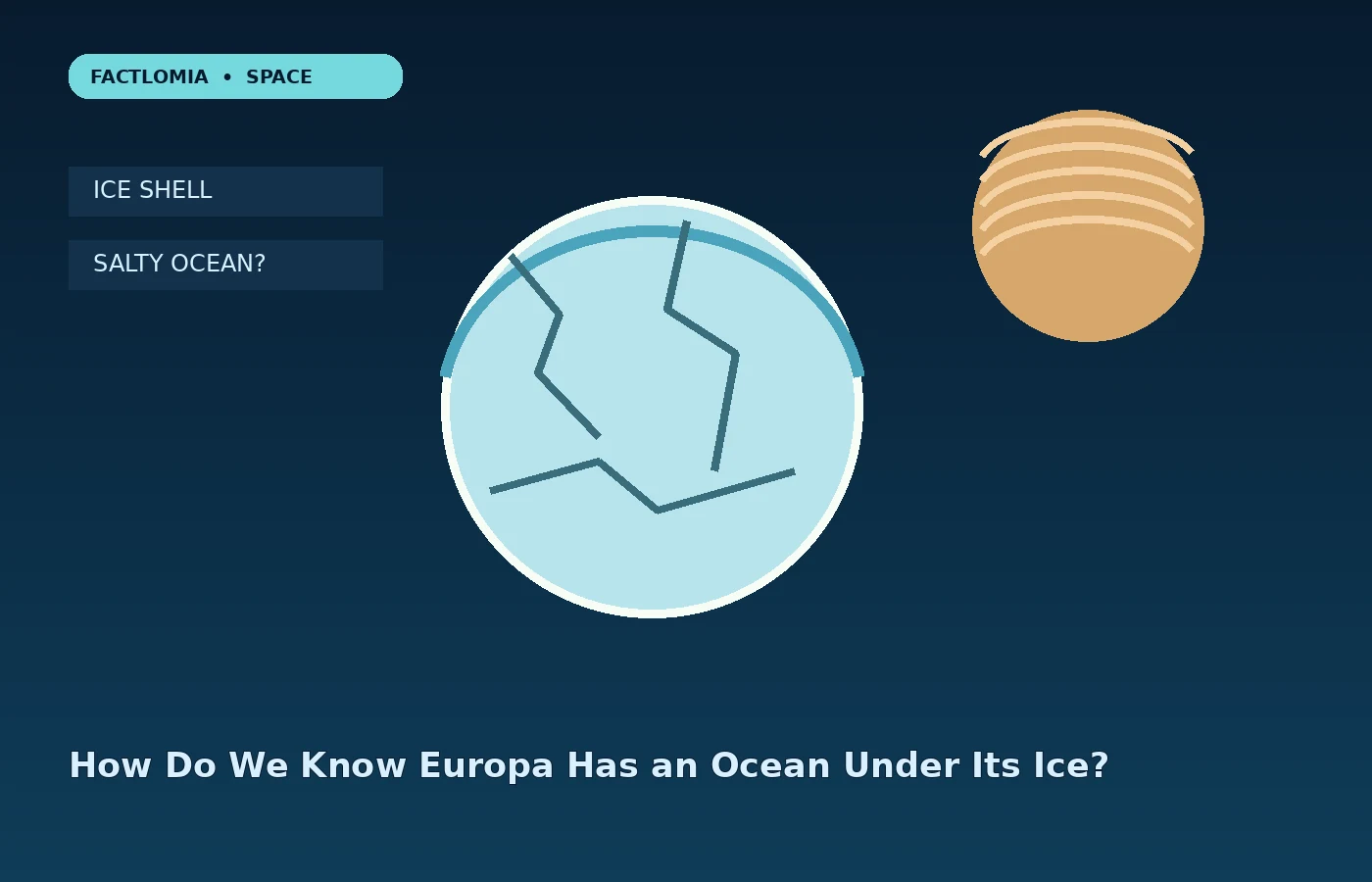
Scientists infer that Jupiter’s moon Europa has a global salty ocean beneath its ice from several clues: a magnetic signal measured by the Galileo spacecraft, a young and fractured surface, and heat generated as Jupiter’s gravity flexes the moon. No spacecraft has directly seen the ocean, so its depth and properties still need confirmation.
A magnetic signal points to salty water
When NASA’s Galileo spacecraft flew past Europa, it measured changes in Jupiter’s magnetic field around the moon. The simplest explanation is that a conductive layer inside Europa responds to Jupiter’s changing field and creates an induced magnetic field. Salty liquid water conducts electricity, making a subsurface ocean a strong candidate. [1] This is an indirect measurement: the magnetometer did not sample the water itself.
Europa’s surface adds another clue. Long cracks, ridges and jumbled blocks suggest that the icy crust has shifted and been renewed. A surface with relatively few large impact craters is also geologically young compared with heavily cratered moons. These features fit a world where internal warmth and a mobile ice shell have altered the landscape. NASA describes the evidence as strong, while noting that a future spacecraft must better characterize the ocean. [2]
Jupiter supplies internal heat
Europa travels around Jupiter on an orbit whose shape is influenced by the gravity of other large moons. As Europa moves closer to and farther from Jupiter, the planet’s powerful gravity squeezes and relaxes the moon. This repeated flexing produces frictional heat inside Europa. Models indicate that tidal heating could help keep water liquid beneath a cold surface.
The ocean is thought to sit under an ice shell perhaps about 15 to 25 kilometers thick, with the water itself potentially tens of kilometers deep. Those figures are estimates, not measurements from a probe that has drilled or sampled the ocean. The depth, salinity and contact between water and rock remain important open questions. For another example of gravity moving ocean water, see how tides work on Earth.
An ocean does not prove there is life
Liquid water is one ingredient that life as we know it needs, but it is not proof that Europa is inhabited. Scientists also look for usable energy and chemical building blocks. Europa’s ocean may interact with rock below, which could supply chemical energy, but the details are uncertain. NASA’s Europa Clipper mission is designed to investigate whether places beneath the ice could support life; it is not a life-detection mission. [3]
Could a spacecraft see the ocean directly? Not with an ordinary camera through kilometers of ice. Instruments can instead measure gravity, magnetic fields, surface composition and radar reflections to constrain what lies beneath. Has the ocean been confirmed by sampling? No. The evidence is compelling but indirect, and the ocean’s exact properties remain to be measured.
What the evidence does—and does not—show
| What is supported | Important limit |
|---|---|
| Europa’s magnetic and surface observations provide strong indirect evidence for an ocean. | The ocean has not been sampled, and evidence for water is not evidence that life has been found. |
This summary draws on the references listed below. Follow the source links for the observations and their context.
Sources and evidence
- NASA — Europa Clipper Mission FAQ ↗
Summarizes the magnetic, geological and compositional evidence, and estimated ice and ocean depths.
- NASA — Europa: Facts ↗
Explains the evidence for a salty subsurface ocean and states that its presence awaits confirmation by a future mission.
- NASA — Europa Clipper Mission Science ↗
Clarifies the mission’s objectives and that it is not designed to detect life directly.
Sources consulted: 29 October 2026. Written with AI assistance and checked against the linked references; not independently reviewed by a subject specialist. Sources do not endorse this article. See our editorial policy.
Revision: New explanatory article distinguishes spacecraft observations from inferred ocean properties and the mission’s limits. Updated 30 October 2026: added an evidence summary and clarified the limits of the explanation; repaired text formatting.