
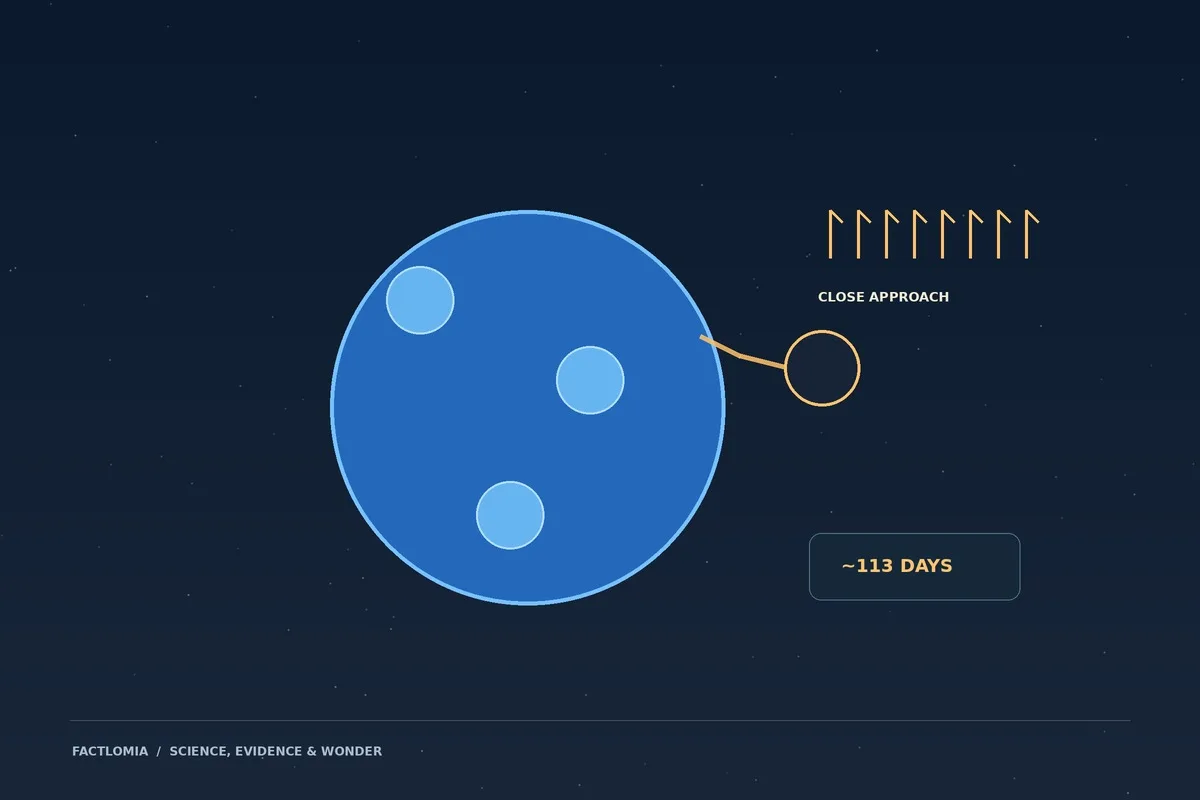
The star AT 2016blu appears to brighten in repeated outbursts about every 113 days. New Chandra X-ray observations support a model in which a hidden compact companion—possibly a neutron star or black hole—pulls material from the massive unstable star as the pair orbit. The interpretation is strong evidence, but the companion’s exact identity is not yet known.
A star that brightens without exploding
AT 2016blu is a luminous blue variable: a massive, unstable star that can undergo dramatic changes in brightness. It has produced repeated outbursts since 2012. Because it survives and brightens again, astronomers call it a “supernova impostor”—a phrase for an event that resembles some features of a supernova but is not the star’s final explosion. [1]
Recent observations found a roughly 113-day rhythm in the outbursts. That regular timing suggested a companion might be involved rather than the star erupting at random.
How a companion could trigger an eruption
In the proposed picture, a compact object follows an elongated orbit around the giant star. As it swings close, it pulls gas from the star. Material falling toward a neutron star or black hole can heat up and emit X-rays, while the interaction may trigger a much brighter optical outburst. [1]
Chandra measured the system at least 100 times brighter in X-rays during the 2026 outburst than in earlier observations from 2001–2002, before the recurring eruptions began. This supports the idea that gas is being pulled toward a compact companion. [2]
What remains uncertain?
The observations do not yet identify the companion as definitively a black hole or a neutron star. Astronomers combine timing, X-rays and changes in brightness to test the model. More observations can help determine the orbit and how the star loses material.
The finding shows how an outburst can reveal an otherwise hidden object: the companion itself may be too faint to see directly, but its gravitational effects and the hot gas around it leave clues.
FAQ: AT 2016blu
Is AT 2016blu a supernova? The recurring events are described as supernova-impostor outbursts; the star has survived them.
Is the companion confirmed to be a black hole? No. Current evidence points to a compact companion that may be a black hole or neutron star.
Sources and evidence
- NASA Chandra — Finds Source of Star’s Mysterious Outbursts ↗
NASA’s interpretation of the recurring outbursts and possible compact companion.
- Chandra X-ray Center — AT 2016blu press release ↗
113-day recurrence, X-ray observations and the uncertainty around the companion.
Sources consulted: 11 November 2026. Written with AI assistance and checked against the linked references; not independently reviewed by a subject specialist. Sources do not endorse this article. See our editorial policy.
Revision: Initial publication. Current claims and limits were checked against the linked research and institutional sources.