
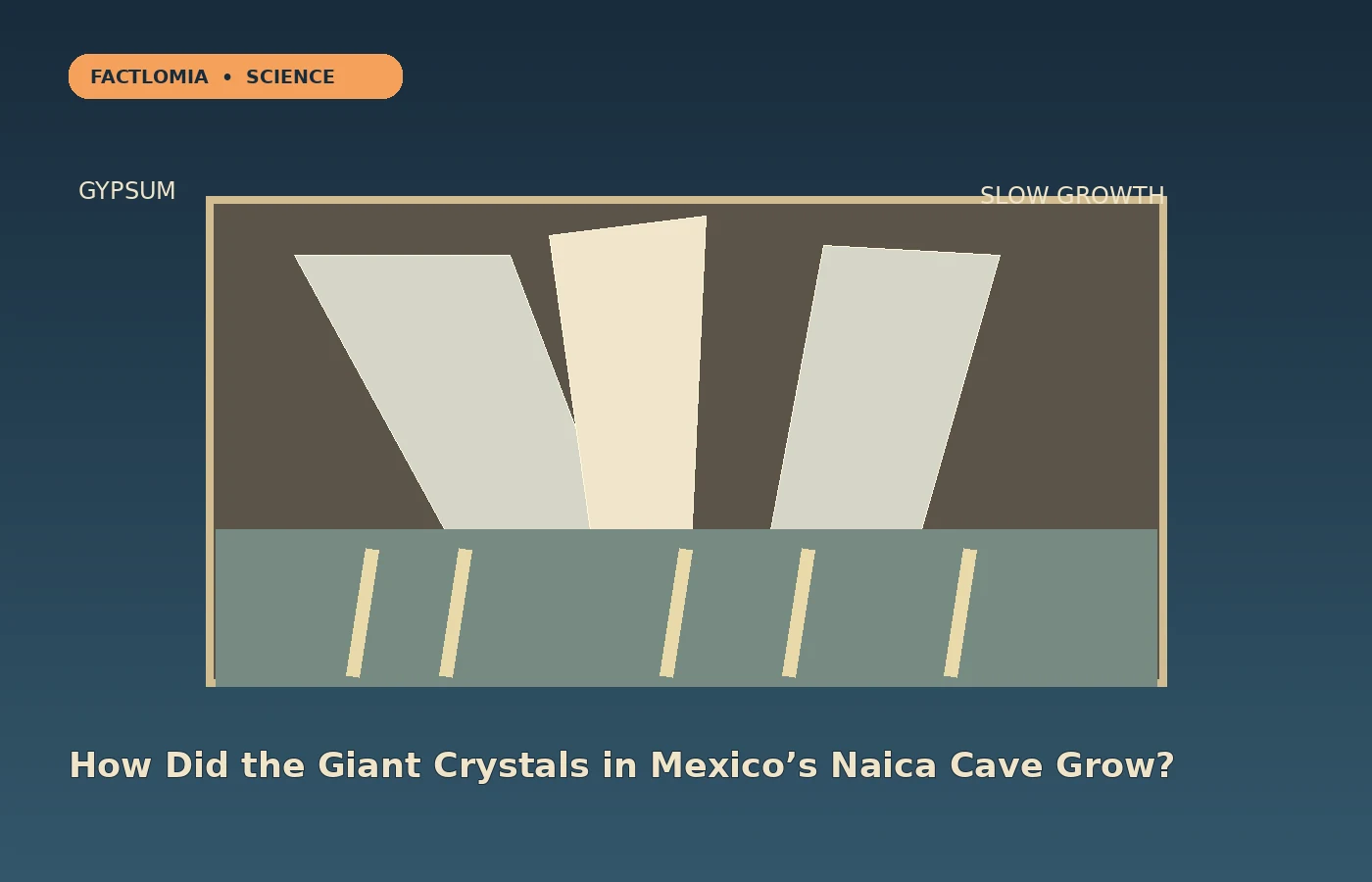
The giant crystals in Naica, Mexico, are gypsum crystals that grew while a flooded cave remained warm and supplied with dissolved minerals. For a long period, the water conditions were close to the range where gypsum could slowly grow without dissolving. Because relatively few crystals began growing, those that did had room to reach extraordinary sizes.
A cave filled with mineral-rich water
The Cave of Crystals lies deep inside the Naica mine in Chihuahua, Mexico. Its crystals are gypsum, a mineral made from calcium sulfate and water. Groundwater circulated through the cave and carried dissolved mineral ingredients. As conditions shifted slightly toward crystal growth, gypsum accumulated on existing crystal surfaces over a long interval.
Researchers describe the formation as a near-equilibrium process: the water was only slightly supersaturated with gypsum, so crystals grew very slowly rather than forming rapidly. A review in Chemical Society Reviews describes crystals more than 11 meters long, while later studies discuss examples approaching 12 meters. [1]
Why only a few crystals became so large
Crystal size depends on both time and competition. If many crystals begin forming, the available dissolved material is divided among more growing surfaces. In Naica’s deepest cave, the number of nuclei was limited and the water cooled extremely slowly, allowing a smaller set of crystals to keep growing for thousands of years. Studies comparing caves in the Naica mine point to temperature and slow cooling as important differences between giant crystals and smaller ones. [2]
The result is not a single perfect recipe that can be reproduced anywhere. The cave’s geology, water chemistry, temperature stability and long history all mattered. The crystals did not grow to room-sized proportions overnight; the process was exceptionally gradual.
Why the cave is difficult to visit
The cave’s natural environment is dangerously hot and humid, which can quickly overwhelm a person without specialized protection. Mining operations drained water from the chambers, making them accessible for a time, but exposing the crystals to changed conditions also raises preservation concerns. The cave is not an ordinary tourist cave, and the large crystals are fragile geological formations.
Are the crystals made of quartz? No. The famous Naica beams are gypsum, specifically its large-crystal variety often called selenite. Did they grow because the cave was cold? The key was long-term, stable warm water and slow cooling, not a cold cave. See how cave formations such as stalactites and stalagmites grow for another mineral-water process.
What the evidence does—and does not—show
| What is supported | Important limit |
|---|---|
| Naica’s giant crystals are gypsum that grew slowly in mineral-rich water. | Crystal growth depends on the history of temperature and water chemistry; a single age estimate needs context. |
This summary draws on the references listed below. Follow the source links for the observations and their context.
Sources and evidence
- Royal Society of Chemistry — Nucleation and Growth of the Naica Giant Gypsum Crystals ↗
Review of the crystal chemistry and slow, near-equilibrium growth at Naica.
- ACS Central Science — Naica’s Crystal Cave Captivates Chemists ↗
Explains why slow cooling and fewer nuclei allowed crystals in the deeper cave to grow larger.
- PubMed — Nucleation and Growth of the Naica Giant Gypsum Crystals ↗
Bibliographic record and abstract for the peer-reviewed review article.
Sources consulted: 29 October 2026. Written with AI assistance and checked against the linked references; not independently reviewed by a subject specialist. Sources do not endorse this article. See our editorial policy.
Revision: New geology explainer distinguishes the actual gypsum mineral and slow-growth conditions from popular exaggerations. Updated 30 October 2026: added an evidence summary and clarified the limits of the explanation; repaired text formatting.