
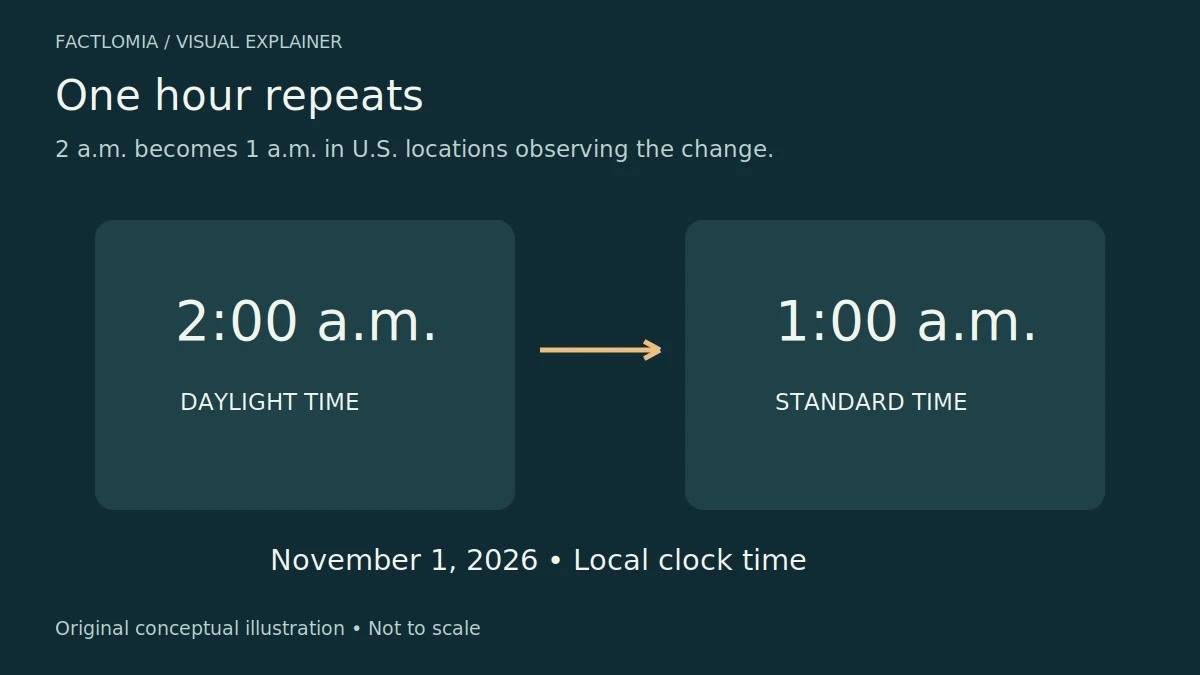
Clocks fall back to end daylight saving time and return to standard time. In U.S. areas that observe the change, 2 a.m. becomes 1 a.m. on November 1, 2026. The clock repeats an hour; Earth does not slow down or produce extra sunlight.
What happens on November 1, 2026?
At 2 a.m. local daylight time, participating U.S. locations turn clocks back to 1 a.m. The hour from 1:00 to 1:59 occurs twice. NIST lists November 1 as the end of the 2026 daylight saving period. This is a local clock transition, not one simultaneous worldwide event. [1]
Why change the clock at all?
Daylight saving time shifts clock labels relative to the Sun so that more daylight falls in the evening during part of the year. Returning to standard time reverses that shift. It moves an hour of clock-referenced daylight toward the morning, without changing the interval between sunrise and sunset. [1]
Do we gain an hour of daylight?
No. The repeated hour makes the transition day longer on the civil clock, but does not lengthen daylight. If a sunset was near 6 p.m. before the change, the same solar event is labeled roughly 5 p.m. afterward, apart from the ordinary day-to-day seasonal difference. [2]
Does every place change its clocks?
No. The rule applies to places observing U.S. daylight saving time; it should not be treated as a global instruction. Check your location rather than copying a date from another country. For travel or scheduled calls, include the city and time zone, especially during the repeated hour. [2]
What should you remember?
“Fall back” means turn the clock backward. The astronomical day and the labels on a clock are different concepts. To explore a physical process that really affects timekeeping signals, read how GPS finds your location.
Sources and evidence
- NIST — Daylight Saving Time Rules ↗
Official U.S. transition rule and 2026 dates.
- timeanddate — USA and Canada End Daylight Saving 2026 ↗
Dated October 2026 explainer of the upcoming clock change.
Sources consulted: 31 October 2026. Written with AI assistance and checked against the linked references; not independently reviewed by a subject specialist. Sources do not endorse this article. See our editorial policy.
Revision: Initial publication. Checked against cited references; dated event information is identified in the text and uncertainties are stated.