
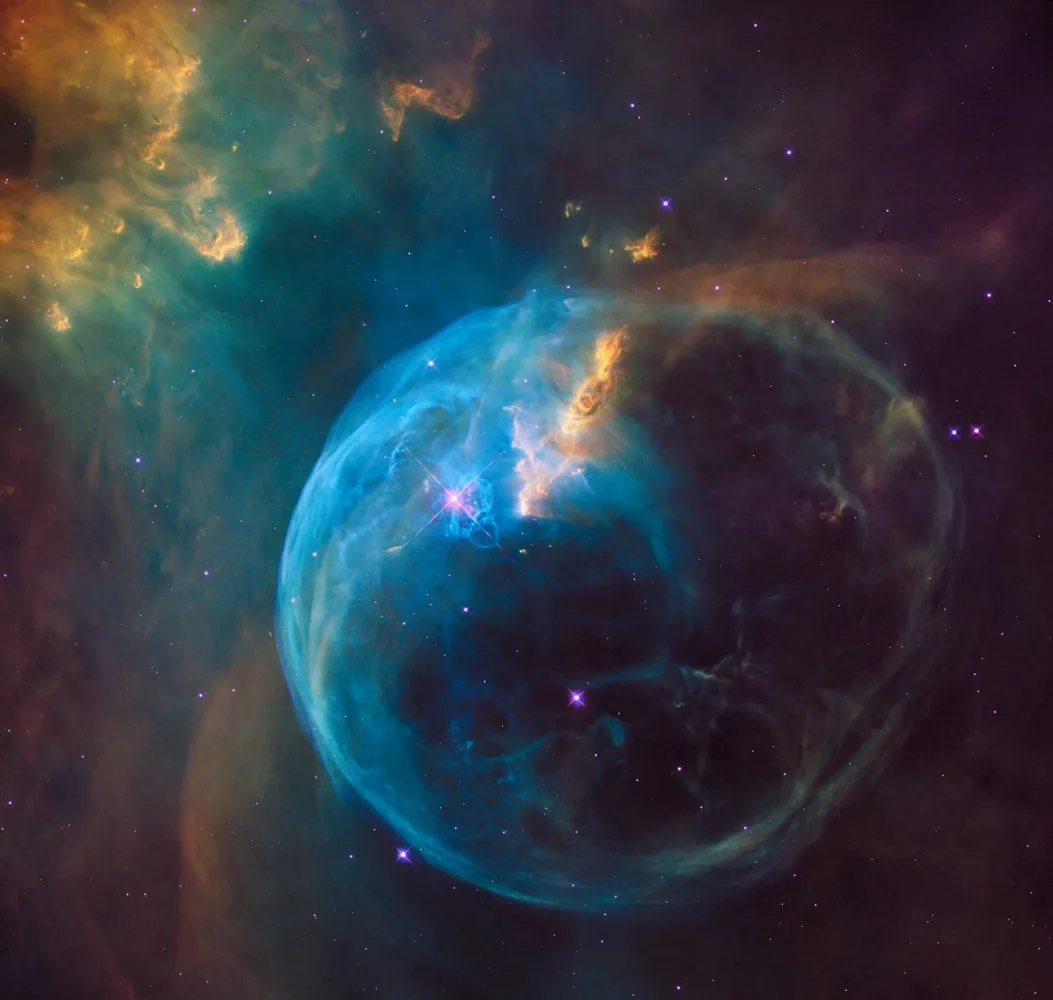
A black hole bends light because its mass curves spacetime. Light follows the straightest possible path through that curved geometry, so its route appears deflected to a distant observer.
Gravity is geometry
In general relativity, mass and energy change the geometry of spacetime. Light always travels along a null path, but the path can curve when spacetime itself is curved. This is why a beam can be deflected without having rest mass.
The effect exists around any massive object, but it becomes dramatic near a black hole because matter is concentrated into a compact region.
Lensing creates distorted views
A black hole between a distant source and an observer can magnify, duplicate or stretch the source’s image. If alignment is close enough, the light can form a ring-like pattern called an Einstein ring.
Not every black hole produces a visible ring. The geometry, distance, alignment and brightness of the background source determine what an instrument can detect.
The event horizon is not a glowing surface
Light that crosses the event horizon cannot return to the outside universe. The bending seen from far away is caused by curved spacetime outside the horizon, while hot gas in an accretion disk can shine around the dark central region.
A black hole is therefore not a cosmic vacuum cleaner. Its gravitational influence follows the same rules as other masses at comparable distances.
A gravity assist uses the same idea
Spacecraft missions can use a planet’s gravity to bend a trajectory and exchange a small amount of energy with the planet’s motion. A black hole bends light through the same geometric principle at much stronger intensity. The comparison is limited, but both show that gravity changes paths rather than merely pulling objects in a straight line.
Sources and evidence
- NASA — What are black holes? ↗
Spacetime curvature, event horizons and black-hole observations.
- European Space Agency — Gravitational lensing ↗
How gravity deflects and magnifies light.
Sources consulted: 9 October 2026. Written with AI assistance and checked against the linked references; not independently reviewed by a subject specialist. Sources do not endorse this article. See our editorial policy.
Revision: Separated gravitational lensing outside the horizon from light that cannot escape. Added a subject-specific example or limitation to strengthen reader value.