
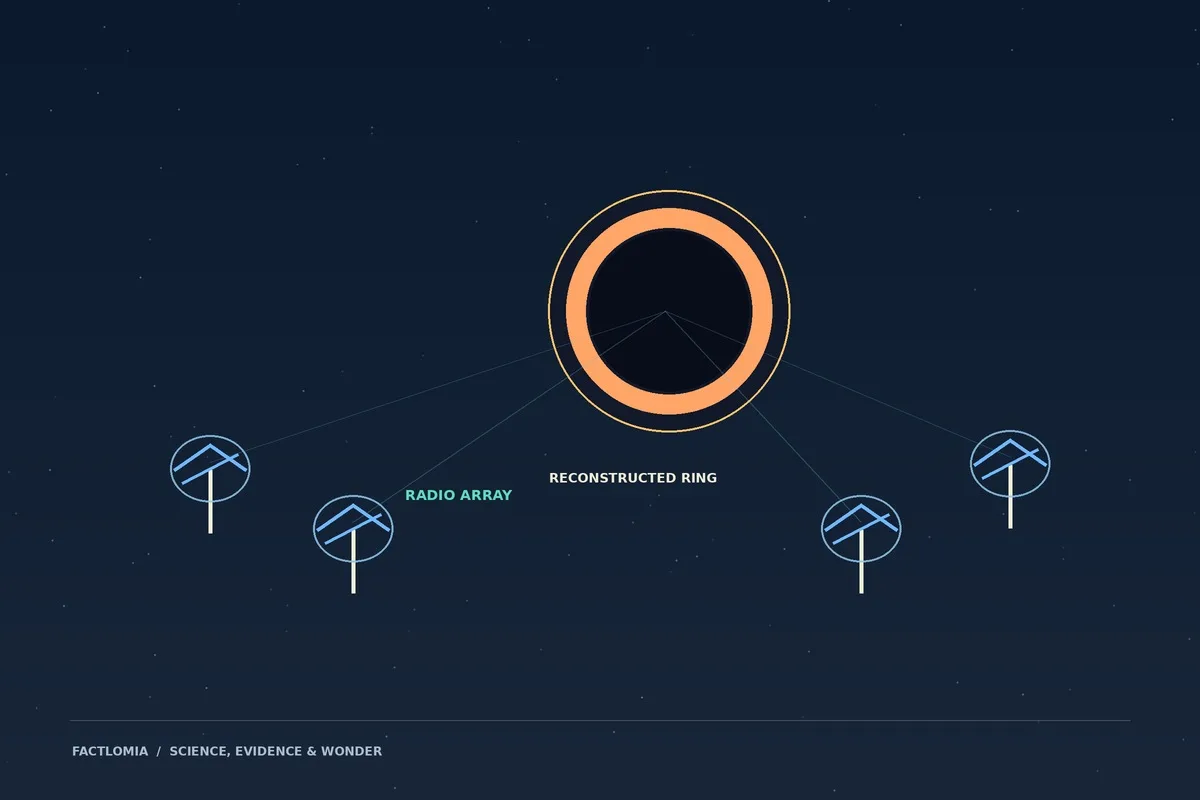
The Event Horizon Telescope does not take a black hole snapshot with a single camera. It combines radio measurements from observatories around Earth and uses computational methods to reconstruct the glowing material around a black hole’s shadow. A new independent analysis of the 2017 M87* data recovered the familiar ring using a different approach, strengthening confidence that the main feature is real.
An Earth-sized radio telescope
The Event Horizon Telescope links radio observatories across the planet using very-long-baseline interferometry. Each station records signals from the same target; precise timing lets astronomers compare the data as if the array were one enormous telescope. The array’s effective resolution is far finer than any single dish can achieve.
Why the result must be reconstructed
The network does not record a complete picture pixel by pixel. It samples only part of the information needed to form an image, and measurements contain noise and calibration uncertainty. Algorithms combine the observations with mathematical constraints to estimate a plausible brightness pattern. Different reconstruction choices can affect fine details, so teams test whether important features survive alternate analyses.
The 2019 image of M87* showed a bright, asymmetric ring around a darker center, the black hole’s shadow against hot gas. The ring is emission from material near the black hole, not light escaping from inside the event horizon. [1]
What the new analysis adds
A paper published in Nature on November 11, 2026, reanalyzed the 2017 observations using an independent interferometric observable and reconstruction strategy. The authors recovered the ring-like structure and reported a diameter consistent with the earlier image. That is a reproducibility check: a central result remains when researchers analyze the data in a different way. [2]
It does not mean every pixel or physical interpretation is settled. The team notes that resolving the finer photon-ring structure and measuring properties such as spin will require future observations with greater capability.
FAQ: the black hole image
Is the image a photograph of the event horizon? It is a reconstructed radio image of emission around the black hole and its shadow, not a visible-light photograph of the horizon itself.
Does reanalysis prove every detail of the original image? It strengthens confidence in the ring feature; smaller details and physical parameters remain subjects of research.
Sources and evidence
- Nature — Independent interferometric observable confirms black hole shadow in M87* ↗
Independent 2026 analysis of M87* and its reconstruction results.
- Event Horizon Telescope — First M87 results: Imaging the Central Supermassive Black Hole ↗
Original imaging method and the reported ring feature.
Sources consulted: 11 November 2026. Written with AI assistance and checked against the linked references; not independently reviewed by a subject specialist. Sources do not endorse this article. See our editorial policy.
Revision: Initial publication. Current claims and limits were checked against the linked research and institutional sources.