
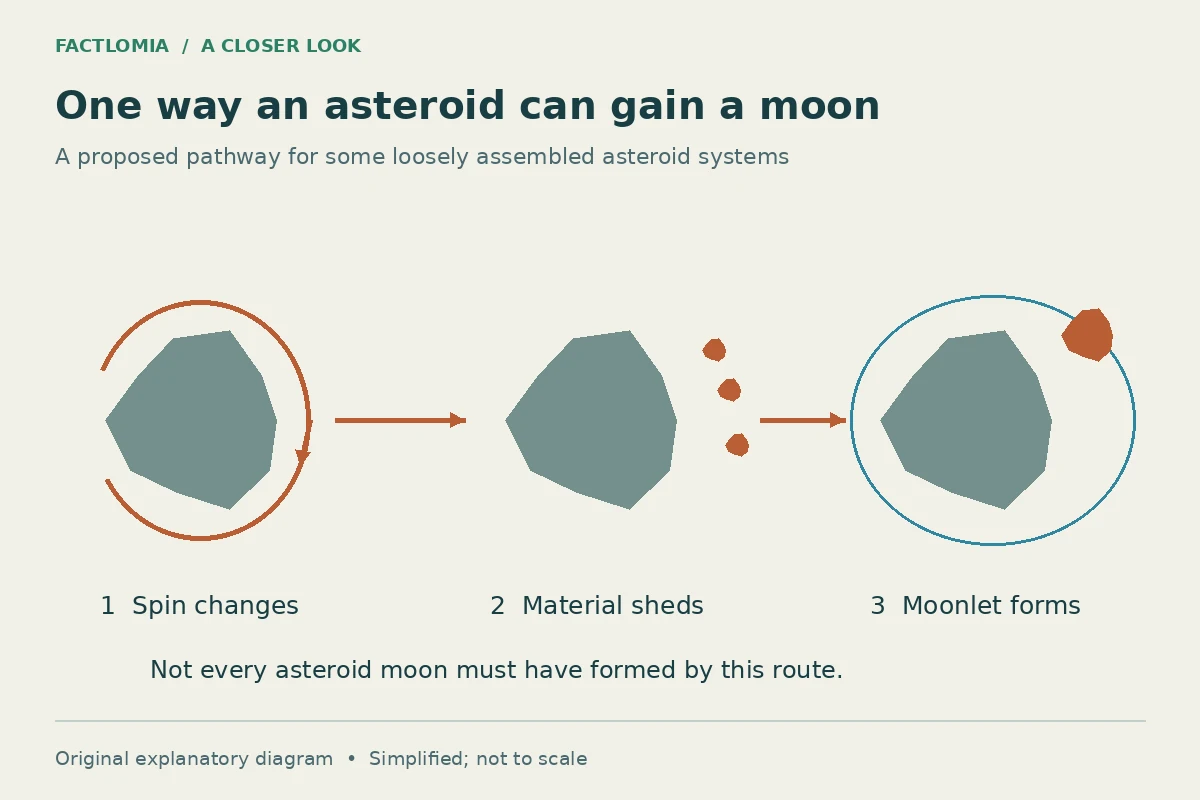
Asteroid moons can form through more than one process. For some small, loosely assembled asteroids, a leading explanation is that rapid rotation sheds material that gathers into an orbiting companion. Sunlight can slowly change an irregular asteroid’s spin, helping set up that process.
A moon does not require a planet
A natural satellite can orbit a small body as well as a planet. Didymos and its companion Dimorphos form a binary asteroid system: both move around their shared center of mass. Calling the smaller object a moonlet describes its relationship to the larger one, not a requirement that it be spherical or geologically active. [1]
How sunlight can change rotation
An irregular asteroid absorbs sunlight and re-emits thermal radiation. Because the shape and surface are not perfectly symmetric, the resulting forces can produce a torque, gradually changing rotation. This is the YORP effect. It differs from the related Yarkovsky effect, which concerns changes in an asteroid’s orbital motion. Sunlight is weak at any instant, but its influence can accumulate over long periods. [2]
From fast spin to a small companion
For a rubble-pile asteroid, rapid spinning can move material toward the equator and eventually shed it. Some escaping material may remain gravitationally associated and assemble into a companion. NASA describes rotational fission as a plausible origin for the Didymos system. That is a formation interpretation supported by its properties, not a film of the original event. [1]
Does every asteroid moon form this way?
No single pathway should be assumed for every system. Collisions and gravitational interactions can also be important in small-body evolution, and NASA notes that the range of binary-asteroid formation processes remains uncertain. An orbit or a spinning-top shape is evidence to test a model, not a unique birth certificate. For the broader orbital principle, see how satellites stay in orbit.
Sources and evidence
- NASA — Didymos and Dimorphos ↗
Binary system, rubble-pile structure, and proposed rotational-fission origin.
- NASA — How the Sun Affects Asteroids ↗
Distinction between sunlight-related YORP torque and Yarkovsky orbital effects.
Sources consulted: 2026-10-21. Written with AI assistance and checked against the linked references; not independently reviewed by a subject specialist. Sources do not endorse this article. See our editorial policy.
Revision: First published 21 October 2026. Source-linked explanation and original diagram.