
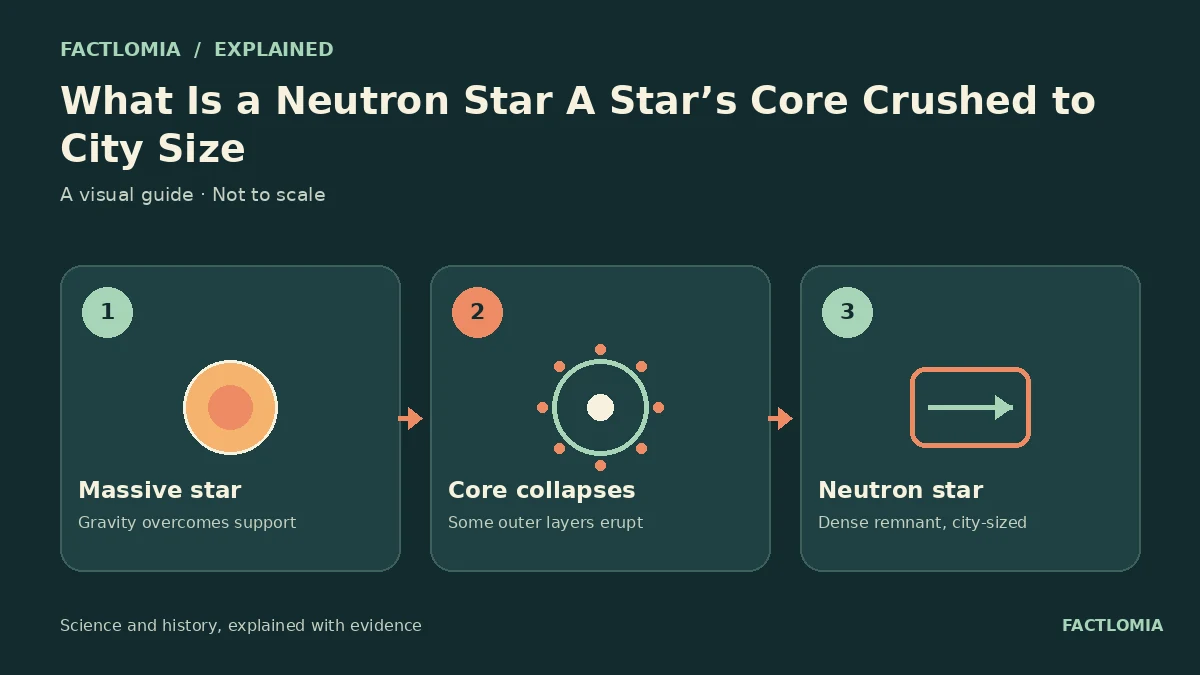
A neutron star is the compact core left behind after some massive stars explode as supernovas. It can pack more mass than the Sun into a sphere roughly the size of a city. The collapse forces matter into an extreme state, making neutron stars among the densest objects astronomers can observe.
How a stellar core becomes a neutron star
When a massive star runs low on the fuel that supports it, its core can collapse under gravity. The outer layers may blast outward in a supernova. If the core that remains is within a certain range of mass, the collapse can leave a neutron star; a heavier remnant may continue collapsing into a black hole. The exact outcome depends on the star and its core, so not every supernova makes a neutron star. [1]
Matter under extraordinary pressure
The remnant is typically only about 20 kilometres across, yet it can contain more mass than the Sun. Gravity squeezes atoms so tightly that ordinary atomic structure cannot remain intact. Much of the material is expected to be neutron-rich, although the precise interior layers are still an active research subject. A teaspoon-sized comparison is memorable, but its implied weight depends on assumptions about the star’s density and should not be treated as a measured scoop. [2]
Pulsars make the invisible visible
Some neutron stars rotate rapidly and send beams of radiation from near their magnetic poles. If a beam sweeps past Earth like a lighthouse, telescopes register regular pulses: the star is then called a pulsar. Other neutron stars are detected through X-rays, gravitational effects on a companion, or radiation produced as matter falls onto them. [3]
Frequently asked questions
Is a neutron star the same as a black hole?
No. A neutron star has a compact surface and is supported by the physics of dense matter. A black hole has collapsed beyond the point from which light can escape.
Are all neutron stars pulsars?
No. Pulsar describes neutron stars whose beams sweep past our line of sight and are detected as pulses; orientation and activity affect what we observe.
Can a neutron star be seen with the naked eye?
Typically not. Astronomers detect neutron stars with telescopes that observe radio, X-ray, optical, or other signals.
Sources and evidence
- NASA — Neutron Stars ↗
Overview of neutron-star formation and current NASA research.
- NASA Imagine the Universe! — Neutron Stars ↗
Explains neutron-star properties, pulsars, and magnetars.
- NASA HEASARC — Internal Structure of a Neutron Star ↗
Background on the imploded stellar core and dense matter.
Sources consulted: 4 November 2026. Written with AI assistance and checked against the linked references; not independently reviewed by a subject specialist. Sources do not endorse this article. See our editorial policy.
Revision: New explainer; distinguishes neutron stars from black holes and marks uncertain interior details.