
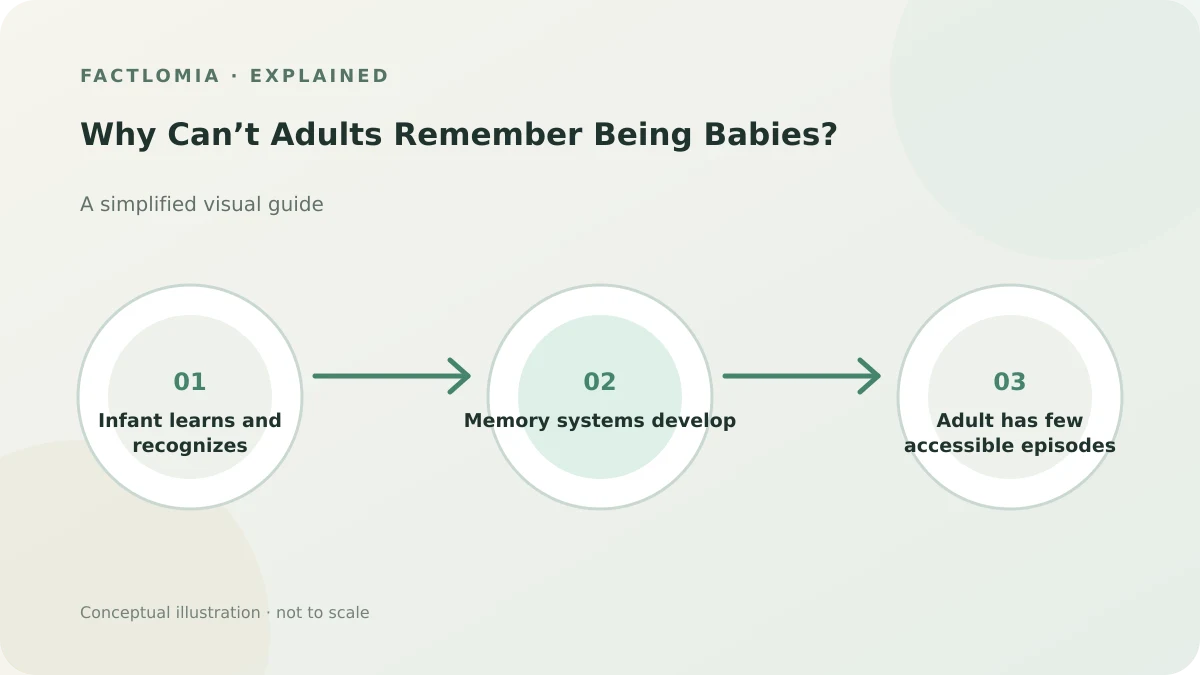
Most adults cannot recall events from their earliest years because autobiographical memory—the ability to store and later retrieve personal episodes—changes as the brain and language develop. Infants can learn and recognize familiar things, but that does not mean their experiences will remain accessible as adult memories.
Early learning is not the same as adult-style recall
Babies can learn, recognize caregivers and form expectations. Those abilities are different from remembering a specific event years later with a sense of when and where it happened. Childhood amnesia describes the scarcity of adults’ autobiographical memories from infancy and the first few years of life. [1]
Memory systems and language are still developing
Researchers study how brain systems involved in episodic memory develop, including the hippocampus and connected networks. Children can report earlier memories than adults, suggesting that the boundary of childhood amnesia shifts as people grow. Language, a developing sense of self and changes in how memories are organized may also contribute. No single explanation accounts for every lost early memory. [2]
Why a family story can feel like a memory
Photographs and repeated stories can help someone imagine an event, but an image or family account is not the same as an independently recalled episode. Over time, people may remember the story or picture rather than the original experience. That does not mean the event did not happen; it means later recall has limits.
For another question about memory and perception, read why time can seem to pass faster with age.
Frequently asked questions
At what age do most people’s earliest memories begin?
Many adults report few memories from before roughly age three, but the boundary varies and is not a universal cutoff.
Can babies form memories?
Yes. Learning and recognition happen in infancy, even though adult autobiographical recall of those experiences is usually limited.
Are memories before age three always false?
Not necessarily. Some people report early memories, but photographs and family stories can also shape what feels familiar. Researchers assess memories carefully rather than assuming all are false.
Sources and evidence
- Psychological Science — Defining the Boundary: Age-Related Changes in Childhood Amnesia ↗
Evidence that children and adolescents report earlier memories than adults, with the boundary shifting through development.
- NIH RePORTER — Episodic Memory Development and Infantile Amnesia ↗
Role of hippocampal development and episodic memory in early childhood recollection.
Sources consulted: 1 November 2026. Written with AI assistance and checked against the linked references; not independently reviewed by a subject specialist. Sources do not endorse this article. See our editorial policy.
Revision: Initial publication. Claims and uncertainty checked against the cited references.