
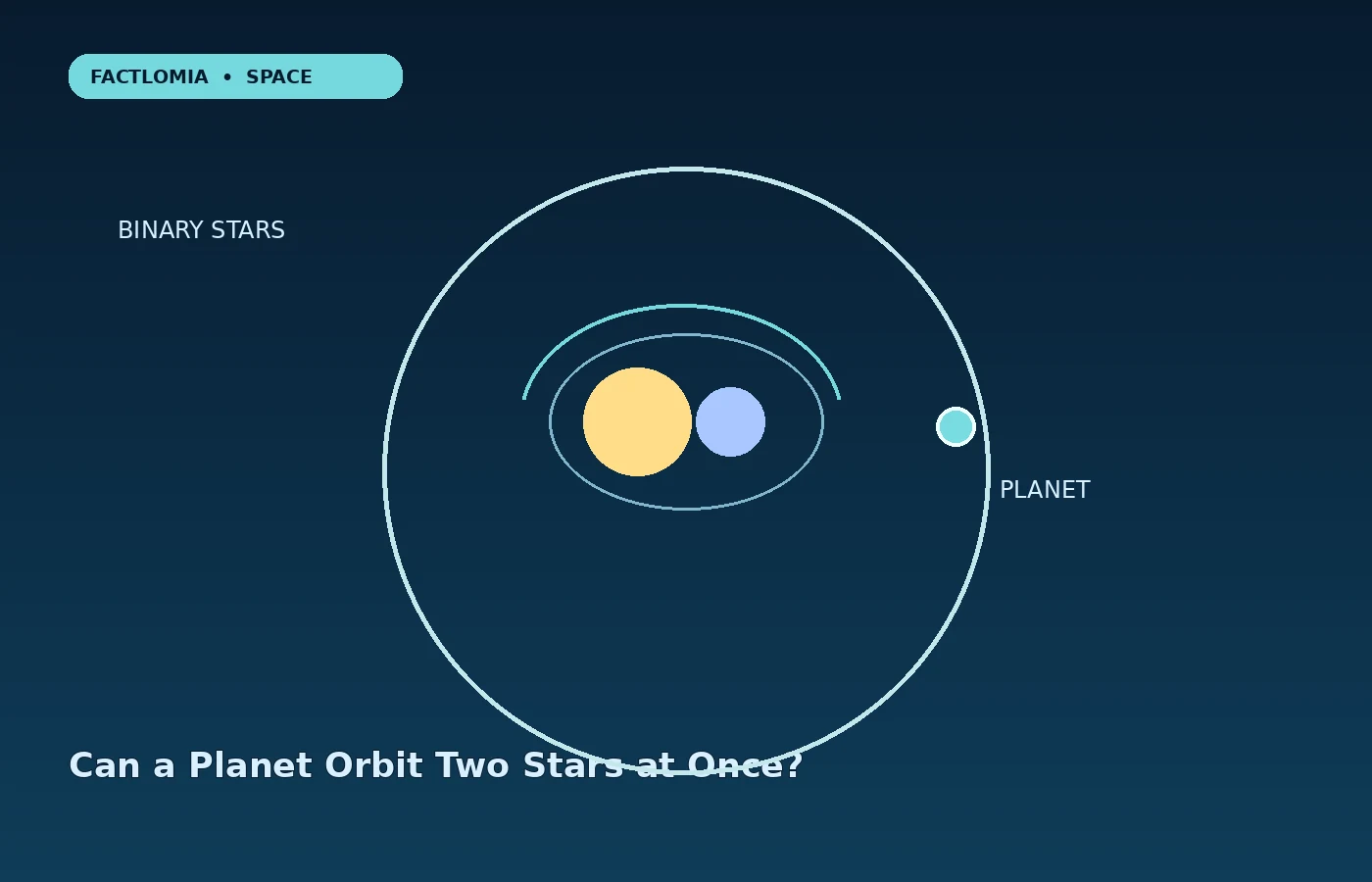
Yes. A planet can orbit two stars that themselves orbit each other. These worlds are called circumbinary planets. Astronomers detect some when a planet crosses the face of one or both stars and causes a small dip in the system’s brightness; because the stars move too, the transits can arrive at irregular intervals.
The two stars orbit each other, and the planet circles both
In a binary-star system, two stars revolve around a shared center of mass. A circumbinary planet follows a wider orbit around the pair, rather than circling just one star. From the planet’s position, both stars could appear in its sky, though the actual view would depend on the system’s geometry.
NASA’s Kepler mission confirmed Kepler-16b, a planet orbiting two stars, and later found other circumbinary systems. These planets are real, but many are gas giants with no solid surface where a person could stand. [1]
Changing starlight gives astronomers a clue
Kepler and other planet-hunting telescopes measure the brightness of stars over time. When a planet passes in front of a star, it blocks a small amount of light: an event called a transit. In a circumbinary system, the stars are moving around each other while the planet orbits the pair, so a transit may occur at an uneven interval and its timing can shift.
Astronomers can also observe eclipses between the two stars. When the planet’s gravitational pull subtly changes the stars’ motions, that can help constrain the planet’s mass and orbit. NASA describes how unusual patterns of eclipses and transits revealed planets in systems with two suns. [2]
A double sunset is possible, but habitability is not guaranteed
A planet in a stable orbit around two stars could receive light from both, creating the possibility of two shadows or sunsets. But a double-star sky does not make a planet Earth-like. Some known circumbinary planets are gas giants, and their distance from the stars, atmosphere and radiation environment matter for habitability.
Would the planet’s orbit be chaotic? Not necessarily. Stable circumbinary orbits exist beyond a critical distance from the pair, and astronomers have observed planets in them. Can two stars make two separate “years”? The stars orbit each other on one timescale while the planet completes its wider orbit on another. For more on how scientists find worlds beyond our solar system, see the main exoplanet detection methods.
What the evidence does—and does not—show
| What is supported | Important limit |
|---|---|
| Observed planets can orbit a pair of stars. Kepler-16b is one documented example. | Two stars do not by themselves make a world habitable; many known examples are gas giants. |
This summary draws on the references listed below. Follow the source links for the observations and their context.
Sources and evidence
- NASA — Kepler-16 b: (Almost) a Real-Life Tatooine ↗
Describes a confirmed planet orbiting two stars and clarifies what the planet is like.
- NASA — Discovering Circumbinary Star Systems ↗
Explains how transits and irregular timing reveal planets around binary stars.
- International Astronomical Union — Kepler Discovers Planetary System Orbiting Two Suns ↗
Summarizes the detection of a multi-planet circumbinary system using transits.
Sources consulted: 29 October 2026. Written with AI assistance and checked against the linked references; not independently reviewed by a subject specialist. Sources do not endorse this article. See our editorial policy.
Revision: New space explainer defines circumbinary orbits and separates orbital stability from habitability. Updated 30 October 2026: added an evidence summary and clarified the limits of the explanation; repaired text formatting.