
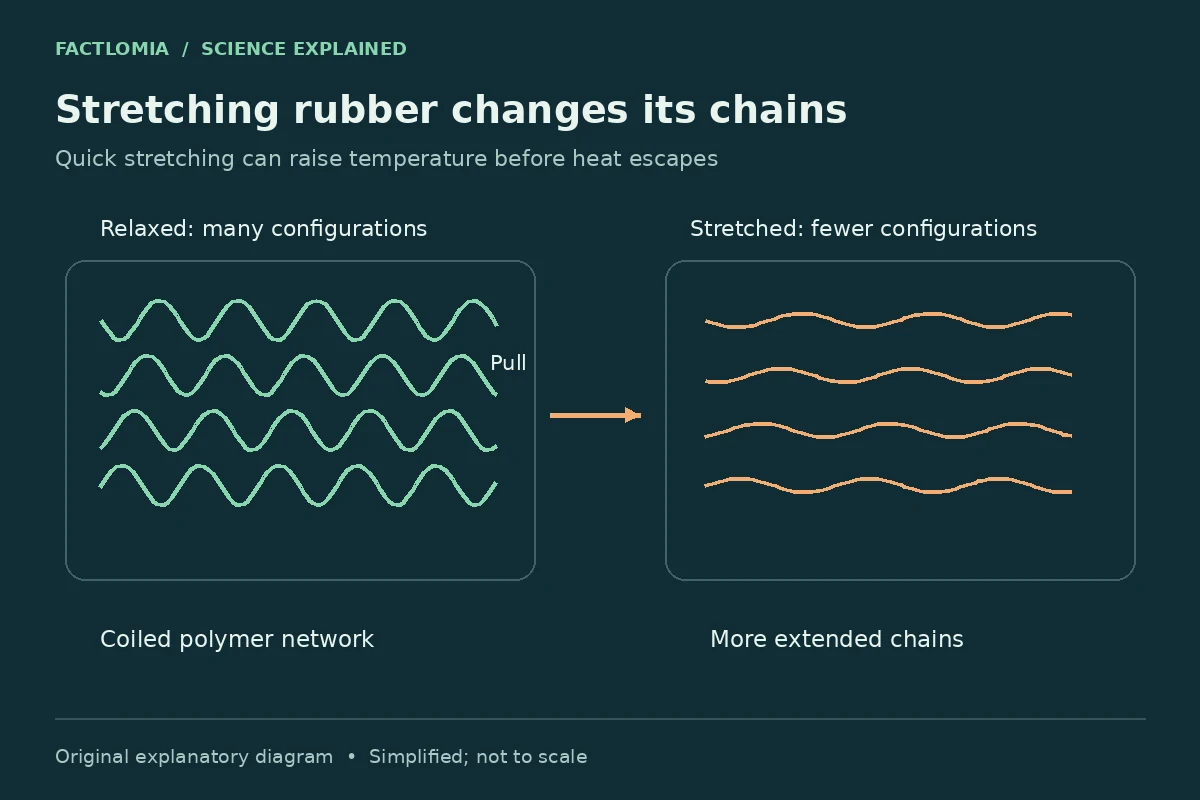
A rubber band can warm when stretched quickly because pulling it changes the arrangement of its long polymer chains while you do work on it. During a rapid stretch, little heat escapes, so its temperature can rise. Letting an equilibrated stretched band relax quickly can cool it.
Rubber is a network of flexible chains
In relaxed rubber, connected polymer chains can adopt many coiled configurations. Stretching favors more extended configurations along the pull, reducing the number of arrangements available to the chains. This is a decrease in configurational entropy. It is a statistical description of possible arrangements, not a claim that the material becomes a perfectly ordered crystal. [1], [2]
Why a quick pull differs from a slow one
Your hands supply work when they pull the band. If stretching is fast compared with heat exchange, the temperature change remains noticeable for a short time. During slow stretching, heat has more time to pass into the surroundings, so the band may stay close to room temperature even though its chain configuration changes. Temperature and heat transfer are related but are not interchangeable measurements. [1], [3]
Why relaxation can feel cool
Hold a stretched band until it exchanges heat with the room, then reduce the tension rapidly. Its chains can access more configurations, and the band can cool below its starting room temperature. The order of these steps matters: stretching, waiting, and releasing describe a small thermodynamic cycle rather than friction between a band and your fingers. [2], [3]
What this explanation leaves out
The chain picture explains a major part of ordinary rubber elasticity. Real bands also contain additives, dissipate energy, and can behave differently under extreme extension or repeated loading. Do not expect every band to show the same temperature rise. For a different example of energy transfer, read why metal feels colder than wood.
Sources and evidence
- University of Washington — Entropy of a Rubber Band ↗
Polymer arrangement and heat exchange during stretching.
- University of Colorado Boulder — Stretching Rubber Bands ↗
Warming during rapid stretching and cooling after relaxation.
- Brzinski and Daniels — Stretching Rubber, Stretching Minds ↗
Teaching laboratory distinguishing rapid and quasistatic processes.
Sources consulted: 2026-10-21. Written with AI assistance and checked against the linked references; not independently reviewed by a subject specialist. Sources do not endorse this article. See our editorial policy.
Revision: First published 21 October 2026. Original explanatory diagram and source-linked text.