
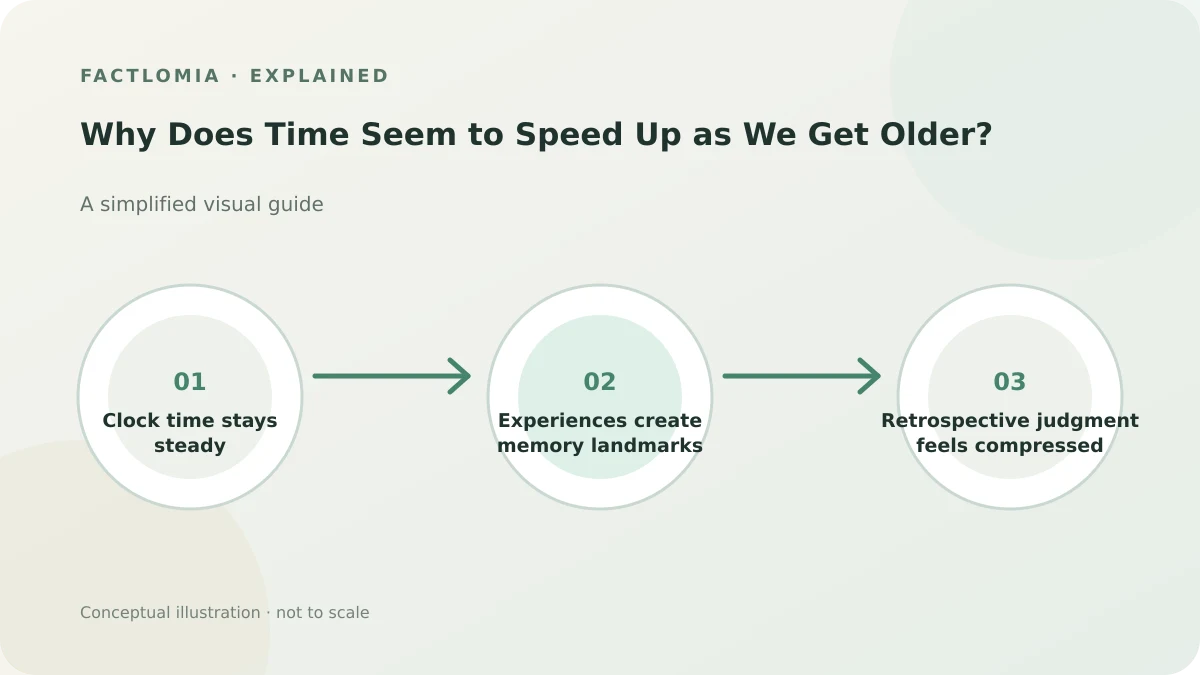
Time does not literally speed up as people age. Many people report that years seem to pass faster in retrospect, but research does not support one simple cause. Routine, memory density, attention, emotional meaning and the standards people compare against may all influence that judgment.
A remembered year is not a clock measurement
People can judge how fast a period felt while it was happening or how quickly it seems to have passed when looking back. These are different judgments. The common feeling that a decade seemed short in retrospect is not evidence that the brain’s clock or physical time has accelerated. [1]
Routine may leave fewer distinct landmarks
One explanation is that familiar routines produce fewer distinctive memories than periods filled with new events. When people look backward, a stretch with fewer memorable landmarks may seem compressed. Studies have found links between remembered routine and judgments of time, but the evidence does not show that routine is the only or universal cause. [2]
Meaning and attention can also shape the feeling
Recent reviews describe several interacting accounts, including memory structure, attention, personal growth and emotional meaning. A busy, enjoyable period can feel fast while it is happening but seem rich when remembered. A quiet period can feel slow in the moment yet leave few landmarks in hindsight. The judgment depends on what question a person is answering and what they compare the period with.
For a related memory question, see why adults remember little from infancy.
Frequently asked questions
Does time objectively move faster as we age?
No. The feeling is subjective; clocks and physical time do not accelerate because a person grows older.
Is routine proven to be the cause?
No single explanation is settled. Routine and fewer distinct memories may contribute, but research finds a more complex picture.
Why do childhood summers feel so long?
Novel experiences and the way memory organizes periods may create more distinct landmarks, but this is one possible contribution rather than a complete explanation.
Sources and evidence
- Frontiers in Psychology — The Time of Your Life: Mapping the Mechanisms Behind Life Tempo Judgments ↗
Recent review of memory, routine, attention, meaning and competing accounts of perceived life tempo.
- Personality and Social Psychology Bulletin — Why Life Moves Fast ↗
Exploratory studies showing mixed evidence for routine and growth explanations of retrospective time judgments.
Sources consulted: 1 November 2026. Written with AI assistance and checked against the linked references; not independently reviewed by a subject specialist. Sources do not endorse this article. See our editorial policy.
Revision: Initial publication. Claims and uncertainty checked against the cited references.