
Icicles grow when liquid water drips from an overhanging surface into freezing air. Some of the water freezes onto the existing ice as it flows downward, while droplets at the tip can extend the icicle. The growing shape depends on the water supply and how quickly heat can escape to the surrounding air.
Where the liquid water comes from
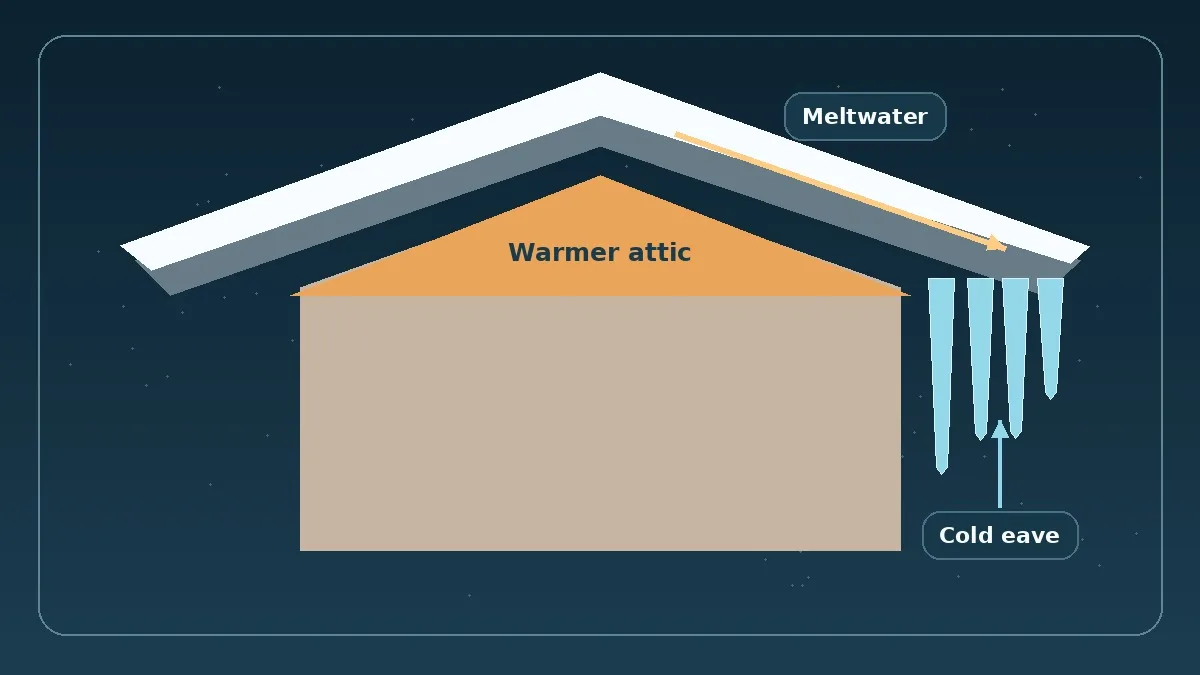
Even when outdoor air is below freezing, snow can melt on a roof that is warmed from below. Water travels toward a colder eave and begins freezing as it leaves the edge. Other icicles can grow where water seeps from rock or drips from a branch. [1]
A thin film builds the ice
Water spreads over the surface instead of freezing all at once. Freezing releases latent heat, and that heat must move away before more liquid can solidify. Some water reaches the tip and drips off, while some becomes part of the ice. Experiments show that the balance between flowing water and heat loss influences the shape. [2]
Heat also matters when something slides over ice. See why ice is slippery for what happens at that contact surface.
Why icicles are sometimes bumpy
A growing icicle need not remain smooth. Laboratory studies observed ripples, uneven tips and occasional branching. Small differences in dissolved material and environmental conditions can alter the way the surface develops. Icicles along an eave can also accompany ice dams when meltwater repeatedly refreezes. [1] [2]
Frequently asked questions
Can an icicle grow when the air is below freezing?
Yes, as long as liquid water continues reaching it.
Why do some icicles have ridges?
Instabilities in the growing ice surface can create ripple patterns.
Sources and evidence
- Michigan government — Preventing Roof Ice Dams ↗
Describes snowmelt refreezing at cold eaves.
- Physical Review E — Experiments on the Morphology of Icicles ↗
Explains flowing water, heat transfer and icicle shape experiments.
Sources consulted: 24 November 2026. Written with AI assistance and checked against the linked references; not independently reviewed by a subject specialist. Sources do not endorse this article. See our editorial policy.
Revision: Initial publication. Factual claims checked against the cited sources.