
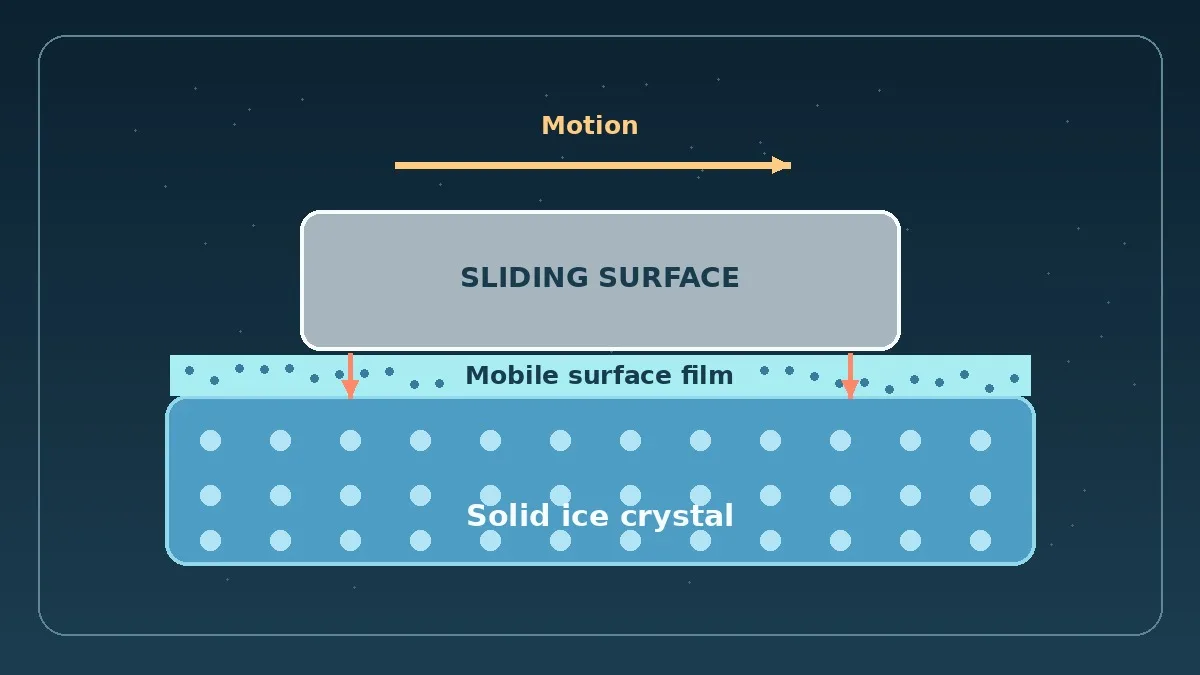
Ice can be slippery because its outermost molecules form a more mobile layer than the solid crystal beneath. Sliding also produces heat at the point of contact. A November 2026 study of ice against glass found that frictional heating could thicken this surface layer and reduce its resistance to motion, helping explain why friction falls as sliding speed increases in the experiments.
Ice has an unusual surface
Inside a crystal, water molecules are arranged in an orderly structure. At the exposed surface, molecules have fewer neighbors and can move more freely. A thin disordered layer can exist even below the ordinary freezing point. Its thickness and behavior depend on temperature and the materials in contact. [1]
What the November 2026 study found
Researchers modeled ice against glass at molecular scales, then accounted for heat produced as the surfaces rubbed together. The molecular model alone did not reproduce the observed relationship between speed and friction. Including heating brought the modeled behavior closer to experiment. The authors reported that the film became thicker and flowed more readily as the contact warmed. [1]
Why the temperature and surface matter
A skate, a glass surface and a rubber shoe do not interact with ice in identical ways. Roughness, speed, load and temperature all influence the result. The new study examines a specific ice-glass system, which gives scientists a way to test the physical explanation without implying that every ice surface has the same friction. [1]
On winter roads, a separate question is why bridges can ice over before the pavement beside them.
Frequently asked questions
Does pressure alone make ice slippery?
Pressure can affect melting, but surface mobility and heat produced during sliding are also important.
Is all ice equally slippery?
No. Temperature, surface texture and the contacting material change friction.
Sources and evidence
- Physical Review Letters — Why Ice Is So Slippery ↗
November 18, 2026 molecular simulations and frictional heating.
Sources consulted: 24 November 2026. Written with AI assistance and checked against the linked references; not independently reviewed by a subject specialist. Sources do not endorse this article. See our editorial policy.
Revision: Initial publication. Factual claims checked against the cited sources.