
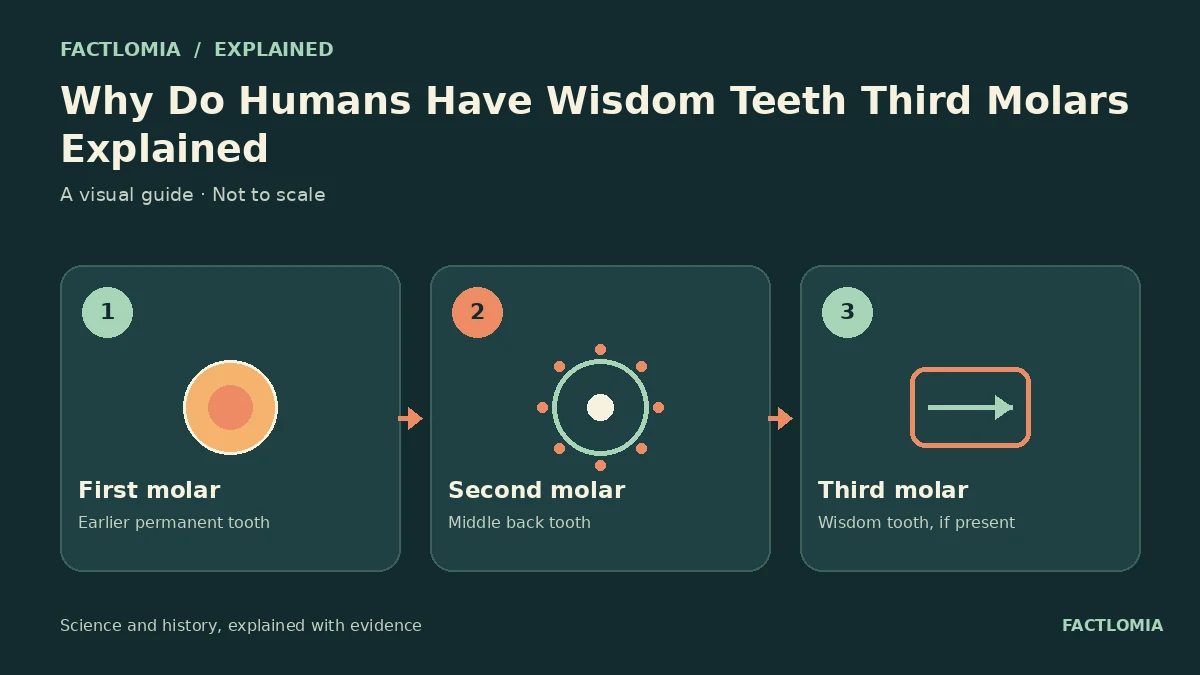
Wisdom teeth are the third set of molars at the back of the mouth. They are part of the normal human tooth pattern, but people differ: some develop fewer than four, some teeth never erupt, and others have enough room for them. Their position depends on tooth development and available space in the jaw.
The last molars to arrive
Third molars commonly begin to emerge in the late teens or early twenties, although timing varies. Some remain partly or fully trapped beneath gum or bone; dentists call an unerupted or poorly positioned tooth impacted. The ADA notes that impaction can affect nearby tissues, but a wisdom tooth does not automatically require removal. [1]
Why room can be limited
A tooth needs space and a suitable angle to erupt. Jaw size, tooth size, growth, and the position of neighboring teeth all contribute. Evolutionary accounts often suggest that changes in diet and food processing altered the demands placed on jaws across human history, but the development of third molars is complex; it is too simple to say that every modern wisdom tooth is merely a leftover from a single past diet. [2]
People vary
Some people never develop one or more third molars. Others have all four, and some erupt normally. This variation is part of human dental development. Whether a particular tooth should be monitored or treated is a dental decision based on its position, symptoms, and oral health—not just on the fact that it is a wisdom tooth. [1]
Frequently asked questions
Does everyone get four wisdom teeth?
No. People can develop fewer than four, and some third molars remain below the gum or never form.
At what age do wisdom teeth appear?
They often emerge between about 17 and 21, but timing differs from person to person.
Do all wisdom teeth need to be removed?
No. A dentist evaluates the tooth’s position and oral-health effects; not every wisdom tooth needs extraction.
Sources and evidence
- American Dental Association — Wisdom Teeth ↗
Explains third molars, eruption timing, impaction, and possible evaluation.
- NCBI Bookshelf — Wisdom Teeth ↗
Patient-focused overview of third molars and variation in eruption.
- PubMed — Human Molar Size Patterns ↗
Research on variation in modern human molar size patterns.
Sources consulted: 4 November 2026. Written with AI assistance and checked against the linked references; not independently reviewed by a subject specialist. Sources do not endorse this article. See our editorial policy.
Revision: New explainer; avoids the unsupported claim that all wisdom teeth are vestigial or must be removed.