
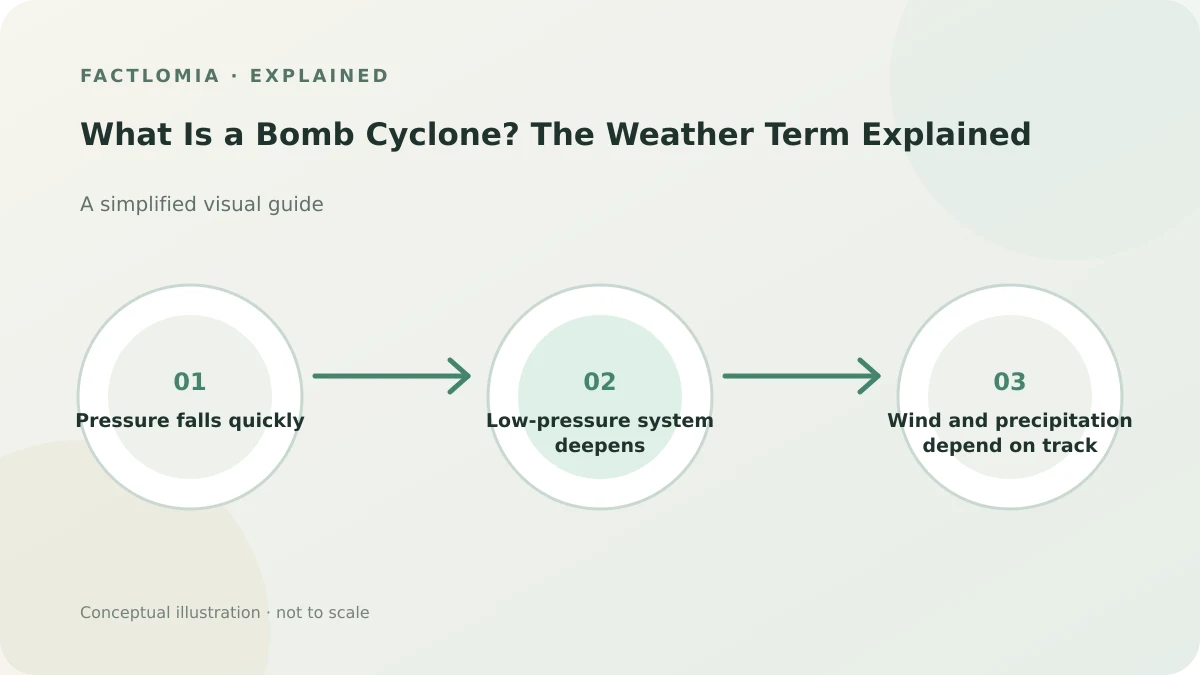
A bomb cyclone is an informal name for a rapidly intensifying midlatitude low-pressure system. Meteorologists commonly use a pressure-drop threshold of about 24 millibars in 24 hours, adjusted for latitude. The term describes explosive cyclogenesis; the storm’s impacts depend on its track, moisture, wind and local conditions.
“Bomb” describes rapid strengthening
In meteorology, bombogenesis refers to a low-pressure system that deepens unusually quickly. A commonly used benchmark is a pressure fall of roughly 24 millibars in 24 hours, with latitude adjustments in the formal criterion. The storm is not an explosion and the word does not identify a separate type of hazard. [1]
Why can a storm intensify so quickly?
Midlatitude storms draw energy from contrasts between air masses and from changes in winds high above the surface. When these processes align, air pressure at the storm’s center can fall rapidly and winds may strengthen. The exact outcome depends on the storm’s structure and path; rapid deepening by itself does not tell you which places will see snow, rain or damaging wind. [2]
The track matters more than the nickname
A bomb cyclone can bring strong winds, heavy precipitation and coastal impacts, but the risks vary with location. A storm offshore may affect a coastline differently from a system tracking inland. Use forecasts and warnings from the National Weather Service instead of treating the label as a forecast.
Compare this fast-deepening system with an atmospheric river, which describes a corridor of water vapor.
Frequently asked questions
Is a bomb cyclone the same as a hurricane?
No. Hurricanes are tropical cyclones; bomb cyclones are rapidly intensifying midlatitude low-pressure systems.
Does every bomb cyclone produce a blizzard?
No. Whether it produces snow, rain, wind or coastal impacts depends on the track and local conditions.
Why does the pressure threshold vary?
The benchmark is adjusted by latitude because the background atmospheric conditions differ across latitudes.
Sources and evidence
- National Weather Service — Glossary: Bomb ↗
Common operational definition of a bomb as rapid low-pressure intensification.
- National Weather Service Houston — Divergence and Convergence ↗
Bombogenesis pressure-drop threshold and the meteorological processes that deepen a storm.
Sources consulted: 1 November 2026. Written with AI assistance and checked against the linked references; not independently reviewed by a subject specialist. Sources do not endorse this article. See our editorial policy.
Revision: Initial publication. Claims and uncertainty checked against the cited references.