
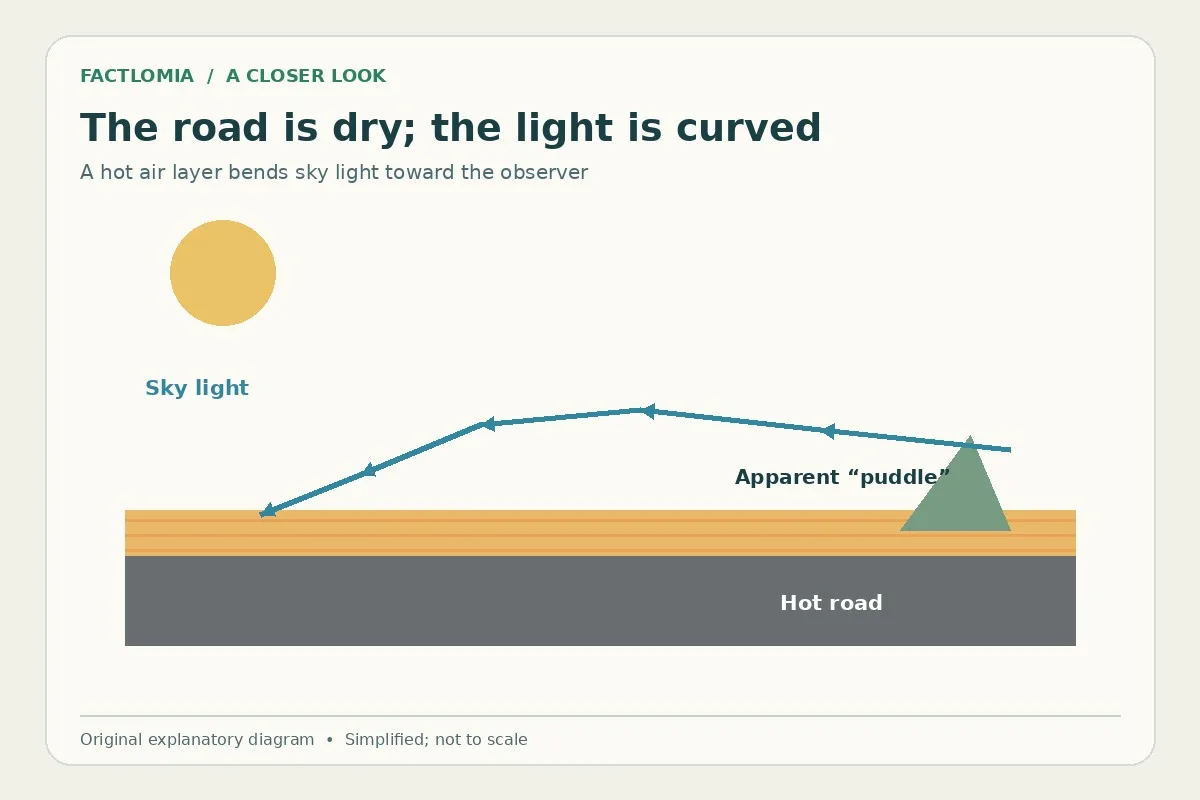
A hot road can look wet because a layer of air near the pavement becomes much warmer than the air above it. Light from the sky bends through this temperature gradient and reaches your eyes from near the road. Your brain interprets the displaced patch of sky as a reflection from a puddle, but the pavement is dry.
A mirage is an image made by bent light
Light usually travels in straight lines through uniform air, but air density and refractive index change with temperature. On a sunny day, pavement can heat the lowest layer of air more than the air above it. Light traveling through these layers bends gradually rather than reflecting from a real pool of water. [1][2]
The common hot-road effect is an inferior mirage. Light from the sky follows a curved path toward the observer, and the eye assumes that light traveled in a straight line. The sky therefore appears to be on the road surface, much like a reflection in water. [1]
Why the “puddle” moves away as you approach
The apparent image depends on the angle between the observer, the road, and the distant sky. As you move, the path of light entering your eyes changes, so the apparent patch of sky shifts farther along the pavement. It disappears when the viewing geometry changes. There was no pool of water to reach. [2]
The shimmering appearance can become more noticeable when hot air near the surface is moving and the temperature changes sharply with height. The image may look like rippling water because the refracting air is constantly changing. A real wet road can also reflect objects, so context and viewing angle matter.
Not every mirage looks like a road puddle
Mirages can distort, raise, lower, or multiply images of distant objects. A superior mirage can occur when colder air lies near a surface and warmer air sits above it, bending light in a different direction. The World Meteorological Organization describes mirages as images caused by light curving through air layers with different refractive indices. [1]
A road mirage is therefore a real optical phenomenon, not a hallucination. It is also different from the flattening of the Sun near the horizon, although both involve atmospheric refraction. Read why the Sun looks flattened near the horizon for that separate effect.
Frequently asked questions
Is there actually water on the road?
No. The “puddle” is an image of the sky bent by layers of hot and cooler air.
Why does it disappear when I get closer?
The viewing angle changes, shifting the image farther away; there is no physical pool to reach.
Can mirages happen in cold weather?
Yes. Temperature inversions over cold surfaces can create superior mirages that distort distant objects upward.
Sources and evidence
- World Meteorological Organization — International Cloud Atlas: Mirage ↗
Defines mirages and explains temperature-dependent refraction, inferior mirages, and the road-water appearance.
- Harvard Natural Sciences Lecture Demonstrations — Hot Road Mirage ↗
Demonstrates the hot-road light path and displaced inverted image.
- Hong Kong Observatory — Mirage ↗
Explains the dry-road illusion and refraction through hot air.
Sources consulted: 2026-10-27. Written with AI assistance and checked against the linked references; not independently reviewed by a subject specialist. Sources do not endorse this article. See our editorial policy.
Revision: First published 27 October 2026. Original explanatory diagram; claims checked against linked sources.