
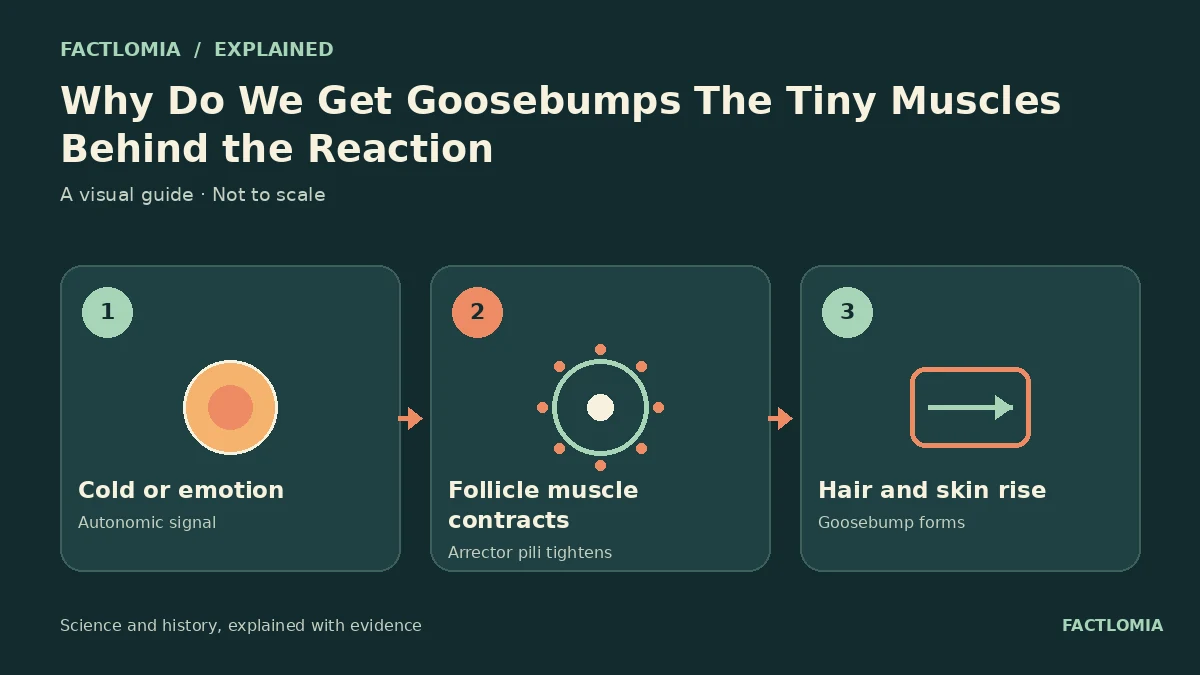
Goosebumps form when tiny muscles attached to hair follicles contract, making hairs stand up and raising small bumps in the skin. Cold can trigger the response, as can some strong emotions. In furry mammals, raised fur can trap insulating air; on humans, the effect is mostly a visible remnant with little warmth benefit.
A reflex at each hair follicle
Each hair follicle has a small smooth muscle called an arrector pili muscle. When the autonomic nervous system activates it, the muscle contracts and pulls the follicle upright. The surrounding skin rises into a bump, while the hair stands more erect. The technical name for this response is piloerection. [1]
Cold and emotion can both trigger it
A drop in temperature can set off goosebumps as part of the body’s response to cold. Strong feelings such as fear, awe, or excitement can trigger the same involuntary system. The response is not a reliable thermometer: people vary, and emotion can produce the bumps in a warm room. [2]
Why humans still have the reflex
For mammals with thick fur, raising hairs can increase the trapped layer of air or make the animal appear larger. Humans have much less body hair, so goosebumps do not provide meaningful insulation. They are a visible trace of a reflex that remains useful in other mammals and is still connected to our automatic nervous system. [1]
Frequently asked questions
Can music cause goosebumps?
Yes. Music or another emotionally powerful experience can activate the response in some people, even without cold.
Do goosebumps make human hair grow?
No. The muscles briefly raise hairs and the skin; they do not cause hair growth.
Why are goosebumps called that?
The small raised bumps resemble the skin of a plucked goose, which is the source of the common English term.
Sources and evidence
- MedlinePlus — Chills ↗
Describes goose bumps as a response to cold and explains raised body hair.
- Cleveland Clinic — Goosebumps ↗
Explains arrector pili muscles and emotional triggers.
- Encyclopaedia Britannica — Piloerection ↗
Defines the involuntary hair-raising reflex in mammals.
Sources consulted: 4 November 2026. Written with AI assistance and checked against the linked references; not independently reviewed by a subject specialist. Sources do not endorse this article. See our editorial policy.
Revision: New explainer; separates the human reflex from the stronger insulation effect in furred mammals.