
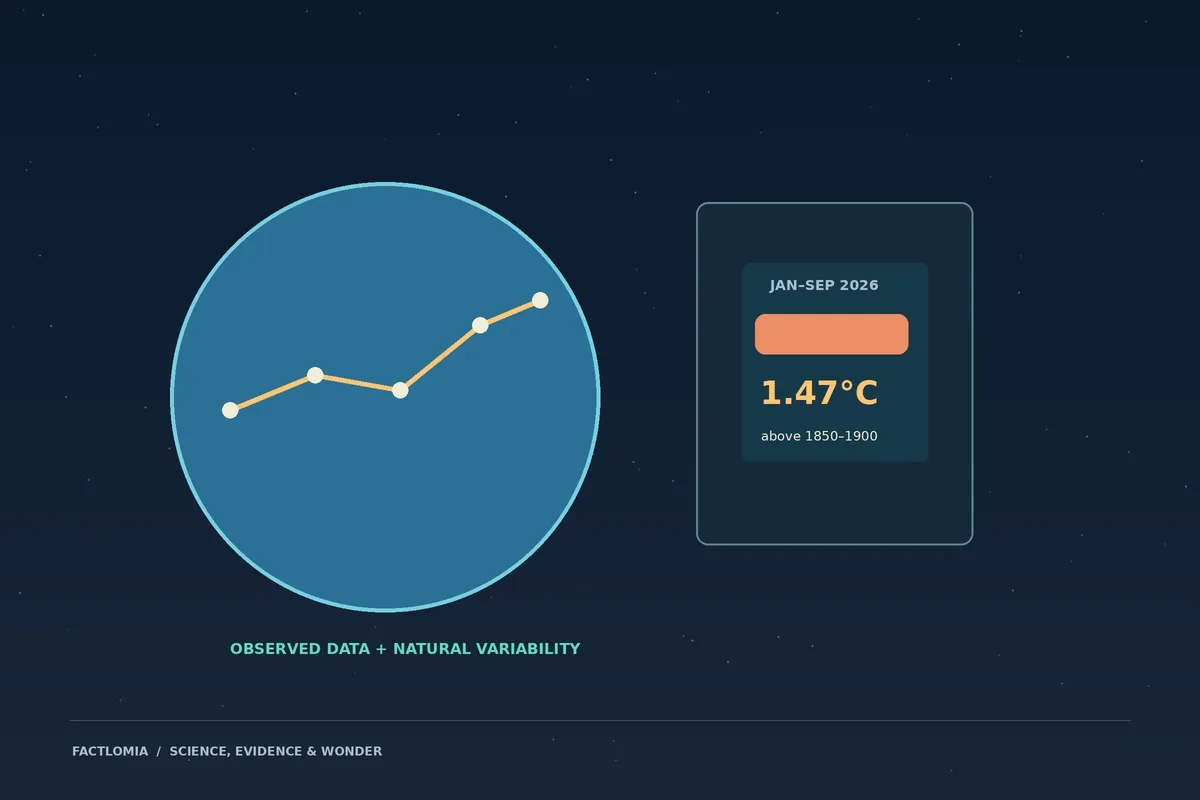
The World Meteorological Organization’s 2026 update reports that global average surface temperature from January through September was about 1.47°C above the 1850–1900 average. It places 2026 among the four warmest years on record so far, but the figure is a year-to-date estimate, not a final annual value or proof that a long-term climate threshold has been permanently crossed.
A year-to-date number, not a final ranking
The WMO released its State of the Climate update at COP31 on November 9. It combines data from multiple observing systems and reports a January–September 2026 global mean temperature anomaly of 1.47°C, with an uncertainty range of ±0.13°C, relative to 1850–1900. The report says 2026 is on track to be one of the four warmest years in the instrumental record. [1]
The report’s data run only through September where available. That matters because a full-year average can shift as additional months are measured.
Why does El Niño matter?
El Niño is a natural pattern of warmer-than-average water in parts of the tropical Pacific that changes weather around the world. It also tends to raise global average temperature for a time. The WMO says the developing El Niño was intensifying in 2026 and may increase temperatures into 2027; the report notes that the largest global-temperature effect often follows the event’s development. [1]
El Niño adds natural variability on top of long-term human-caused warming. It does not explain away the decades-long rise in global temperatures.
Does 1.47°C mean the Paris limit was crossed?
Not by itself. The Paris Agreement’s 1.5°C goal concerns long-term warming, usually assessed over a multi-year period. A single year or a set of months can temporarily sit near or above 1.5°C because of natural variability, while the long-term average remains different. The WMO’s number is an observation for a specific period against a stated baseline, not a declaration that the long-term goal has been formally crossed. [1]
The report also tracks oceans, sea level, ice and greenhouse gases, because climate change is broader than one temperature statistic.
FAQ: reading a climate update
What is the preindustrial baseline? The WMO compares recent temperatures with the 1850–1900 average, a common reference period for global warming estimates.
Will 2026’s final number be exactly 1.47°C? No. That is the January–September estimate; the full-year value can differ.
Sources and evidence
- WMO — State of the Climate Update for COP31 ↗
Report period and data coverage through September 2026.
- WMO — State of the climate in 2026 gives new meaning to “off the charts” ↗
Temperature anomaly, ranking and WMO interpretation of El Niño.
Sources consulted: 11 November 2026. Written with AI assistance and checked against the linked references; not independently reviewed by a subject specialist. Sources do not endorse this article. See our editorial policy.
Revision: Initial publication. Current claims and limits were checked against the linked research and institutional sources.