
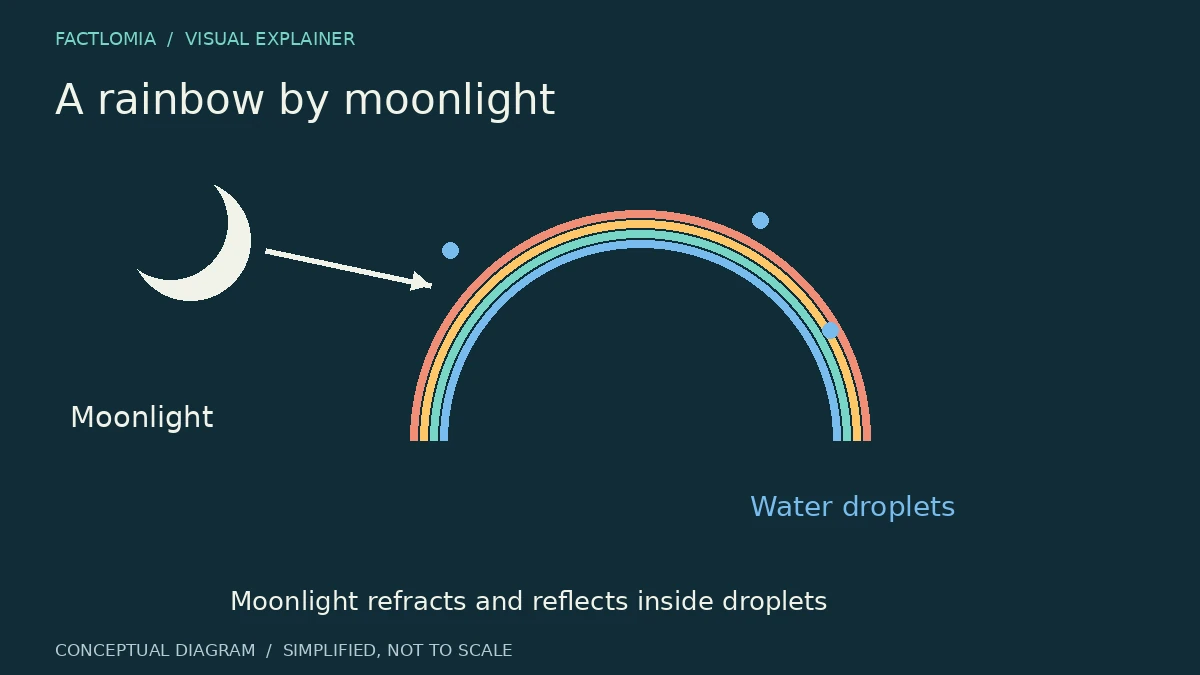
A moonbow is a rainbow produced when moonlight passes through water droplets and is refracted, reflected, and separated into colors. It appears opposite the Moon, as a daytime rainbow appears opposite the Sun. Moonlight is much dimmer than sunlight, so a moonbow often looks white or pale to the eye; a camera’s long exposure can reveal more color.
Moonlight enters droplets and bends
Moonlight is sunlight reflected from the Moon. When that light enters a raindrop, it bends, reflects inside the drop, and bends again as it leaves. Different wavelengths bend by slightly different amounts, spreading white light into a colored arc. The World Meteorological Organization describes rainbows as arcs produced by light from the Sun or Moon in water droplets. [1]
Why the bow is opposite the Moon
For the primary bow, light reaches the observer after following a particular path through each drop. The drops that send this light toward the observer appear at a fixed angle from the point directly opposite the light source. That is why a moonbow forms in the part of the sky opposite the Moon, not around the Moon itself. [1]
Why it can look nearly colorless
Human color vision is less sensitive in dim light. A moonbow can therefore appear white or faintly colored even though the light contains a spectrum. Long-exposure photographs gather light over time and may show colors that are hard to see by eye. Seeing one requires moonlight and water droplets in the right parts of the sky, so the display is uncommon. [1][2]
Moonbow or lunar halo?
A moonbow is made by liquid water droplets and has the geometry of a rainbow. A halo around the Moon is usually formed by refraction through ice crystals in high clouds. Their appearance and position differ. Compare this with iridescent colors in clouds.
Frequently asked questions
Does a moonbow have real colors?
Yes. The colors are often too faint for human night vision to distinguish clearly.
Where should I look?
Look in the direction opposite a bright Moon where rain, mist, or spray is present.
Is a moonbow the same as a lunar halo?
No. A moonbow forms in water droplets; a lunar halo usually forms in ice crystals.
Sources and evidence
- World Meteorological Organization — International Cloud Atlas: Rainbow ↗
Defines rainbows formed by sunlight or moonlight and describes their optical mechanism and weaker moonbow colors.
- UK Met Office — Rainbows: Optical Wonders ↗
Explains moonbow conditions and why they often look white to the eye.
Sources consulted: 2026-10-27. Written with AI assistance and checked against the linked references; not independently reviewed by a subject specialist. Sources do not endorse this article. See our editorial policy.
Revision: First published 27 October 2026. Original explanatory diagram; claims checked against linked sources.