
Oil and water usually separate because a uniform mixture is not their favored state under ordinary conditions. Water is polar, while typical oils are largely nonpolar, and mixing them changes the molecular arrangements of the system. Density determines which liquid sits on top; it does not by itself explain why the liquids fail to dissolve in each other.
The molecules have different properties
Water molecules have an uneven charge distribution and form hydrogen bonds with each other. Typical oil molecules are largely nonpolar. These differences are useful clues to their limited mutual solubility, often summarized by the rule of thumb that like dissolves like. [1]
The full explanation includes entropy
Saying water simply repels oil is misleading: attractions exist between molecules of both substances. The thermodynamics of mixing includes both energy and entropy, which concerns molecular arrangements. Research discussions of the hydrophobic effect emphasize that entropy is important to oil–water separation at room temperature. [2]
Floating is a separate question
Common cooking oils are less dense than water, so their layer rests above it. But being less dense does not automatically make a liquid insoluble. Density explains the vertical order after separation; molecular interactions and the free energy of mixing explain limited solubility. [1]
Shaking does not make a permanent solution
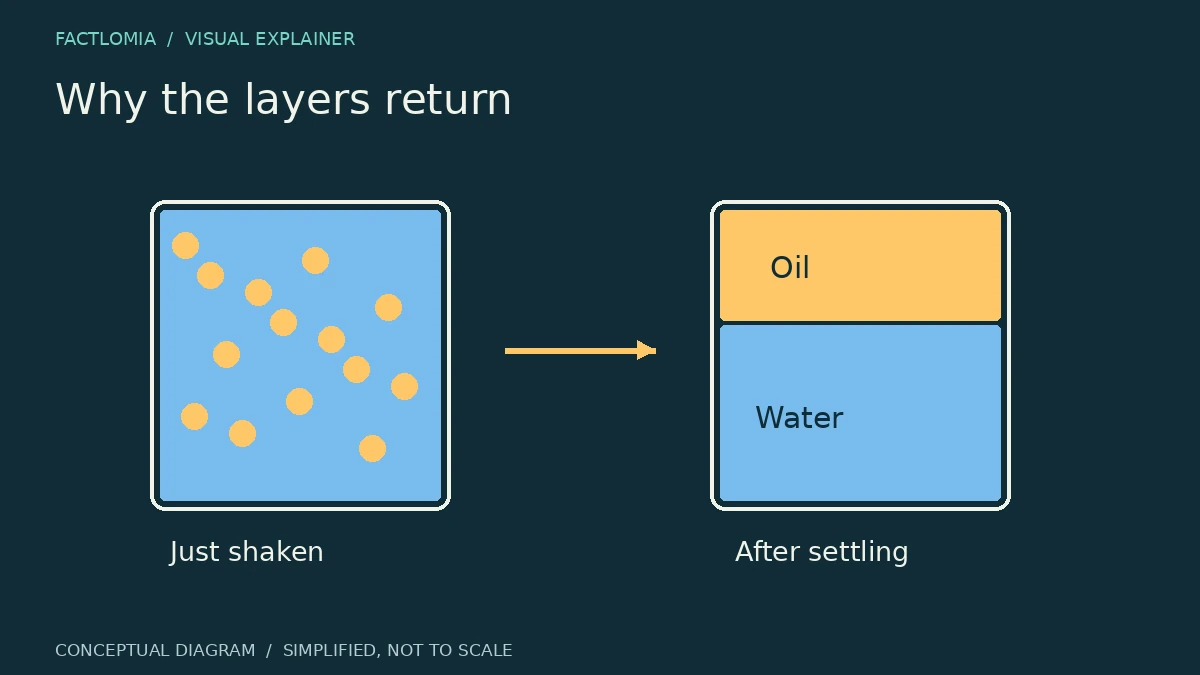
Shaking breaks a layer into small droplets dispersed through the other liquid. Afterward, droplets can join and the layers reappear. This temporary dispersion differs from a molecular solution. Emulsifiers can help keep droplets dispersed by changing what happens at the oil–water interface. [1]
Keep exploring: how soap helps remove grease.
Sources and evidence
- American Chemical Society — Can Liquids Dissolve in Water? ↗
Polarity, liquid solubility, temporary mixing, and the separation of oil and water.
- Chemical Reviews — How Water’s Properties Are Encoded in Its Molecular Structure and Energies ↗
Thermodynamic explanation of the hydrophobic effect and the role of entropy.
Sources consulted: 2026-10-28. Written with AI assistance and checked against the linked references; not independently reviewed by a subject specialist. Sources do not endorse this article. See our editorial policy.
Revision: First published 28 October 2026. Sources checked and original explanatory graphic added.