
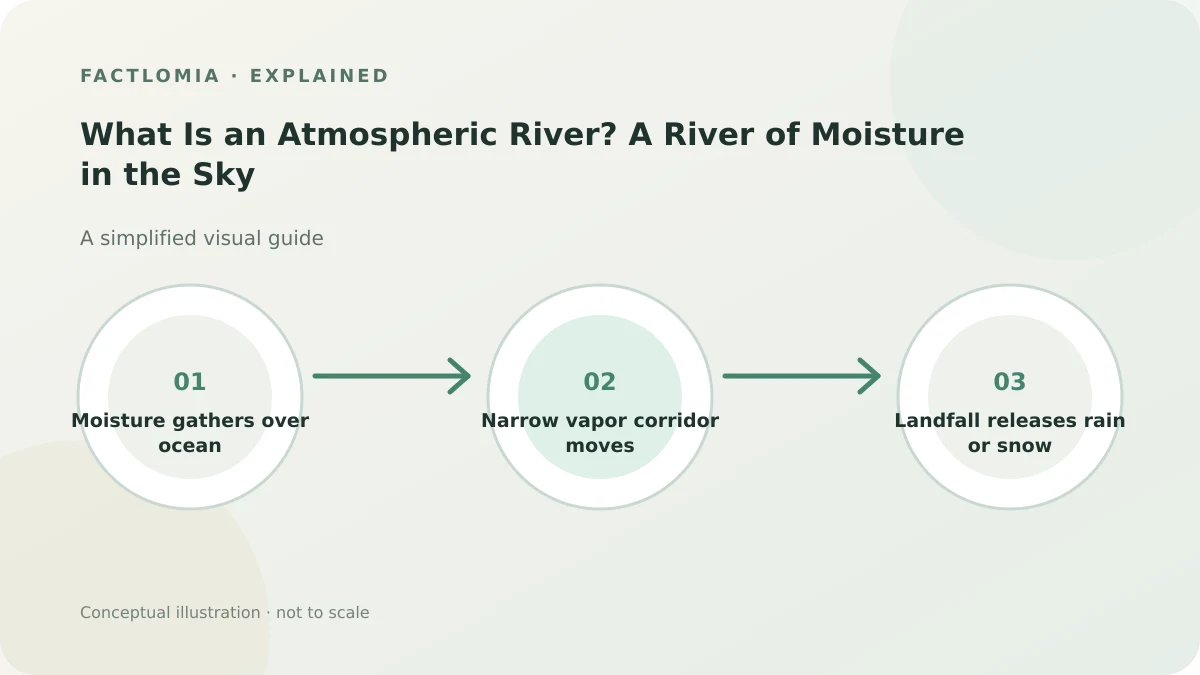
An atmospheric river is a relatively long, narrow corridor that transports water vapor through the atmosphere. When it reaches land, the vapor can fall as rain or snow. Many atmospheric rivers are beneficial, while unusually strong or slow-moving ones can raise flood and landslide risks.
A moving corridor of water vapor
Atmospheric rivers are concentrated streams of moisture in the atmosphere, often extending for long distances. They transport much of the water vapor outside the tropics. The name is a comparison with a river’s flow, not a literal stream suspended in the sky. [1]
What happens when one reaches land?
As moist air is pushed upward over terrain or by weather systems, it cools and water vapor condenses. The result may be rain or snow. For the western United States, atmospheric rivers can contribute to water supplies and mountain snowpack. If an intense system stalls over a vulnerable watershed, prolonged rain can cause flooding or landslides. [1]
Strength and duration matter: not every atmospheric river is destructive, and a forecast’s expected rainfall and local ground conditions determine the risk.
Why forecasters watch their paths
Satellites and weather models help forecasters track moisture corridors and estimate where precipitation may fall. The same system can deliver useful water in one location and dangerous rain in another. Forecasters therefore assess the amount of moisture, wind, storm speed and watershed vulnerability rather than relying on the term alone.
Related: how ocean waves keep moving.
Frequently asked questions
Is an atmospheric river always dangerous?
No. Many are weak and provide beneficial rain or snow. Strong, persistent systems can produce hazardous flooding.
Is the Pineapple Express an atmospheric river?
It is a familiar name for a strong moisture pathway that can carry tropical Pacific moisture toward the U.S. West Coast.
Can atmospheric rivers bring snow?
Yes. Where air is cold enough, their moisture can contribute to mountain snowfall and snowpack.
Sources and evidence
- NOAA — What Are Atmospheric Rivers? ↗
Definition, transport of water vapor, West Coast impacts and beneficial versus hazardous events.
- NOAA — Atmospheric Rivers and the Water Cycle ↗
How atmospheric rivers fit into the water cycle and can contribute to precipitation.
Sources consulted: 1 November 2026. Written with AI assistance and checked against the linked references; not independently reviewed by a subject specialist. Sources do not endorse this article. See our editorial policy.
Revision: Initial publication. Claims and uncertainty checked against the cited references.