
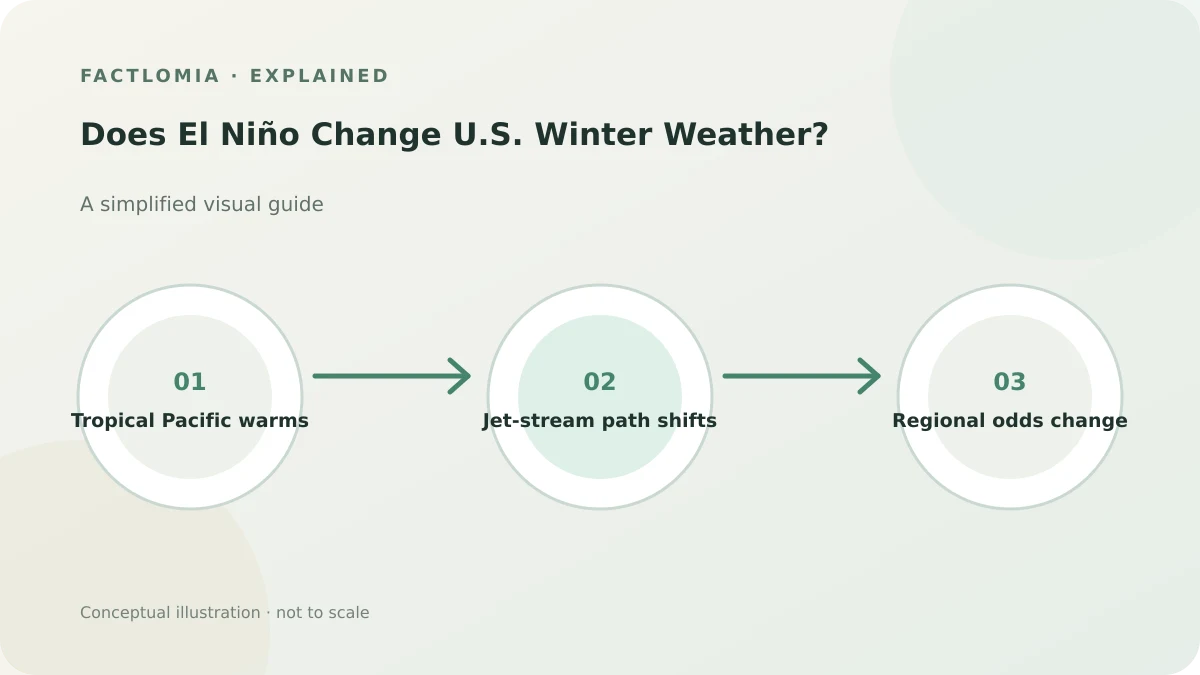
El Niño is a periodic warming of the central and eastern tropical Pacific that can alter atmospheric circulation. In U.S. winter, it often shifts the jet stream and changes regional odds of precipitation and temperature, but impacts vary by event and location; it is not a deterministic forecast for any single town.
El Niño begins in the tropical Pacific
El Niño is the warm phase of the El Niño–Southern Oscillation (ENSO), a recurring pattern involving sea-surface temperatures and the atmosphere over the tropical Pacific. The pattern affects large-scale winds, which can influence where the mid-latitude jet stream tends to travel. It is one influence on winter climate, alongside other ocean and atmospheric patterns. [1]
The U.S. effects are regional probabilities
During many El Niño winters, the southern tier of the United States has increased odds of wetter conditions, while parts of the northern tier may be warmer than average. The familiar map is a summary of past tendencies, not a promise: the strength and location of impacts vary, and local outcomes can differ from the average pattern. [2]
El Niño does not tell forecasters exactly how much snow a specific city will get. A seasonal outlook describes probabilities over a broad region; short-range weather forecasts handle individual storms.
What an El Niño forecast can—and cannot—say
NOAA updates the ENSO status as new observations and forecasts arrive. When using an outlook, check its issue date, the map’s time period and whether it describes temperature or precipitation. A seasonal signal may tilt the odds without determining whether a particular week is snowy, stormy or mild.
For a related winter-weather mechanism, see how lake-effect snow forms.
Frequently asked questions
Does El Niño mean a warm winter everywhere?
No. Its typical effects differ by region, and local weather varies from the seasonal average.
Does El Niño guarantee snow in the southern United States?
No. It can increase the odds of certain precipitation patterns, but it cannot guarantee a specific storm or snowfall at one location.
Is El Niño the same as climate change?
No. ENSO is a natural climate pattern that varies over time; climate change is a long-term shift in climate averages and extremes.
Sources and evidence
- NOAA Climate.gov — El Niño and La Niña FAQs ↗
ENSO definitions and why U.S. winter effects are probabilistic rather than certain.
- NOAA Climate.gov — How El Niño and La Niña Affect the Winter Jet Stream and U.S. Climate ↗
Jet-stream changes and typical regional winter patterns in the United States.
Sources consulted: 1 November 2026. Written with AI assistance and checked against the linked references; not independently reviewed by a subject specialist. Sources do not endorse this article. See our editorial policy.
Revision: Initial publication. Claims and uncertainty checked against the cited references.