
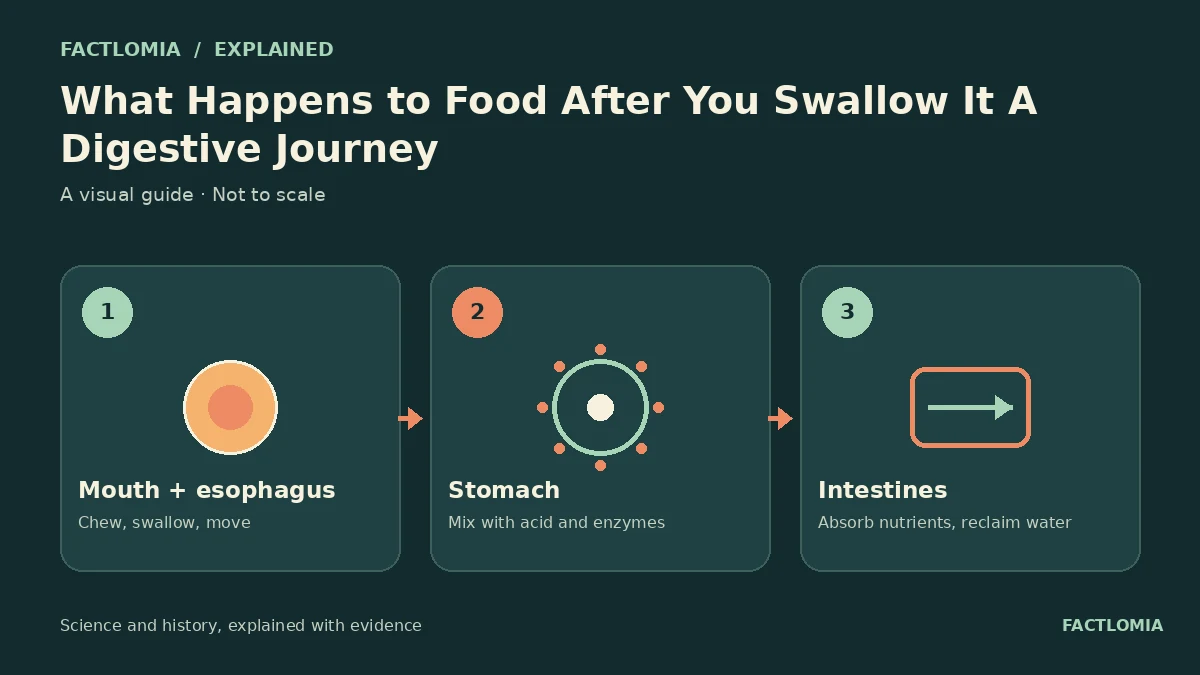
After you swallow, food travels down the esophagus to the stomach, then into the small intestine. Muscles and digestive juices break it into small molecules that can be absorbed. The large intestine absorbs water from what remains, and waste eventually leaves the body as stool.
From mouth to stomach
Chewing breaks food into smaller pieces, and saliva moistens it and begins digesting some carbohydrates. When you swallow, the epiglottis helps direct food away from the airway. Muscular waves called peristalsis move it down the esophagus; gravity is not the only force, which is why swallowing can still work when the body is reclined. The stomach then mixes food with acid and enzymes. [1]
The small intestine does most nutrient absorption
In the small intestine, digestive juices from the pancreas and bile from the liver help break down food. Nutrients pass through the intestinal lining into the body for energy, growth, and cell repair. The small intestine’s folded surface and tiny projections create a large area for absorption. [1]
Water is reclaimed and waste moves on
Material that has not been digested passes into the large intestine. The colon absorbs water and salts, while gut microbes use some remaining material. The body compacts what is left into stool, which is stored briefly in the rectum before leaving through the anus. Digestion is a coordinated process, not a single event that happens only in the stomach. [2]
Frequently asked questions
How long does digestion take?
There is no one exact time for every meal. Transit varies with the food, the person, and the part of the digestive tract being considered.
Does food go into the stomach when you swallow?
Usually it enters the esophagus and moves to the stomach through muscular contractions called peristalsis.
Where are nutrients absorbed?
Most nutrient absorption happens in the small intestine; the large intestine absorbs water and electrolytes.
Sources and evidence
- NIDDK — Your Digestive System & How It Works ↗
Official overview of the organs, movements, and digestive juices involved.
- NIDDK — The Digestive System (PDF) ↗
Accessible guide to food movement and nutrient absorption.
- OpenStax — The Digestive System ↗
Educational anatomy reference for digestive organs and processes.
Sources consulted: 4 November 2026. Written with AI assistance and checked against the linked references; not independently reviewed by a subject specialist. Sources do not endorse this article. See our editorial policy.
Revision: New explainer; describes digestion as coordinated mechanical and chemical processing.