
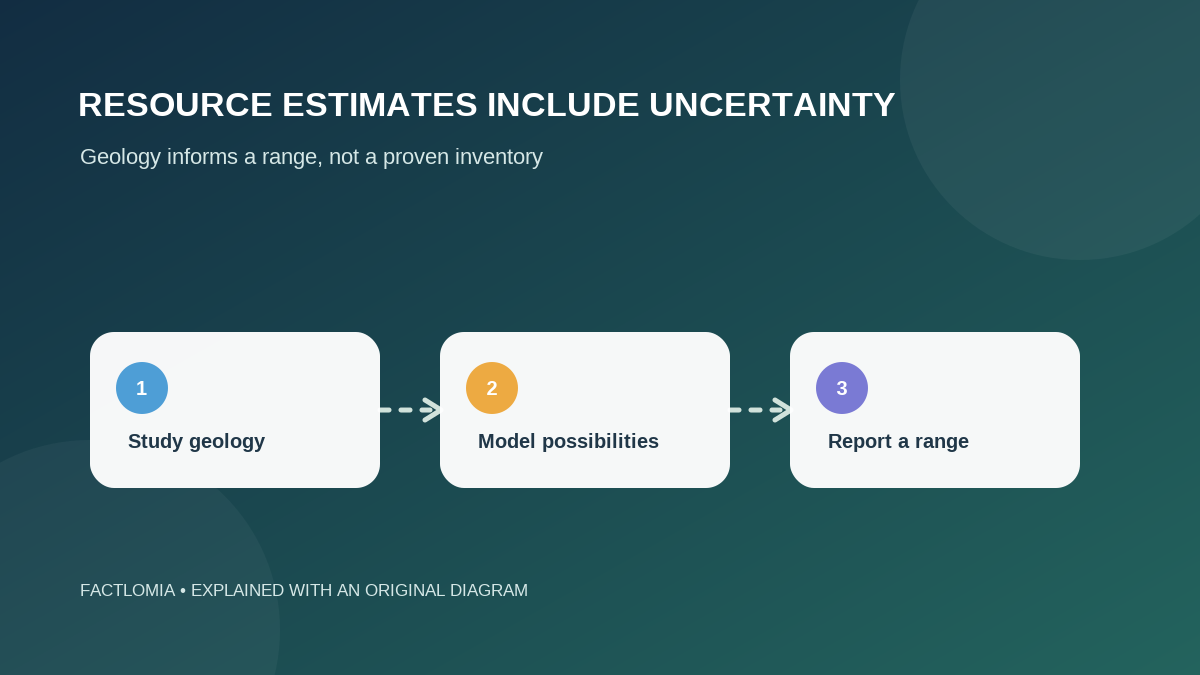
Geologists estimate undiscovered resources by studying petroleum systems, geological structures, and statistical ranges—not by counting gas already drilled and measured. The USGS’s 2026 assessment gives a mean estimate of 96 trillion cubic feet of technically recoverable conventional gas in northern Alaska. It is an assessment of resource potential, not proven reserves or a guarantee of future production.
How can scientists estimate something undiscovered?
Geologists first define an assessment area and identify the rocks and structures that could generate, move, and trap petroleum. They combine geological maps, well information, analogs, and a petroleum-system model to estimate how many accumulations might exist and how large they could be.
Because the exact number and size of undiscovered accumulations are unknown, assessments report uncertainty ranges and statistical summaries. The USGS describes its 2026 Northern Alaska estimate as a mean of 96 trillion cubic feet (TCF) of undiscovered, technically recoverable conventional gas.
What does technically recoverable mean?
“Technically recoverable” means the resource is estimated to be producible with current technology, without assuming that production would be profitable. Economic viability depends on costs, prices, infrastructure, access, regulation, and other factors that are not settled by a geology-based resource assessment.
The USGS assessment reports a broad F95–F5 range of roughly 17 to 277 TCF around the mean estimate. In this statistical framing, the range communicates uncertainty; it is not a promise that the middle value will be found or produced.
How does it differ from reserves?
Reserves are quantities tied to discoveries and judged commercially recoverable under defined conditions. An undiscovered-resource estimate describes potential in places that have not yet been found. The two numbers answer different questions and should not be compared as if they were interchangeable.
An assessment can inform research, planning, and discussion. It does not decide whether exploration or production should proceed, and it does not measure the environmental effects of any future activity.
Frequently asked questions
Does 96 TCF mean Alaska has 96 TCF ready to use?
No. It is a mean estimate of undiscovered, technically recoverable conventional resources, not a measured inventory or proven reserve.
Will the estimate be exact?
No. The uncertainty range is part of the assessment and reflects that geology is incompletely known.
Sources and evidence
- USGS: 2026 Northern Alaska gas assessment ↗
The assessed area, geology-based method, mean estimate, and uncertainty range.
- USGS: 2026 assessment full text ↗
Definitions and detailed results for undiscovered conventional gas resources.
Sources consulted: November 15, 2026. Written with AI assistance and checked against the linked references; not independently reviewed by a subject specialist. Sources do not endorse this article. See our editorial policy.
Revision: Updated November 16, 2026: topic-matched original cover illustration added; primary-source claims and citations reviewed.