
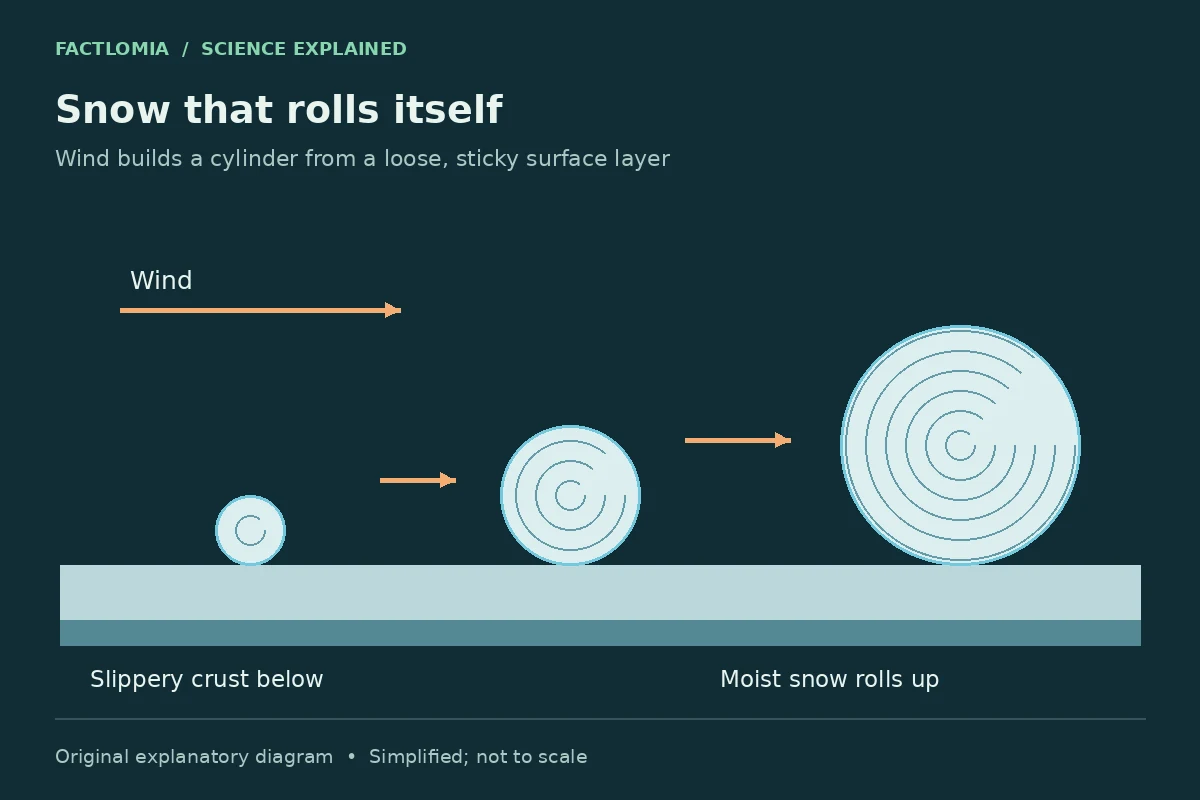
Snow rollers form when wind pushes a small piece of moist snow across an icy or crusted surface. The moving piece picks up more snow and grows into a cylinder, much like a rolled-up carpet. A suitable slope can help gravity keep it moving.
Three ingredients have to line up
The base must let snow slide rather than grip firmly. Above it, a layer of wet snow must hold together well enough to peel up and roll. Finally, the wind must move that layer without tearing the growing roll apart. The Royal Meteorological Society lists an icy or crusted ground surface, strong gusty wind, and sufficiently deep wet snowfall as key conditions. [1]
Why the result looks like a hay bale
A snow roller grows by collecting a sheet of snow around its outside. That process favors a cylinder rather than the tightly packed ball a person makes by squeezing snow in their hands. A trail behind the object can reveal the snow it collected. The roll stops when the available push no longer overcomes resistance, or when it reaches unsuitable terrain. [1], [2]
Why some snow rollers have holes
The earliest inner layers can be fragile. As those weak layers erode or fall away, the cylinder can become hollow, producing the nickname snow doughnut. Not every roller develops a clean hole, and a photograph of a circular snow shape alone cannot prove how it formed. Tracks, layers, and surrounding weather provide useful context. [2]
Are they a type of snowfall?
No. They are structures assembled on the ground after snow is available, rather than individual particles that grow in a cloud. They are also different from plowed snowballs or snow pushed off a roof by people. Their formation needs an unusual combination of conditions, so an ordinary windy snowfall may leave none. Explore another winter surface phenomenon in why snow sparkles.
Sources and evidence
- Royal Meteorological Society — Snow rollers in Wiltshire ↗
Formation conditions, rolling growth, and stopping.
- American Meteorological Society — Snow roller ↗
Meteorological definition and naturally formed snow cylinders.
Sources consulted: 2026-10-21. Written with AI assistance and checked against the linked references; not independently reviewed by a subject specialist. Sources do not endorse this article. See our editorial policy.
Revision: First published 21 October 2026. Original explanatory diagram and source-linked text.