
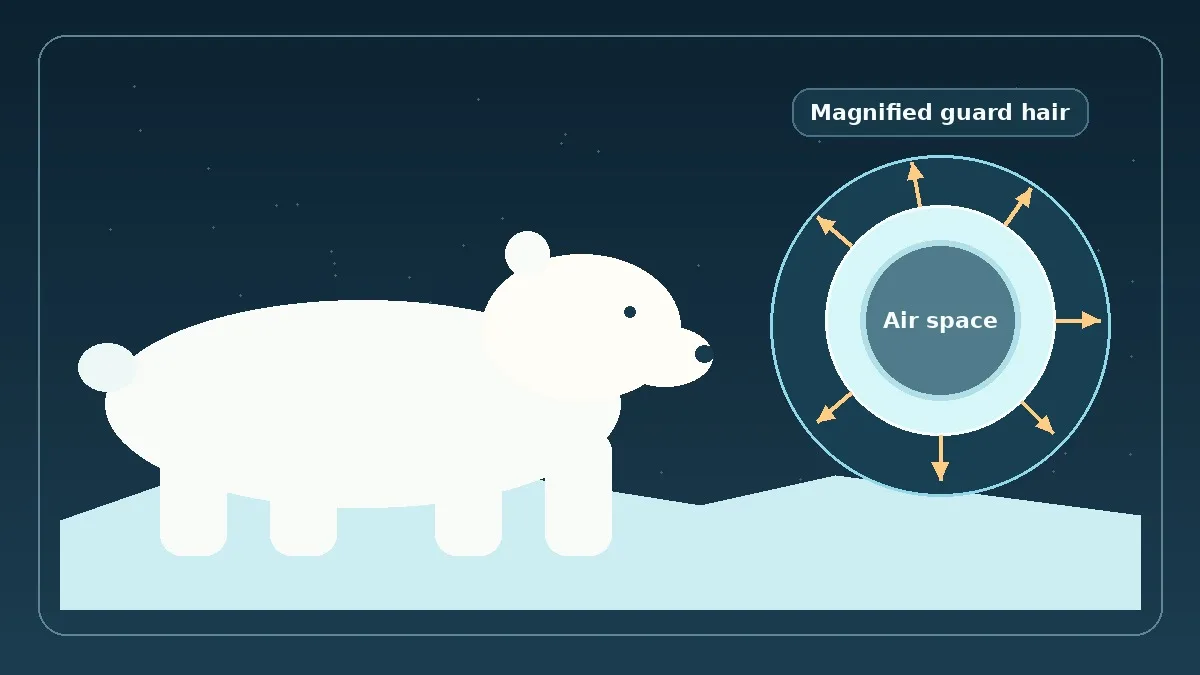
Polar bears appear white because their colorless fur scatters visible light in many directions. The long outer guard hairs generally contain hollow spaces, while the shorter undercoat is colorless too. When many hairs interact with light, the combined scattering makes the coat look white or cream even though the skin beneath is dark.
The two layers of a coat
The thick undercoat helps insulate the bear. Longer guard hairs cover it and help shield the softer hair beneath. A single hair examined closely looks very different from a whole coat. Most sources describe the outer guard hairs as hollow and transparent. [1]
How colorless material can look white
A clear object lets light pass through, but the interfaces between materials can redirect light. Polar bear hair and its internal air spaces scatter many wavelengths. A dense collection of these hairs sends broad-spectrum visible light toward an observer, producing a white-looking coat. [1]
Why some bears look yellowish or green
A bear’s appearance depends on illumination and the condition of its fur. An unusual example occurred in some zoos, where green algae were found within the hairs of bears with a green tint. Beneath the coat, polar bear skin is black. [1] [2]
Frequently asked questions
Is polar bear skin white?
No. It is dark, usually described as black.
Are the hairs optical fibers?
The familiar explanation that polar bear hairs act like optical fibers is unsupported by the evidence summarized by the Library of Congress.
Sources and evidence
- Library of Congress — Is a Polar Bear’s Fur Transparent? ↗
Hair structure, scattering and documented algae inside hairs.
- WWF — Top Facts About Polar Bears ↗
Describes translucent fur and black skin.
Sources consulted: 24 November 2026. Written with AI assistance and checked against the linked references; not independently reviewed by a subject specialist. Sources do not endorse this article. See our editorial policy.
Revision: Initial publication. Factual claims checked against the cited sources.