
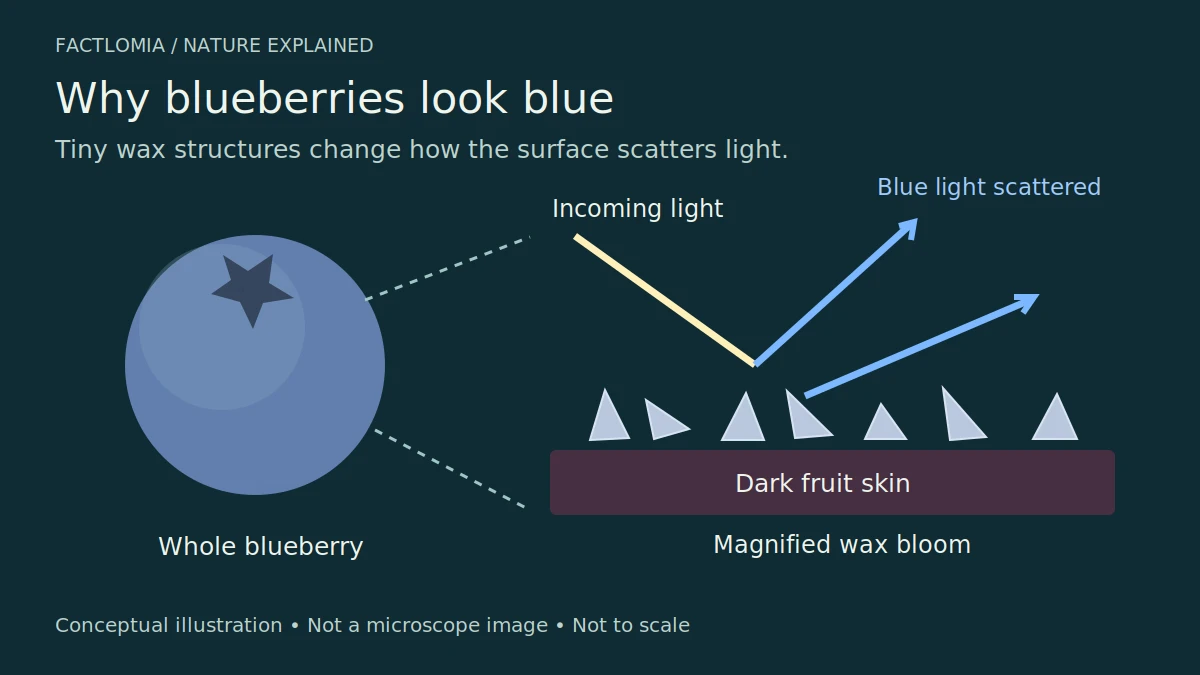
Blueberries look blue mainly because microscopic structures in their natural wax coating scatter blue light. Their skin contains dark pigments, but those pigments do not explain the blue surface appearance. Crushing the fruit disrupts the structure that produces the effect, so its juice does not keep the berry’s powdery blue look.
The blue comes from structure, not blue juice
In a 2024 study, researchers examined the outer wax of blueberries and other dark fruits. They found irregularly arranged, nonspherical wax crystals that interact with light to create a blue-to-ultraviolet reflection. Humans see the visible blue part of that signal. This is an example of structural color: the arrangement of a material helps determine its appearance. [1]
What is the powdery coating on a blueberry?
The pale, dusty-looking surface is a natural wax bloom. Its tiny structures sit outside the darker skin. Removing the wax changes how the surface looks because the light-scattering layer is no longer intact. The important distinction is between the material itself and the way it is organized on the fruit. [1]
Why doesn’t squeezing a berry produce the same blue?
Squeezing mixes the fruit’s contents without preserving the organized surface coating. The researchers describe dark red pigments in the skin rather than a blue pigment that could simply be extracted as blue juice. A whole berry and a crushed berry therefore present different optical systems to your eyes. [2]
How did scientists test the explanation?
The team removed the wax and allowed it to recrystallize on a card. The resulting coating produced a blue appearance again, supporting the role of its physical structure. This result suggests possibilities for making new color-producing coatings, although a laboratory demonstration is not the same as a finished commercial paint. [2]
Is this the same as every other natural blue?
No single mechanism explains every blue object. Here, the key is scattering by the wax bloom. For another example of a surface changing what light does, explore why some beetles look metallic. The useful question is always: what is the light interacting with?
Sources and evidence
- Middleton et al. — Science Advances (2024): Self-assembled, disordered structural color from fruit wax bloom ↗
Primary experimental study of wax structures and structural color in blueberries and other fruits.
- University of Bristol — Scientists reveal why blueberries are blue (7 February 2024) ↗
Researcher explanation of pigments, wax removal and recrystallization experiments.
Sources consulted: 31 October 2026. Written with AI assistance and checked against the linked references; not independently reviewed by a subject specialist. Sources do not endorse this article. See our editorial policy.
Revision: Initial publication, checked against the cited primary research and university report.