
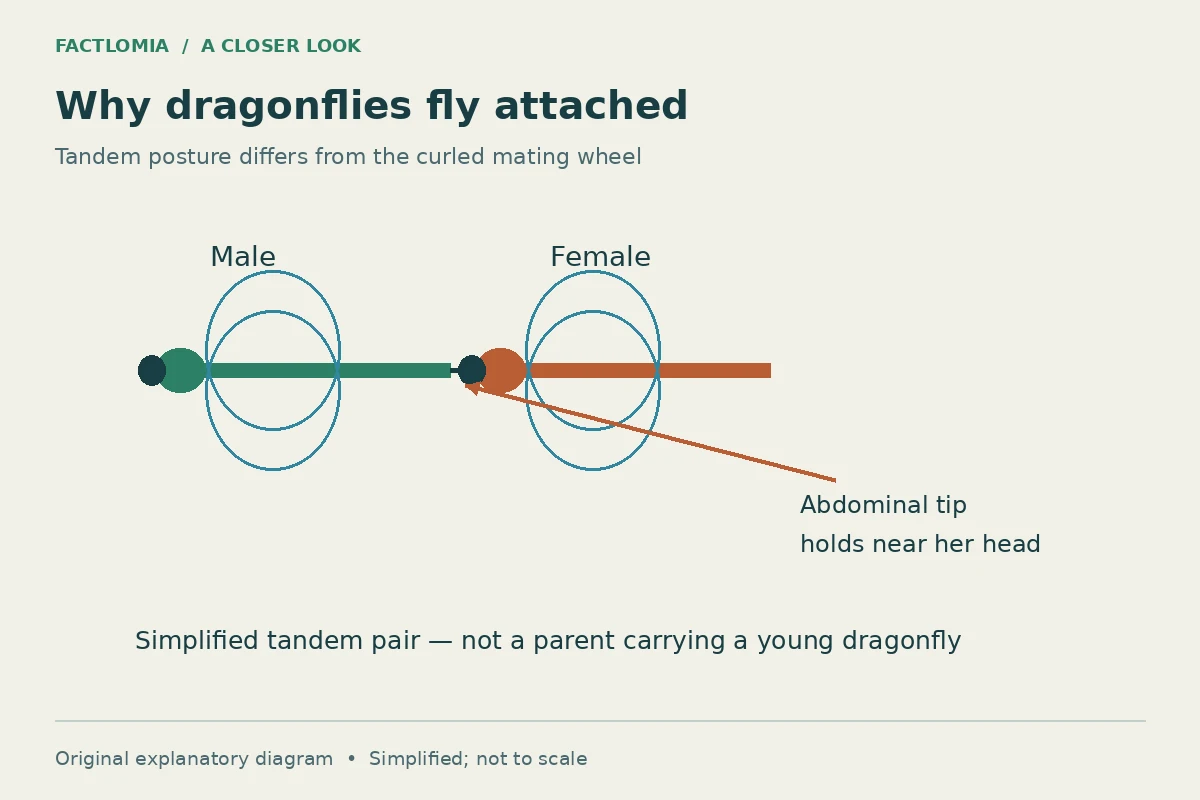
Dragonflies flying attached are usually a reproductive pair. In the tandem position, the male holds the female with claspers at the end of his abdomen. The curved mating wheel is a different arrangement: the female bends her abdomen forward to contact the male’s secondary reproductive structures.
Tandem and the wheel are different positions
A straight or gently curved chain and a heart-shaped pair are not identical stages. In tandem, the male’s abdominal tip grips near the back of the female’s head in dragonflies. To mate, the female curls her abdomen toward the front of the male’s abdomen, forming the wheel. This unusual geometry reflects the separation between the male’s sperm-producing opening and the secondary structures used for mating. [1], [2]
Why stay attached after mating?
Some species remain in tandem while the female lays eggs. The National Park Service describes common green darners doing this as the female inserts eggs into aquatic plant material. Remaining attached can function as contact guarding, reducing opportunities for a rival male to mate with the female. The appearance of a tandem pair alone does not establish that eggs are being laid at that exact moment. [1]
Are they fighting or helping each other fly?
Dragonflies do have aerial contests, but an orderly pair joined head-to-tail is a recognizable reproductive posture. It is not normally a parent carrying a youngster: the immature stages live in water and look very different from winged adults. Nor does the pair need to be motionless. Common green darners can fly while paired. [1], [2]
What an observer can identify
Look for the point of attachment and whether the female’s abdomen curls toward the male. Species differ in their courtship, guarding, and egg-laying behavior, so one diagram cannot represent every dragonfly or damselfly. Watch without separating the insects. For another insect behavior with a different purpose, read why butterflies gather on damp mud.
Sources and evidence
- National Park Service — Common Green Darner ↗
Mating-wheel and tandem positions, contact guarding, and egg laying.
- National Park Service — Dragonflies and Damselflies ↗
Odonate reproductive anatomy and behavior.
Sources consulted: 2026-10-21. Written with AI assistance and checked against the linked references; not independently reviewed by a subject specialist. Sources do not endorse this article. See our editorial policy.
Revision: First published 21 October 2026. Source-linked explanation and original diagram.