
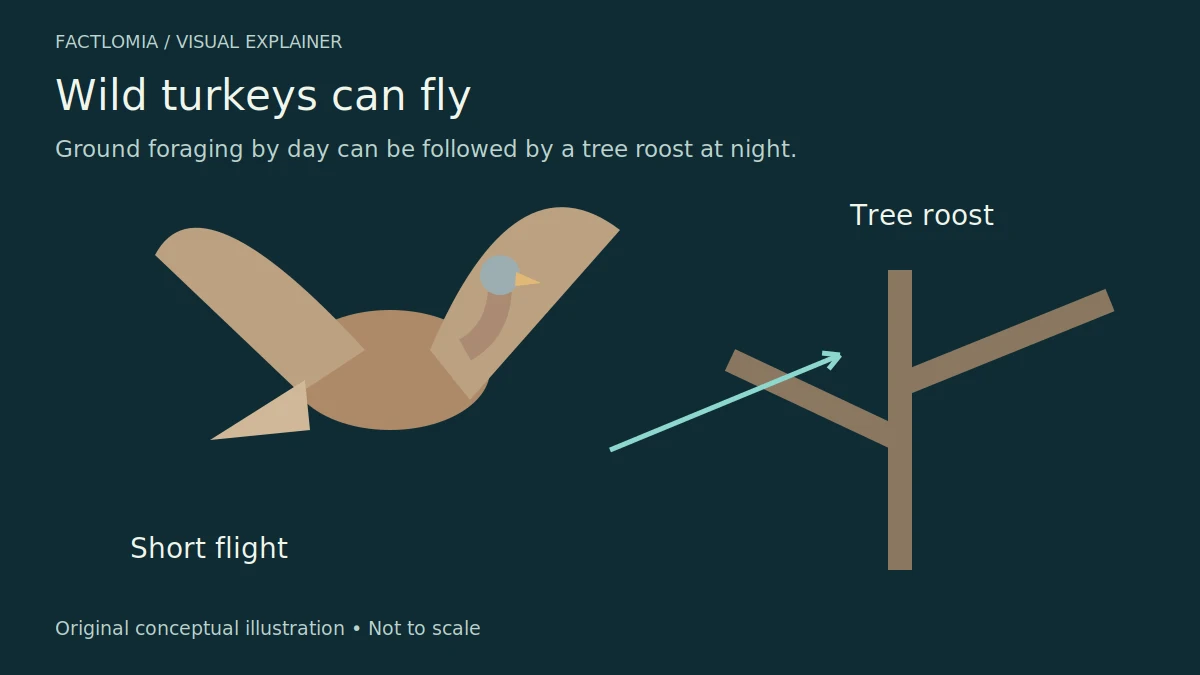
Yes. Wild turkeys can fly, and they use flight to reach tree roosts and sometimes to escape danger. Seeing them walk and forage on the ground does not mean they are flightless. Their familiar ground-dwelling behavior is only part of their daily routine.
Why do people think turkeys cannot fly?
Many encounters happen while the birds are walking, feeding or displaying. Those activities make their wings less obvious than their legs and broad bodies. The Cornell Lab of Ornithology describes wild turkeys as mostly getting around on foot, while also being capable of running and flying. [1]
Where do they go at night?
At sundown, wild turkeys can fly into lower tree branches and move upward to a high roost. Cornell reports that they commonly roost in flocks, although some roost alone. A turkey observed on the ground in the afternoon may therefore spend the night well above it. [1]
How fast can a wild turkey fly?
The U.S. Fish and Wildlife Service gives a figure of up to about 50 miles per hour in flight. “Up to” describes a capability, not the bird’s speed on every trip. It should not be read as a claim that a turkey cruises that fast for long distances. [2]
Do they always fly away when frightened?
No. Running is another escape option, and behavior depends on the situation. Cornell notes a tendency for threatened females to fly and males to run. That is a tendency rather than a rule an observer should test by approaching or chasing a bird. [1]
Does this answer apply to every farm turkey?
The evidence here concerns wild turkeys. Do not assume identical flight performance for every domestic breed or individual. If the surprising part is a large bird’s ability to get airborne, compare it with the mechanics of hummingbird hovering—a very different style of flight.
Sources and evidence
- Cornell Lab of Ornithology — Wild Turkey Life History ↗
Ground travel, escape behavior and nighttime tree roosts.
- U.S. Fish and Wildlife Service — Wild Facts About Wild Turkeys ↗
Reported upper flight-speed figure and natural-history context.
Sources consulted: 31 October 2026. Written with AI assistance and checked against the linked references; not independently reviewed by a subject specialist. Sources do not endorse this article. See our editorial policy.
Revision: Initial publication. Checked against cited references; dated event information is identified in the text and uncertainties are stated.