
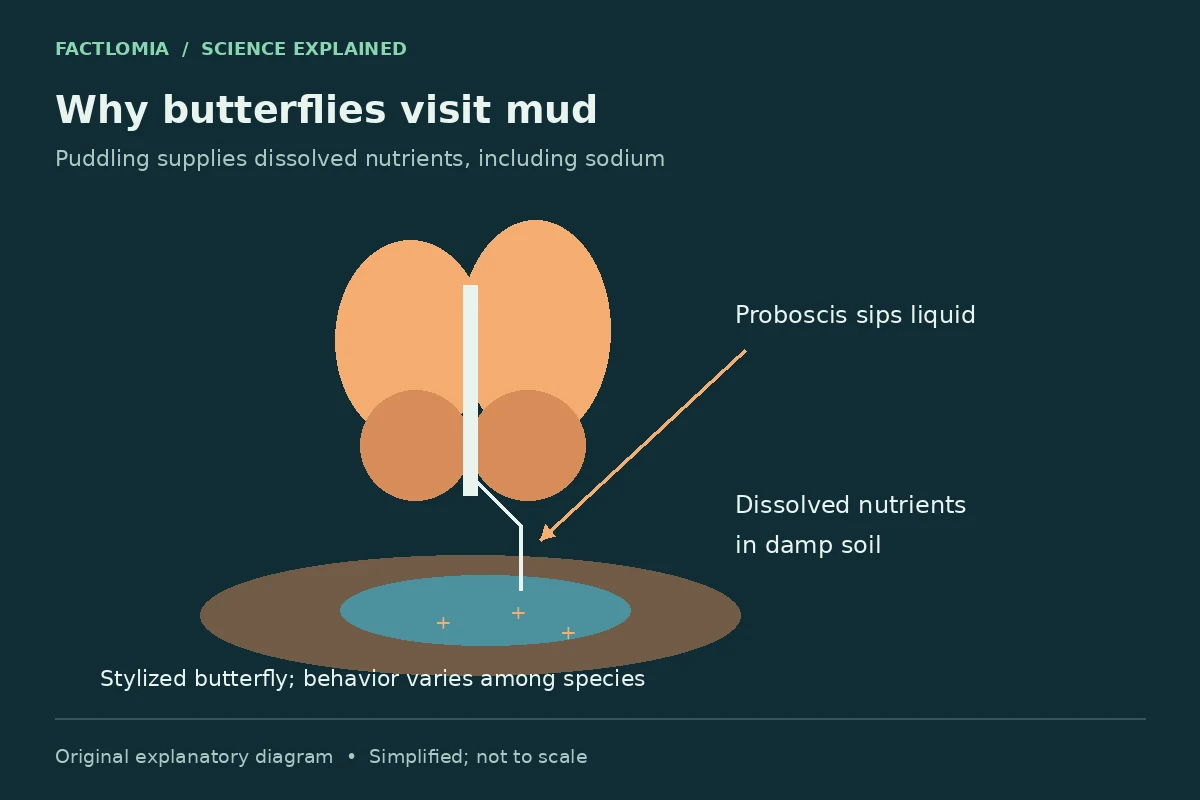
Butterflies drink from damp mud to obtain dissolved substances, especially sodium in many species. This behavior is called puddling. A butterfly uses its proboscis to sip liquid from the surface; it is not eating the soil as a caterpillar eats a leaf.
Flowers do not supply every nutrient equally
Nectar provides a valuable source of sugar, but an animal also needs other nutrients. Damp ground can offer dissolved salts that differ from the diet available in flowers. The American Museum of Natural History describes males drinking at wet sites and retaining salts while passing water through their bodies. [1]
Why sodium gets so much attention
Experiments on tiger swallowtails identified sodium as a stimulus for puddling. This gives a testable explanation beyond the idea that butterflies simply like dirt. But an experiment on one species is not a universal menu for all butterflies. Other research comparing tropical butterflies found differences between families and strong attraction to protein-containing resources. [2], [3]
Why are so many puddling butterflies male?
In many studied species, males are frequent visitors to wet ground. Nutrients collected by males can pass to females during mating, linking feeding behavior with reproduction. That does not mean every puddling butterfly is male, or that reproduction explains every visit. Species, sex, life stage, and local nutrient availability all affect what an observer sees. [1], [3]
Is a muddy puddle the same as a pond?
No. Butterflies can sip from a damp surface without floating in open water. Wet sand, shore edges, and other moist resources can all serve as feeding sites. A cluster on mud therefore need not indicate that the insects are trapped. Watch where the proboscis touches the surface rather than assuming the wing pattern explains the behavior. For another feeding adaptation, explore how butterflies taste with their feet.
Sources and evidence
- American Museum of Natural History — Butterfly Behavior ↗
Puddling, mineral uptake, and transfer during mating.
- Arms et al. — Sodium as a stimulus for puddling ↗
Experimental evidence from tiger swallowtail butterflies.
- Beck et al. — Mud-puddling in tropical butterflies ↗
Differences in nutrient-resource preferences among butterfly families.
Sources consulted: 2026-10-21. Written with AI assistance and checked against the linked references; not independently reviewed by a subject specialist. Sources do not endorse this article. See our editorial policy.
Revision: First published 21 October 2026. Original explanatory diagram and source-linked text.