
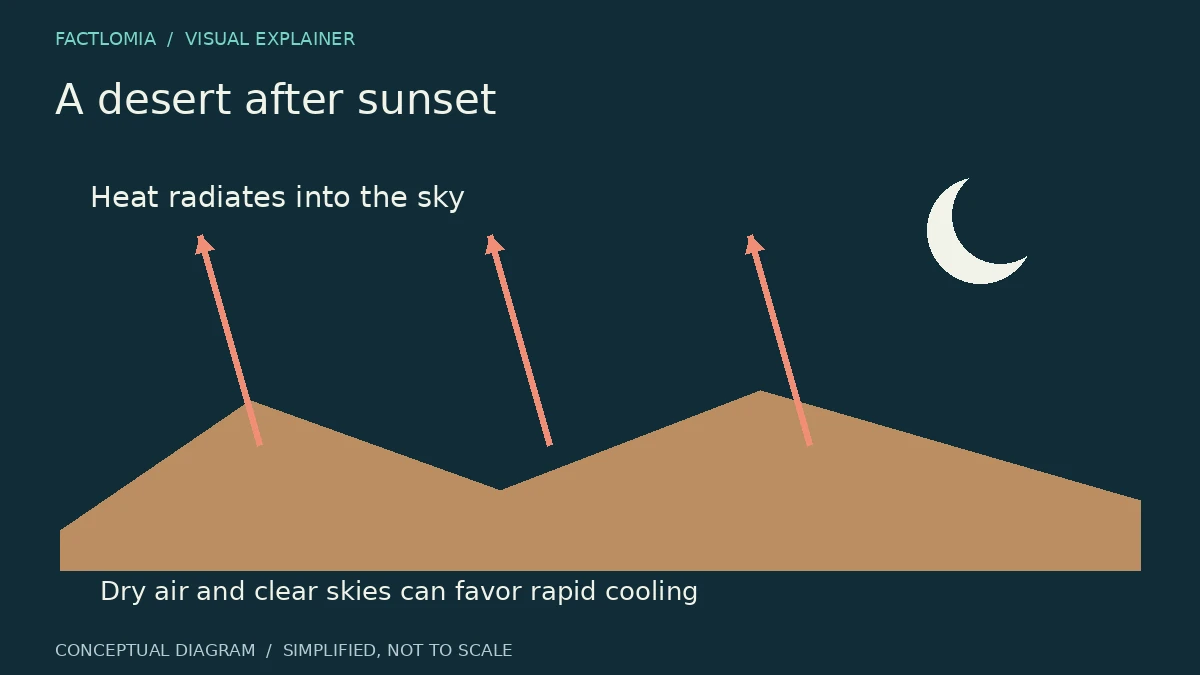
Many deserts cool sharply after sunset because the ground loses heat by infrared radiation while dry, often cloudless air returns comparatively little of that energy toward the surface. Without sunlight replacing the loss, the ground and nearby air cool. The size of the drop depends on weather, elevation, and season; desert nights are not always freezing.
Sunset changes the surface energy balance
The ground emits infrared radiation during both day and night. During daylight, incoming sunshine can more than compensate for that loss. After sunset, the solar input stops, so the surface can lose energy faster than it receives it. [1]
Dry air provides less infrared warming
Water vapor absorbs infrared energy emitted from below and radiates energy in all directions, including back toward the surface. A dry atmospheric column provides less of this warming influence than a humid one. That helps explain large day-to-night changes in arid regions. [2]
Clear and calm conditions favor cooling
Cloudless skies allow stronger radiational cooling than many cloudy conditions. On calm nights, cooler air can remain near the ground instead of being mixed with warmer air above. Weather conditions can therefore strongly change how a particular desert night feels. [1]
A desert is defined by dryness
Desert does not mean a place that must be hot by day and icy by night. Elevation, latitude, season, humidity, and wind all matter. The useful explanation is the nighttime energy balance, rather than a universal temperature rule for every desert. [2]
Keep exploring: why sand and water heat differently.
Sources and evidence
- NOAA — Radiational Cooling and Radiation Inversion ↗
Radiational cooling and the influence of clear, dry, calm nighttime conditions.
- NASA — AIRS Atmospheric Water Vapor Brochure ↗
The infrared absorption of water vapor and nighttime cooling over deserts and mountains.
Sources consulted: 2026-10-28. Written with AI assistance and checked against the linked references; not independently reviewed by a subject specialist. Sources do not endorse this article. See our editorial policy.
Revision: First published 28 October 2026. Sources checked and original explanatory graphic added.