
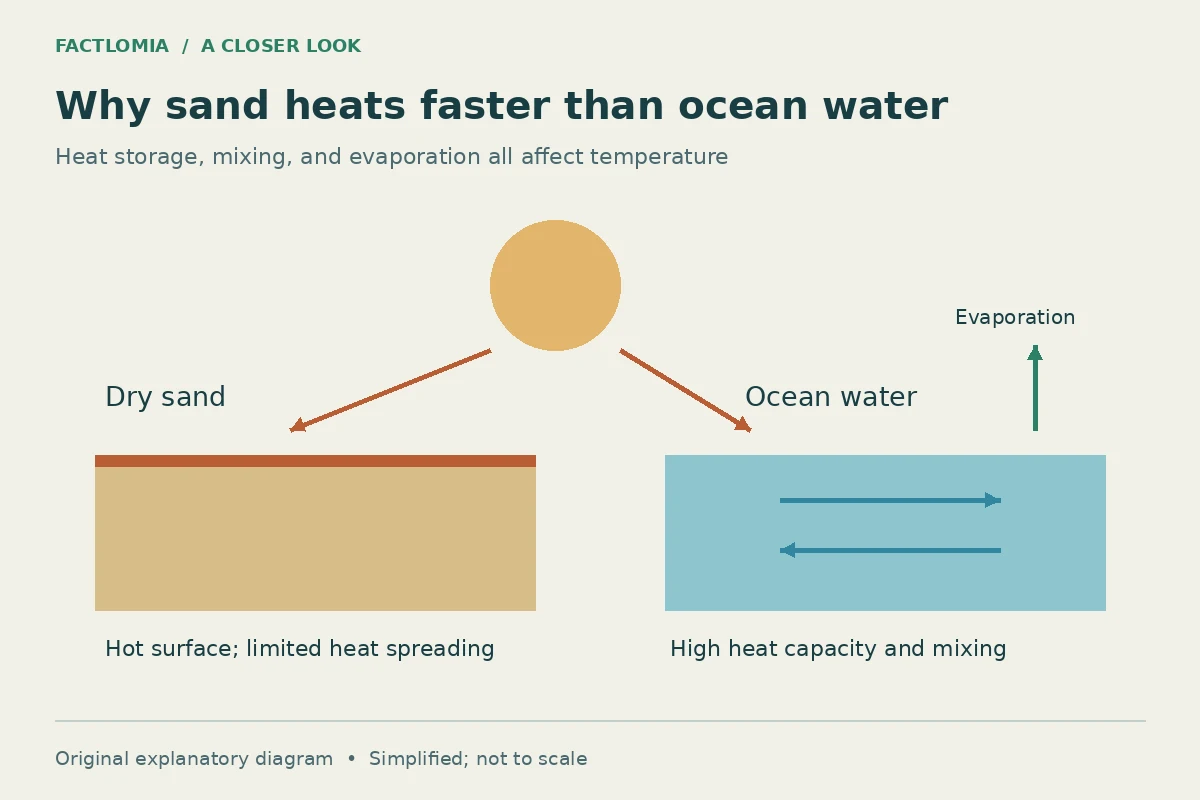
Dry beach sand often gets hotter than nearby ocean water because its surface temperature rises with less energy, while water stores more energy per degree of warming. Mixing and evaporation also help keep ocean surface temperatures from rising as quickly as sunlit sand.
Heat capacity explains part of the difference
Specific heat capacity measures the energy needed to warm a given mass by one degree. Water has a high specific heat capacity compared with many common materials. Under a simplified equal-mass, equal-energy comparison, water therefore warms less than sand. That does not mean the ocean absorbs no sunlight; it means absorbing energy need not produce a large temperature rise. [1], [2]
A beach is not two identical laboratory samples
Sunlight heats a relatively thin upper layer of dry sand. In water, currents, waves, and other circulation redistribute energy, while evaporation removes energy from the surface. Water depth, wind, moisture, grain color, and recent weather affect the actual temperatures. Heat capacity is an important starting point, not a complete forecast for every shoreline. [1], [3]
Why cooler sand can be just below the surface
Dry sand does not rapidly spread heat through a large depth. The exposed grains can become much hotter than the material beneath them. Wet sand behaves differently because water changes heat storage and energy transfer, and evaporation can cool it. A barefoot step samples the local surface and contact conditions rather than the average temperature of the entire beach. [3]
Does hotter sand mean hotter air?
Not necessarily. Air temperature is a different measurement from surface temperature, and direct sunlight can make a surface considerably hotter than surrounding shaded air. Do not use the air-temperature forecast alone to judge exposed sand. For a related distinction between temperature and touch, see why metal can feel colder than wood. Water also gives grains cohesion in a sandcastle.
Sources and evidence
- USGS — Specific Heat Capacity and Water ↗
Definition and unusually high specific heat capacity of water.
- USGS — Heat capacity at the beach ↗
Direct comparison between sand and water under equal heat input.
- University of Pennsylvania — The surprising physics of beach sand ↗
Granular heat behavior, moisture, and surface effects.
Sources consulted: 2026-10-21. Written with AI assistance and checked against the linked references; not independently reviewed by a subject specialist. Sources do not endorse this article. See our editorial policy.
Revision: First published 21 October 2026. Source-linked explanation and original diagram.